
A Practical Guide to Bid Writing Training That Wins Contracts
Effective bid writing training isn’t a one-off course. It’s about building a repeatable system that improves your win rates. The goal is to focus on practical skills like compliance, strategy, and persuasive writing. Your training should be tailored to your team’s specific weaknesses and tied to winning real contracts.
Why Standard Bid Writing Training Often Fails
Let’s be honest, a lot of corporate training is a waste of time. It’s generic, boring, and forgotten by Friday. Many bid writing training programmes miss the mark for the same reasons. They float around in the clouds of theory and feel disconnected from the tenders you're actually trying to win.
The demand for good training is huge. In the UK's £18.6 billion consultancy industry, a study found that only 12.5% of businesses felt confident in their bid writing skills. A massive 83.1% said they were keen to get training. You can read the full research on bridging the bid-writing skills gap.
This guide offers a different approach. Think of it as a playbook for designing training that sticks and delivers a measurable return. We’ll show you how to build a programme that directly affects your win rate.
Moving Beyond the Theory
The problem with most training is that it stays theoretical. Your team might learn about persuasive language, but they don't practise it on a live bid. They’re told to "be compliant," but they never build a real-world compliance matrix for a complex tender.
This guide is about building muscle memory, not just memorising rules. You'll learn how to create a structured plan your bid team will value. It helps them move from just submitting bids to consistently winning them.
Our approach also weaves in modern tools from the start. Here’s how Bidwell's features support your training workflow:
- Tender Monitoring: Find better-fit opportunities. Your team can then apply their new skills to bids you can actually win.
- Knowledge Base: Create a central hub for your best content. This ensures the high-quality, winning answers developed during training are captured and reused.
- AI Response Generation: Teach your team to use AI as a first-draft tool. This shifts their focus from basic writing to the high-value work of strategic review and editing.
Diagnosing Your Team's Skill Gaps
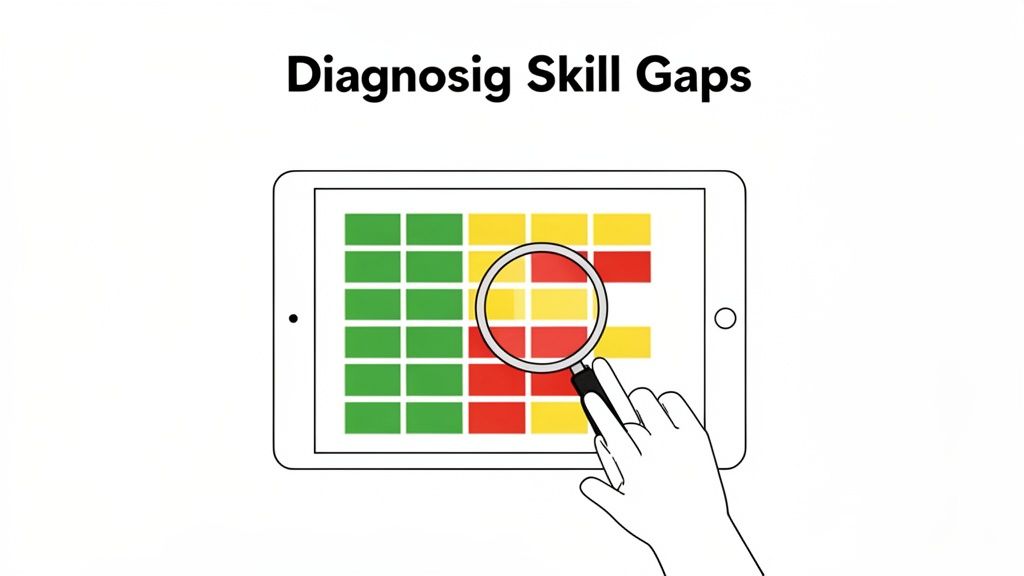
You can't fix what you don't realise is broken. Before designing a training programme, you need an honest picture of where your team stands. Guesswork leads to generic training that wastes everyone's time.
The goal is to move from assumptions to an evidence-based plan. This is how you stop teaching experienced writers the basics or throwing junior members in at the deep end. You'll be targeting the specific skills that will improve your win rate.
Starting with a Skills Audit
A simple skills audit is the best place to begin. It doesn't need to be a huge, complicated exercise. Look at the entire bid lifecycle and rate your team's ability at each stage.
Start by asking sharp questions about your last few bids, both wins and losses. Which stage caused the most stress? Where did you drop easy marks? The answers will quickly reveal patterns.
To give this some structure, use a straightforward training needs assessment template to organise your findings. This process also forces you to think about different roles. Our guide on what a bid writer actually does is a great resource for defining these roles.
Evaluating Key Competency Areas
Your audit needs to cover the full spectrum of bidding, not just the writing. Break it down into manageable areas to get a clearer picture of where the real weaknesses lie. Have an honest conversation with your team to rate their current proficiency in each area.
Bid Writing Skills Assessment Matrix
| Competency Area | What to Look For | Team Proficiency Rating |
|---|---|---|
| Opportunity Qualification | Can the team spot winnable tenders? Are they making data-led bid/no-bid decisions? | Novice / Competent / Expert |
| Compliance & Process | Do they follow instructions to the letter? Do they build compliance matrices and avoid missing mandatory requirements? | Novice / Competent / Expert |
| Solution Design & Strategy | Can they understand the client's real needs? Do they work well with Subject Matter Experts to create a winning solution? | Novice / Competent / Expert |
| Persuasive Writing | Is the writing clear and focused on the evaluator's scoring? Can they turn features into client-focused benefits? | Novice / Competent / Expert |
| Commercial Acumen | Does the team understand how to price for value? Can they build a commercial model that is competitive and profitable? | Novice / Competent / Expert |
| Project Management | Can they manage multiple deadlines and contributors without last-minute panic? Is the process smooth or chaotic? | Novice / Competent / Expert |
Filling this out gives you a visual map of your team's strengths and their development needs.
What the Gaps Tell You
Let’s be clear on the critical competencies you need to assess:
Opportunity Qualification: A poor process here means you burn hours on bids you were never going to win. Bidwell's tender monitoring helps by filtering for relevant, high-value contracts.
Compliance and Process Management: Simple mistakes like getting the font size wrong are common reasons for instant disqualification. Everyone must understand that instructions must be followed exactly.
Solution and Strategy: Can your team get beyond the tender document to understand the client’s real problem? This is about designing a solution that truly solves their issue.
Writing and Persuasion: Is the writing sharp and focused on what the evaluator needs to award marks? This turns your solution into a story that convinces the client you're the only choice.
Key Takeaway: A good diagnosis isn't about finding fault. It's about identifying where targeted training will have the biggest impact on your bidding success.
Once you have this data, you can see where the real gaps are. Perhaps your team are brilliant writers but struggle to find the right opportunities. Or maybe they manage the process well, but their proposals lack a compelling commercial edge. This insight is the foundation for creating training that delivers real results.
Designing Your Core Training Modules
Right, you’ve done the skills audit and you know where the gaps are. Now it's time to build the actual training. Your training needs to be practical, action-focused, and targeted at the weaknesses you’ve already found.
A solid bid writing programme is built on four critical pillars. Think of these as the core components of your bidding engine. When your team gets these right, you’ll see it in your win rate.
Mastering Compliance and Process
This is your foundation. You can write the most persuasive bid in the world, but it’s worthless if it gets thrown out for a simple compliance mistake. A shocking number of bids fail because teams don’t follow the buyer’s instructions.
Your training here needs to be brutally practical. Don't just talk about why compliance is important; make them do it.
- Practical Exercise: Hand the team a genuinely complex tender document. Their only task? Build a compliance matrix that lists every single instruction. This builds the muscle memory they need to avoid silly mistakes under pressure.
This module is also the perfect place to introduce your bid management process. A chaotic process leads to rushed work and errors. An organised one gives you quality and control. You can see a good example of bid writing structure in our related guide.
Building a Winning Commercial Strategy
Price is always a factor, but the lowest price rarely wins on its own. This module is about teaching your team to build a commercial offer that is both competitive and profitable. It’s about learning to show genuine value, not just cutting costs.
The training should focus on linking your price directly to the solution. How does your offer deliver better long-term value for the client? Can you quantify the return on investment for them? This shifts the conversation from cost to value.
A strong commercial strategy doesn’t just present a number. It tells a story about why that number is the right investment for the client.
Writing to Win
Once you’ve ticked the compliance boxes and built a solid commercial case, you have to convince the evaluator. This module focuses on turning dry, technical information into a compelling, easy-to-read narrative. Your training has to be hands-on.
- Scenario-Based Writing: Find a previous bid response that scored poorly. Get the team to rewrite a key section, turning features into client-focused benefits. For instance, instead of "We have a 24/7 helpdesk," they should write, "You'll have a 24/7 helpdesk, which means critical issues are resolved in under one hour, guaranteeing your operational continuity."
This is where Bidwell's Knowledge Base becomes a strategic tool. You can store these high-scoring, benefit-led answers so they can be easily found and adapted for future bids. It stops the team from reinventing the wheel every time.
Creating a Bulletproof Review Process
The final module is all about quality control. A rushed, last-minute review is where mistakes happen. Your training must establish a structured, multi-stage review process. This ensures every bid leaving your business is as good as it can possibly be.
This involves different reviews: a compliance check, a commercial review, and a final "red team" review. That’s where someone outside the core bid team reads it from the client's perspective. This final check often catches the internal jargon and lazy assumptions that can confuse an evaluator.
Choosing the Right Training Delivery Method
How you deliver your bid writing training is as important as the content. A busy bid team doesn't have time for a week-long offsite. You need a method that fits your company's rhythm, budget, and the skills you’re trying to build.
There’s no single “best” way to do this. The decision usually comes down to a trade-off between cost, convenience, and the need for specialist expertise.
In-House Workshops vs. External Experts
Running the training yourself is often the cheapest route. It lets you tailor the content to your company’s specific challenges. The catch? Your internal expert gets pulled away from their day job, and you might miss fresh perspectives.
Hiring an external specialist brings that vital outside view. These trainers have seen what works (and what doesn't) across dozens of companies. They can challenge your team's assumptions. UK providers offer flexible packages, with day rates often between £450-£750. You can find more detail on bespoke bid writing courses and their impact.
This process flow shows the core bid modules your training should cover, whichever delivery method you choose.
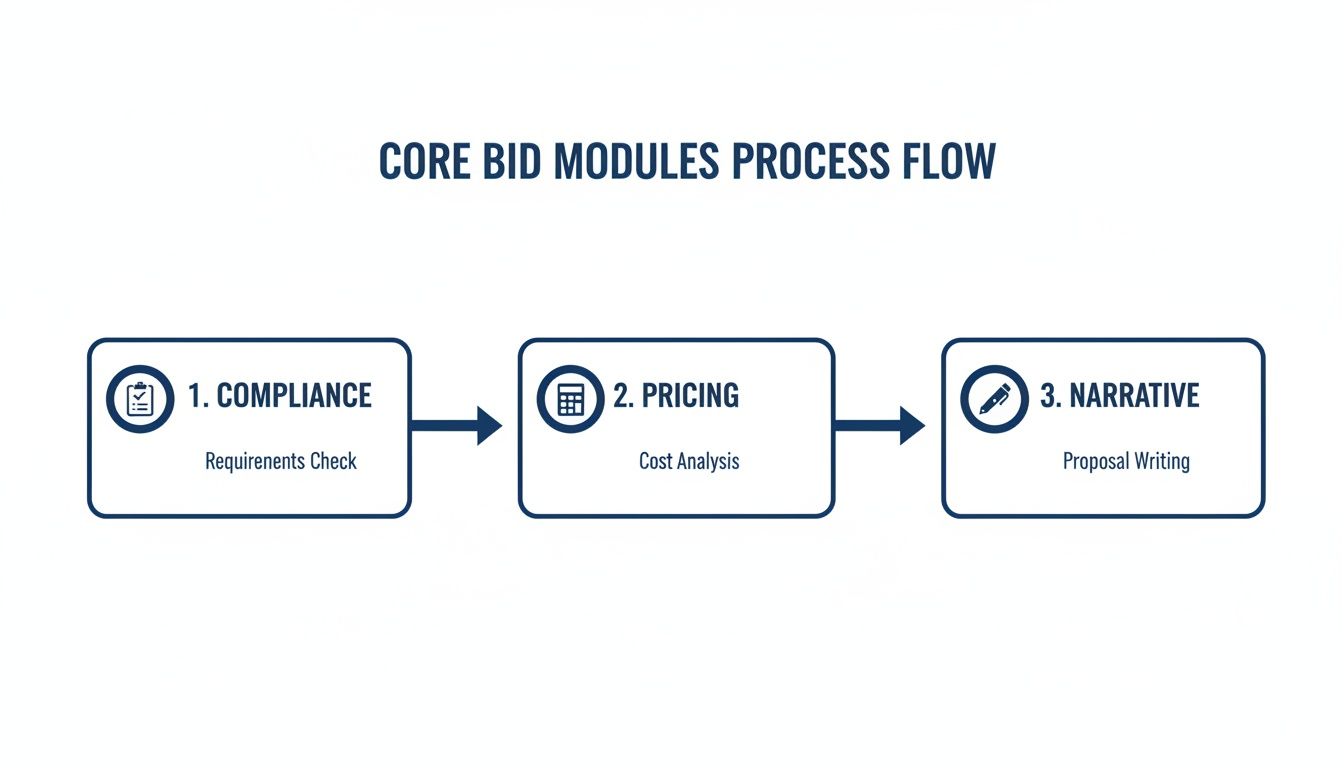
It highlights a simple truth: a successful bid depends on mastering compliance, pricing, and narrative in that order. A weakness in one area undermines the others.
The Power of a Blended Approach
Often, the smartest solution is to mix and match. A blended approach lets you get the best of all worlds. You can combine expert-led sessions on strategy with self-paced online learning for technical skills.
This approach respects your team's time while ensuring they get targeted support where it's needed most. It’s about being smart with your resources to get the biggest impact.
For instance, you could bring in an expert for a half-day workshop on commercial strategy. Then, you follow up with practical exercises where the team uses Bidwell’s AI response generation to draft answers, which are then stored in your central Knowledge Base. This puts theory into practice immediately.
Here’s how a blended structure could look:
- Live Workshop: An interactive session on a complex topic like bid strategy or pricing.
- Self-Paced Modules: Online resources for foundational skills like proofreading or compliance checks.
- Practical Application: Using tools like Bidwell to apply new techniques to real tenders you’ve found via its tender monitoring feature.
This creates a continuous learning loop. It connects high-level training directly to the day-to-day workflow, making the skills much more likely to stick.
How to Integrate AI Into Your Bidding Workflow
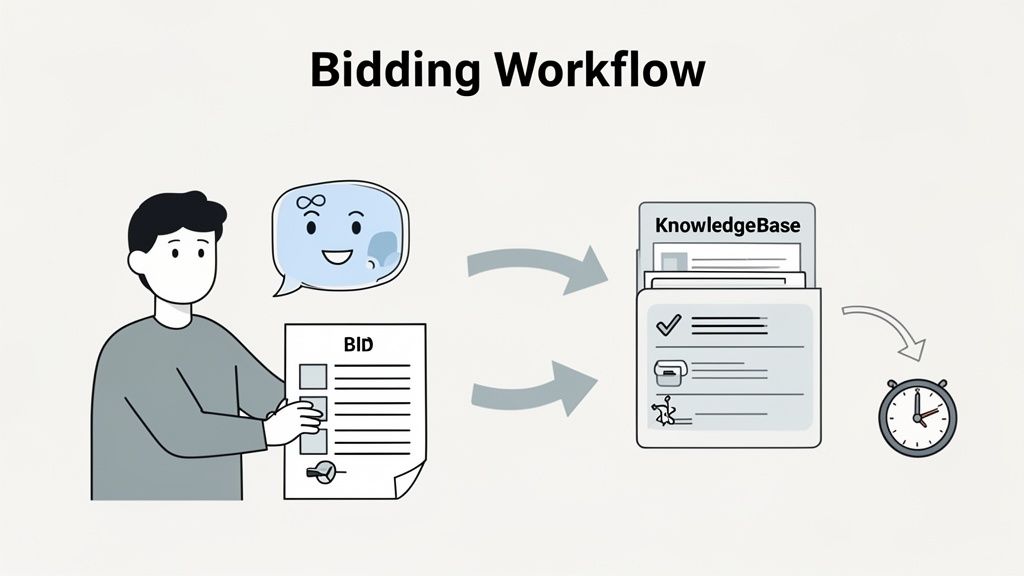
Modern bid writing training isn't just about human skills anymore. It’s about teaching your team to use the right tools to make those skills count. A dedicated training module on weaving AI into your bidding process is essential if you want an efficient team.
This is where you connect your team’s knowledge with a platform like Bidwell. The goal isn't to replace bid writers but to raise their role. They shift from being writers to strategic editors and reviewers.
From Manual Searching to Smart Monitoring
Your first training point should be on finding better opportunities, faster. Manually trawling through tender portals is a huge time-sink. It often leads to bidding on poorly matched contracts out of desperation.
Show your team how to use Bidwell’s tender monitoring feature. Train them to set up targeted alerts based on your ideal contract type, value, and location. Their job changes from searching for needles in a haystack to reviewing a curated list of tenders each morning.
Building Your Single Source of Truth
Next, focus your training on the knowledge base. This is the central brain for your company's best content. A disorganised system with content scattered across shared drives is a massive drag on efficiency.
Teach your team the discipline of populating and maintaining this database. Every time a bid is won, the high-scoring answers should be cleaned up and added. This creates a powerful asset that gets smarter with every submission. A well-organised base is crucial for getting quality results from any AI tool. You can learn more about creating effective content structures from our guide on developing a response template for an RFP.
Using AI for First-Draft Generation
Finally, train your team on how to properly use AI response generation. This is where you'll find the biggest efficiency gains. Stress that the AI is a tool for creating a solid first draft, not the finished product.
The real skill is in the review. Your team's expertise is what turns a good AI-generated draft into a brilliant, winning response. Their training should focus on refining, fact-checking, and adding the human touch.
A workflow that once took 40 hours of writing can be reduced to just four hours of focused review and editing. To really get this right, your team might benefit from a specialized AI course. This shift frees them from repetitive writing to concentrate on what really matters: bid strategy.
Measuring the Real Impact of Your Training
How do you know if your bid writing training actually worked? Feedback forms are nice, but they don't prove anything to senior leadership. You need to focus on tangible business outcomes and hard numbers.
This means tracking a few key performance indicators (KPIs) before and after the training period. Don't overcomplicate it. Start with the basics to get a clear picture of what’s changed.
Tracking the Right Metrics
Focus on the numbers that directly connect your training investment to business success. These metrics tell a story about efficiency, quality, and profitability.
Here are the essential KPIs to monitor:
- Bid-to-Win Ratio: This is the big one. Has your win rate improved from 1 in 10 to 1 in 7 since the training? A clear improvement here is the strongest proof of your return on investment.
- Submission Quality Scores: When you get feedback, are your scores for quality higher? This shows the writing and strategic thinking have genuinely improved.
- Time Spent Per Bid: Are you completing bids faster without sacrificing quality? Using a tool like Bidwell, you can see if the AI response generation and Knowledge Base have cut down the average time from 40 hours to just a few hours.
Tracking these metrics isn’t just about justifying the training budget. It creates a cycle of continuous improvement, showing you exactly where to focus your efforts next.
Common Questions About Bid Writing Training
Setting up bid writing training can feel like a big job, especially when your team is already flat out. But it doesn't have to be. Here are some quick answers to the questions we hear most often.
How Long Should the Training Be?
Honestly, there's no magic number. Let your skills assessment be your guide.
If you’re just getting the team up to speed with a new tool like Bidwell, a focused half-day session could be all you need. If you're tackling deeper issues like commercial modelling, it’s better to plan a series of shorter workshops over a few weeks.
Avoid the big, one-off training day. Bite-sized, regular sessions are far more effective. People actually remember and apply what they’ve learned.
How Do We Train With No Time?
This is the classic problem. Every bid team is a busy bid team. The trick is to stop thinking of training as something separate from the day job. Integrate learning directly into the work.
Use a live bid as your training ground. For example, use Bidwell's tender monitoring to find a suitable, low-risk opportunity. Then, walk the team through building the response using the shared Knowledge Base and AI response generation. It makes the training instantly relevant and productive.
Training doesn't have to stop the work. The best bid writing training is hands-on, using real tenders to build skills in real time.
This approach works because the lessons are tied directly to the team's daily tasks. The skills just stick.
Ready to build a smarter, faster bidding process? Bidwell combines powerful tender monitoring, a central knowledge base, and AI response generation to help you win more contracts with less effort. See how it works at https://bidwell.app.


