
Master the example of bid writing: Win UK tenders with proven templates

Winning public sector contracts isn't about fancy words. It's about clear, organised, and persuasive writing. If you've ever stared at a tender document and wondered where to start, you're in the right place. The core principles often overlap with knowing how to write a grant proposal that wins. Both need a solid grasp of the evaluator's needs and a compelling, evidence-based response.
This guide isn't theory. We're breaking down the six essential sections you'll find in most UK tenders. We'll provide a concrete example of bid writing for each one, show you what evaluators look for, and explain how to write it faster. We'll give you actionable tips and highlight common pitfalls that cause bids to fail.
We'll also show how you can use tools like Bidwell to make the whole process less painful. Our platform helps you find relevant tenders with daily alerts from its tender monitoring feature. You can organise your best content in a central knowledge base and use AI response generation for accurate first drafts. Let's get started.
1. Example 1: The Executive Summary
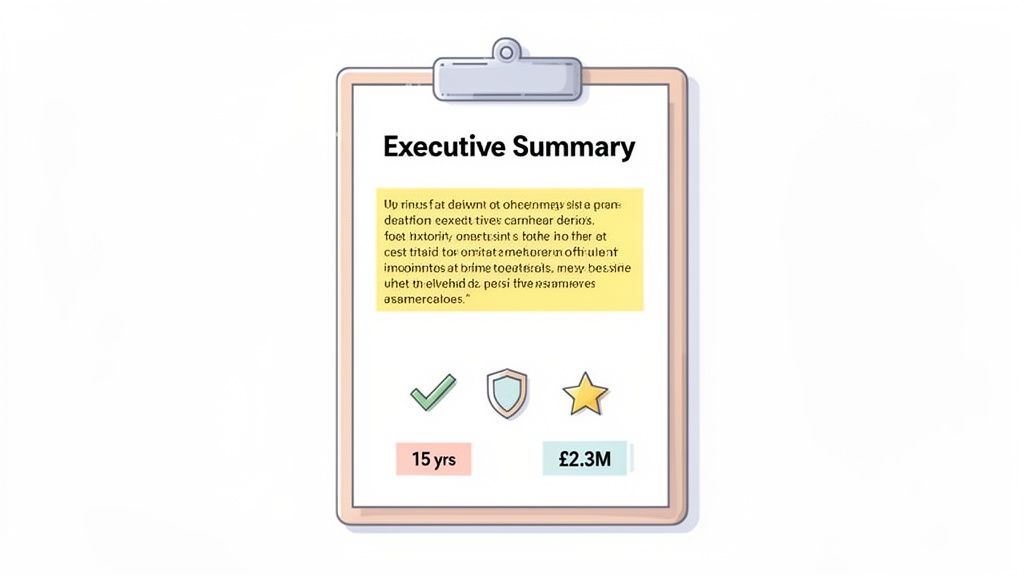
Think of the Executive Summary as the trailer for your bid. It’s a short, powerful overview (usually 150-300 words) that sums up your entire proposal. It must grab the evaluator's attention immediately and prove you understand their problems.
For busy public sector teams, this is often the make-or-break section. A strong summary gets your bid read properly; a weak one sends it to the bottom of the pile. This is the first chance you get to make a good impression.
Why It Works
A great executive summary is a condensed version of your 'win themes'. For an NHS procurement bid, this might mean emphasising patient safety improvements and a 15% cost saving. For a local authority, it could be showing your understanding of community impact. It directly addresses the buyer's most pressing needs from the very first sentence.
Strategic Breakdown & Actionable Tips
Writing an effective summary is about precision and relevance. Don't waste a single word.
- Write It Last: You can only summarise the bid once it's complete. Draft everything else first, then pull the strongest points into your summary.
- Mirror Their Language: Use the exact terminology from the tender document. This shows you've paid close attention and understand their world.
- Quantify Everything: Vague claims are weak. Specifics are powerful. Use numbers: "15 years' experience delivering for UK councils," "achieved 99.8% uptime," or "a £2.3M annual turnover."
- Structure for Impact: Open with a clear statement that shows you get their core challenge. Follow with 2-3 key points on how your solution solves it, each backed by a specific metric.
A well-organised knowledge base is vital here, allowing you to quickly pull verified stats and past performance data. To ensure your executive summary captures attention, review these powerful executive summary examples. Understanding common RFP and tender questions can also give you a head start.
2. Example 2: Company Background & Credentials Section
This section is your organisation's CV. It’s where you prove you have the stability, experience, and qualifications to deliver the contract successfully. It provides tangible evidence of your capability, from accreditations to financial health.
For evaluators, this is a crucial risk assessment step. They need to trust that you won't disappear halfway through a project. A well-written credentials section can level the playing field against larger competitors by showing specific expertise.
Why It Works
A strong company background tells a story of reliability tailored to the buyer's needs. For a construction firm bidding on a Local Authority project, this means leading with your Health & Safety track record. For an IT provider, it’s about highlighting your ISO 27001 certification. It directly answers the evaluator’s question: "Can we trust you to do this properly?"
Strategic Breakdown & Actionable Tips
Building trust is about providing specific, verifiable proof. Don't make the evaluator work to connect the dots.
- Focus on Relevance, Not History: The buyer cares about what you can do for them now. Structure this section around credentials most relevant to their requirements.
- Quantify Your Experience: Specific numbers build confidence. Use concrete data like "served over 50 public sector clients" or "maintained a 99.5% project completion rate."
- Showcase Your Team: Include a mini-profile or an org chart for the key personnel who will work on the contract. Highlight their specific experience and qualifications.
- Verify Your Accreditations: Double-check that all certifications (like ISO 9001) are current and won't expire during the procurement process.
This section relies on accurate company information. An organised knowledge base, like Bidwell's, is essential for instantly pulling correct accreditation documents and team CVs. For a complete guide, read our detailed breakdown on how to write a tender bid.
3. Example 3: The Technical Approach & Methodology Section
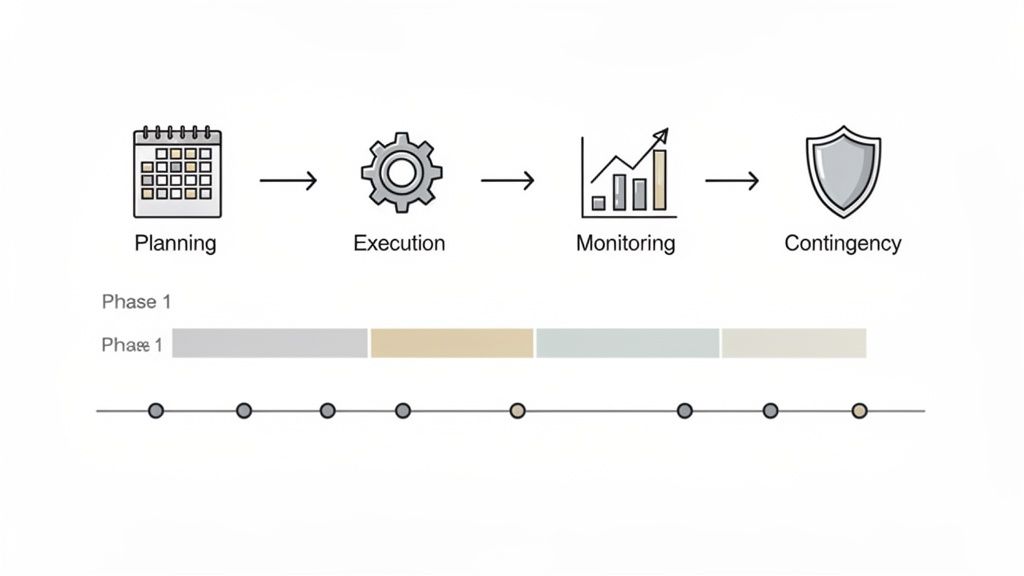
This section explains exactly how you will deliver the contract. It details your processes, timelines, resource allocation, and risk management. It proves you have a credible and well-thought-out plan.
For public sector evaluators, this is where they look for competence. It often carries the heaviest weighting, sometimes up to 50% of the total score. A vague methodology is a red flag, suggesting you haven’t grasped the requirements.
Why It Works
A strong methodology builds confidence. For a facilities management bid, it means detailing specific cleaning schedules and maintenance protocols. For a training provider, it involves outlining the curriculum structure and delivery methods. It directly answers the evaluator’s question: “Can they actually do what they promise?”
Strategic Breakdown & Actionable Tips
This section is all about showing, not just telling. You need a clear, logical, and evidence-backed plan.
- Structure Around the Specification: Mirror the tender’s requirements point by point. If they ask for your delivery process in section 4.1, your response should be titled 4.1 and directly answer it.
- Be Specific and Visual: Avoid vague terms like ‘promptly’. Instead, commit to a “4-hour response time.” Use visuals like flowcharts, process diagrams, or Gantt charts to make complex processes easy to understand.
- Show, Don't Just Tell: Instead of saying you manage risks, describe your risk register and escalation process. Include contingency plans for likely issues.
- Connect to Past Success: Reference relevant case studies where you've used this methodology before. A well-organised knowledge base is crucial for quickly finding these proof points.
Your methodology is the blueprint for your proposed partnership. To master this detailed section, learn more about how to write a method statement. An effective methodology shows you're a low-risk, high-value choice.
4. Social Value & Added Value Section
Think of social value as the positive ripple effect your work creates beyond the core contract. It answers the question: "What wider community, economic, and environmental benefits will you bring?" Under the Public Services (Social Value) Act 2012, this is a mandatory, scored section in UK tenders. It's an area where contracts are won and lost.
This section is where you prove you’re a responsible partner, not just a supplier. A strong social value offer shows you’re aligned with the buyer’s goals for their community. Its weighting has grown, often accounting for 10-20% of the total marks.

Why It Works
A winning social value section makes specific, measurable, and relevant commitments. For a construction firm, this could mean pledging to create '15 apprenticeships for local school leavers over the 24-month contract'. For a technology provider, it could be a promise to run 'free digital skills workshops for 500 residents'. It’s about delivering tangible benefits that matter to the community.
Strategic Breakdown & Actionable Tips
Writing a compelling social value response is about authenticity and specificity. Vague promises won’t score points.
- Tailor to Their Priorities: Read the tender documents carefully. Does the council want to tackle youth unemployment? Align your offer directly with their stated social value themes.
- Make It S.M.A.R.T: Your commitments must be Specific, Measurable, Achievable, Relevant, and Time-bound. Don't say "We'll support local jobs." Write "We will hire 4 long-term unemployed individuals from the M25 postcode within the first 6 months."
- Provide Evidence: Use case studies from previous contracts to show you have a track record of delivering on your social value commitments.
- Quantify Your Impact: Numbers are more powerful than words. Quantify your offer, such as "saving 25 tonnes of CO2 annually through our electric vehicle fleet."
Your knowledge base is your greatest asset here. You can store pre-approved social value commitments and case studies, allowing you to quickly assemble a tailored response. With an organised library of past successes, you can show genuine commitment.
5. Quality Assurance & Performance Management Section
This section is where you prove you’ll do what you say you’ll do, consistently. It’s a detailed plan showing how you'll monitor, measure, and report on performance. It's not just about promising quality; it's about providing a framework that demonstrates it.
For public sector clients, this is a must. They need certainty that taxpayer money is being spent effectively. A weak quality assurance plan suggests risk and a lack of accountability.
Why It Works
A strong quality and performance section gives the evaluator confidence. For an IT support contract, this means defining Key Performance Indicators (KPIs) like a '1-hour response time for critical issues'. For a facilities management tender, it might be a commitment to '95% cleanliness standards, verified by monthly audits'. It provides concrete, measurable evidence of your commitment.
Strategic Breakdown & Actionable Tips
Writing this section is about clarity, precision, and alignment. Don't leave any room for ambiguity.
- Align KPIs Directly to Outcomes: Link every KPI back to a specific requirement in the tender document. If they want to reduce downtime, your KPI should be about system uptime or response times.
- Make Your KPIs SMART: This is a classic for a reason. Ensure every KPI is Specific, Measurable, Achievable, Relevant, and Time-bound. "Improve satisfaction" is useless. "Achieve a 4.5/5 customer satisfaction score within 12 months" is powerful.
- Define Your Reporting Framework: How will you report? To whom? How often? Specify the format (e.g., a monthly PDF dashboard) and the frequency. This shows you have a thought-out process.
- Show, Don't Just Tell: Explain how you'll gather the data. Will you use automated monitoring tools, customer surveys, or manual audits? Detail the mechanism to prove your KPIs aren't just empty numbers.
This section requires precise data about your past performance. An organised knowledge base, like Bidwell's, is essential. It lets you instantly find approved KPIs, reporting templates, and quality certificates to build a compelling response.
6. Example 6: The Pricing & Cost Justification Section
The pricing section isn't just a list of numbers; it's the financial proof of your proposal. It details your commercial terms and breaks down every cost. In public sector bids, where cost can be 30-50% of the total score, this section is under intense scrutiny. It needs to be competitive, transparent, and believable.
A weak pricing section can sink an otherwise perfect technical submission. Evaluators are looking for a price that is not only affordable but also realistic enough to guarantee high-quality delivery without risk. This part of your bid must show commercial viability and value for money.
Why It Works
A winning pricing section provides a clear link between the quality promised and the cost required. For a professional services firm, this means breaking down costs by role, seniority, and hours per phase. It’s about showing your working, proving that every pound is accounted for and contributes to the client's desired outcome. This transparency builds trust.
Strategic Breakdown & Actionable Tips
Building a compelling commercial case is about balancing competitiveness with credibility. You need to show you’ve thought it through.
- Show Your Working: Don't just present a final figure. Provide a transparent breakdown that justifies the cost. Detail labour, materials, management fees, and overheads. This proves your price is based on realistic calculations.
- Benchmark Your Price: Research market rates. You don't have to be the cheapest, but you must be able to justify your price point against the value delivered.
- Align Price with Quality: Your pricing must mirror the quality proposed in your method statements. A premium solution demands a premium price, but you must explain why the extra investment delivers superior value.
- Highlight the "Freebies": Clearly point out any value-added elements included at no extra cost. This could be enhanced reporting or a dedicated account manager. It’s a powerful way to show value for money.
A well-organised knowledge base is essential here. You can quickly pull historical pricing data from previous bids and cost justification templates. This ensures your commercial submission is competitive, consistent, and profitable.
6-Point Bid Writing Comparison
| Section | 🔄 Implementation complexity | ⚡ Resource & time efficiency | 📊 Expected outcomes | ⭐ Key advantages | 💡 Quick tip |
|---|---|---|---|---|---|
| Executive Summary Section | Medium — strategic writing and synthesis | Moderate prep time; fast to review | Concise overview that increases bid read-through and initial scoring | ⭐ Quickly captures evaluator attention; frames the bid | Write last; mirror tender language; include key metrics |
| Company Background & Credentials Section | Low–Medium — gather and tailor documents | Moderate — maintaining certifications and refs | Builds credibility and verifies capability for delivery | ⭐ Provides objective evidence and levels playing field for SMEs | Quantify experience; ensure certifications are current |
| Technical Approach & Methodology Section | High — detailed planning and subject-matter input | Resource‑intensive and time-consuming to draft | Demonstrates feasibility, timelines, and reduces delivery risk | ⭐ Core section for practicality and high-weight evaluation | Use visuals (Gantt/flowcharts); align with spec; be specific |
| Social Value & Added Value Section | Medium — requires genuine program design and measurement | Moderate — may need new initiatives or partnerships | Differentiates bids and can add significant evaluation marks | ⭐ Shows values alignment and creates competitive advantage | Make commitments specific, measurable, and locally relevant |
| Quality Assurance & Performance Management Section | Medium–High — define KPIs, reporting and audits | Ongoing resource commitment for monitoring/reporting | Provides measurable assurance and supports contract governance | ⭐ Enables objective performance control and mitigates risk | Make KPIs SMART; specify reporting cadence and escalation |
| Pricing & Cost Justification Section | Medium–High — complex modelling and assumptions | Time‑intensive; sensitive to market/assumption changes | Determines value‑for‑money and commercial viability | ⭐ Demonstrates financial realism and builds evaluator trust | Be transparent on assumptions; align pricing with technical approach |
Putting It All Together: Your Next Steps
We've worked through the anatomy of a winning tender. You've seen a practical example of bid writing for each critical section. This isn't a rigid template, but a framework for building your own compelling, evidence-based responses.
The core lesson is this: a successful bid isn't just about good writing. It's about showing the evaluator you've understood their problem. You need to show you have a credible plan to solve it and you offer genuine value.
From Theory to Action
Let's boil it down to the most important takeaways for your next tender:
- Be the Solution, Not Just a Supplier: Your responses must always circle back to the client's needs. Frame your experience, methodology, and social value in the context of how they directly benefit the buyer.
- Evidence is Everything: Vague claims like "we are experienced" are worthless. Specific, quantifiable proof is what scores points. Think "we have delivered five similar projects in the social housing sector over the past three years, achieving 98% resident satisfaction".
- Structure for the Scorer: Evaluators are short on time. Use clear headings, bullet points, and bold text to signpost key information. A well-structured answer makes their job easier, which can only help you.
- Consistency is Key: Your win themes and key messages must be consistent throughout the document. The Executive Summary should set the stage, and every section should reinforce those initial promises with detailed proof.
Building Your Bid Writing Engine
Mastering these techniques makes bid writing a strategic business function. But doing it manually is a huge drain on resources. This is where your internal processes and tools become critical.
You need a system. A central place for your best-ever answers, case studies, and team CVs. You need a way to spot the right opportunities. You also need a method to generate accurate first drafts so your team can refine, not write from scratch.
This is how you move from scrambling to meet deadlines to strategically winning contracts. By organising your knowledge and automating repetitive tasks, you free up your experts to focus on tailoring each bid to win.
Ready to stop reinventing the wheel with every tender? Bidwell combines tender monitoring, a smart knowledge base, and an AI response generator to help you create higher-quality bids in less time. See how you can apply every example of bid writing from this article, faster. Find your next opportunity and start writing winning responses today at Bidwell.


