
A Practical Guide: how to bid for government contracts in the UK

Bidding on a government contract comes down to three things: finding the right opportunity, writing a killer response, and submitting it on time. It sounds simple. But winning your share of government spending is all about how you get organised from day one.
Laying the Groundwork to Win Government Contracts
Winning public sector work can feel like a puzzle. For UK businesses, it's a massive opportunity. It’s a myth that these contracts are just for big companies. The government needs the innovation that small and medium-sized enterprises (SMEs) bring.
Getting the basics right is what separates winning bid teams from overwhelmed ones.
Your first job is knowing where to look. You don't need secret contacts. By law, UK government bodies must make contract opportunities public on official websites. Getting familiar with these portals is your first step.
Getting to Grips with the Key Tender Portals
You'll spend most of your time hunting for new work on a few key websites. Think of these as the main gateways for finding contracts across the UK.
Here’s a quick list of the main portals you'll use to find UK government contract opportunities.
Key UK Tender Portals at a Glance
| Portal Name | What It's For | Best For |
|---|---|---|
| Find a Tender (FTS) | High-value public sector contracts across the whole of the UK. | Finding the bigger opportunities, typically those worth over £138,000. |
| Contracts Finder | Lower-value contracts specifically for the public sector in England. | SMEs starting out or looking for contracts above £12,000 (central gov) or £30,000 (wider public sector). |
| Public Contracts Scotland | The dedicated portal for all public sector opportunities in Scotland. | Businesses focused on winning work with Scottish government bodies, councils, and the NHS in Scotland. |
| Sell2Wales | The official source for finding and bidding on Welsh public sector contracts. | Any company wanting to do business with public sector organisations in Wales. |
Manually checking each site every day is a tedious task. A tender monitoring service, like the one in Bidwell, automates this. It sends you a list of contracts that fit what you do, saving you hours of searching.
The UK government spends £350 billion every year on public sector procurement. Central government makes up 66% of that total. For companies that learn the system, this is a stable source of revenue. You can look at data on regional government spending to see which areas are growing.
The Bidding Lifecycle in a Nutshell
Every tender follows a predictable path. First, you see a tender notice. Next, you qualify it—is this a good fit for us? This is the 'bid/no-bid' decision.
If it’s a “go,” you prepare your response. This usually starts with a Selection Questionnaire (SQ) to check you meet basic requirements. Then comes the more detailed Invitation to Tender (ITT).
This is where having your company information ready is a huge help. A central knowledge base, like the one in Bidwell, acts as a single source of truth. All your policies, case studies, and team CVs are in one place, so you’re not scrambling for documents.
Bidwell’s AI response generation can also tap into that knowledge base. It drafts high-quality answers to tender questions using your company's information. What used to be weeks of writing becomes a few hours of review.
Finding and Qualifying the Right Tenders
You can't win a contract you don't know about. But finding the right ones means cutting through the noise to focus your energy. You need to move from scrolling to strategic targeting.
Let’s walk through how to use the main UK portals. More importantly, we'll cover how to decide which opportunities are worth your time. Chasing every tender is a fast track to burnout.
Mastering the UK Tender Portals
As we've mentioned, portals like Contracts Finder and Find a Tender are your main tools. Contracts Finder is for public sector bodies in England, usually for work over £12,000. For SMEs, it’s a brilliant place to start.
Find a Tender (FTS) is the big league. It’s the UK’s replacement for the EU's Tenders Electronic Daily (TED) and lists all high-value contracts. If you’re hunting for opportunities above £138,000, this is where you need to be.
The process of finding and qualifying a bid can feel complex, but this decision tree breaks it down into a clear path.
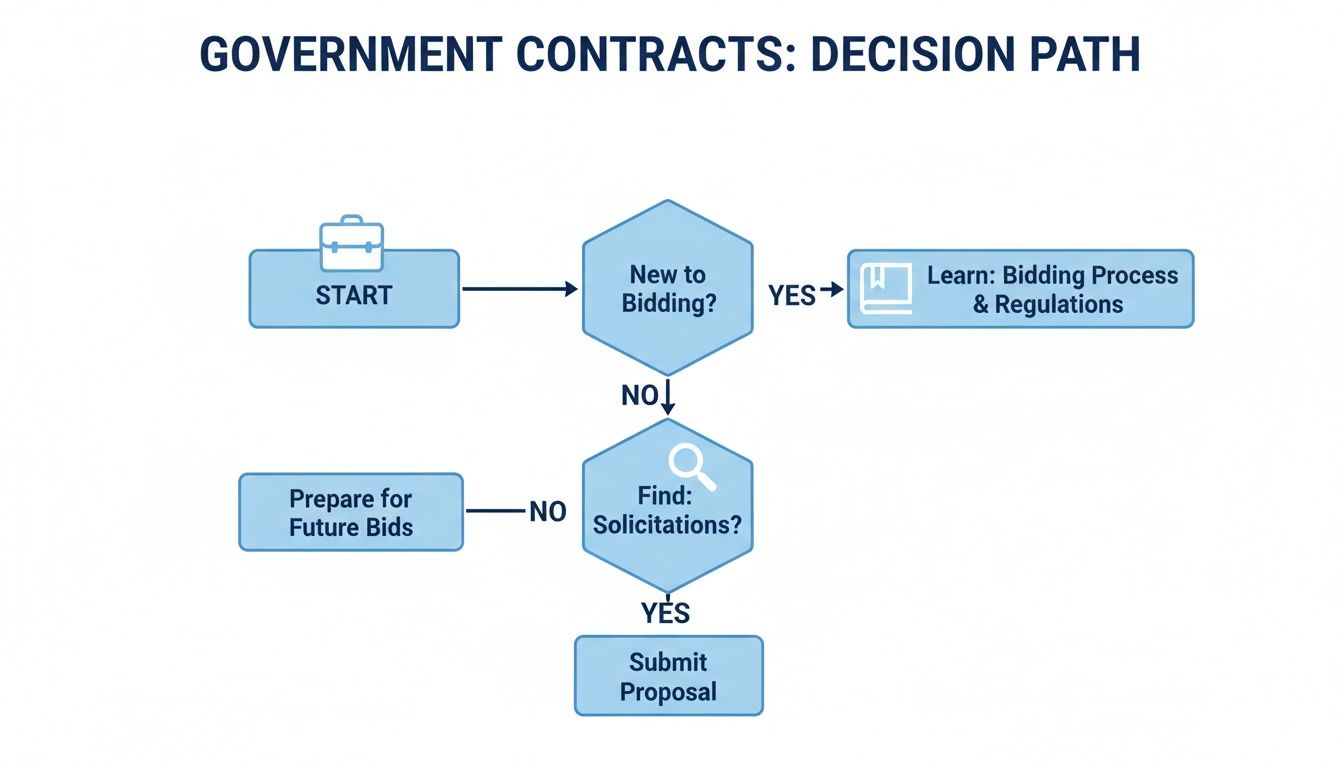
As you can see, your first decision is whether you're just learning the process or actively seeking new contracts.
The Problem with Doing It All Manually
Relying on manual searches and portal email alerts creates a lot of work. You'll get swamped with irrelevant notifications. It's a huge waste of time for any business.
This is where a dedicated tender monitoring tool becomes a necessity. Instead of you doing the searching, a platform like Bidwell does it for you. It uses your criteria to find relevant contracts and delivers a clean, daily list.
The All-Important Bid or No-Bid Decision
Finding a tender is just the first step. The next is the 'bid/no-bid' decision. Just because you can bid doesn’t mean you should. A disciplined process saves you from wasting hours on bids you have little chance of winning.
Before you commit, ask some hard questions:
- Can we genuinely deliver this? Do we have the skills and resources? Be honest.
- Do we meet all mandatory requirements? Check for accreditations like ISO 9001 or minimum turnover. Failing one of these is an instant disqualification.
- Is this actually profitable for us? Look at the contract value and your likely costs.
- Do we have a winning strategy? Can you see a clear advantage you have over the competition?
A quick 'no' is far more valuable than a long 'maybe'. Protecting your team's time and focusing only on high-probability bids is the most effective strategy.
Making this call quickly is vital. Bidwell helps here, too. It provides AI-generated summaries with each tender alert. You can read a summary of the requirements in about 60 seconds, helping you make that initial call much faster.
This approach means you only work on opportunities that are a great fit. To learn more, you can read about the UK procurement process and how to navigate it. It’s a fundamental part of bidding successfully.
Preparing a Compliant and Compelling Bid
So, you've found an opportunity and made the 'go' decision. Now the real work starts. This is where you build a case that proves you're the only choice for the job.
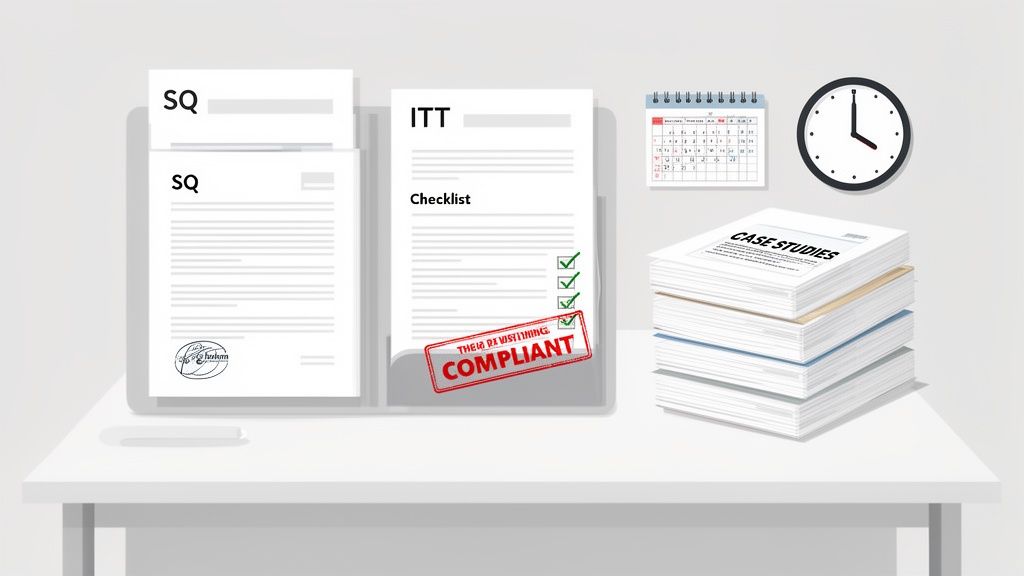
It usually kicks off with a Selection Questionnaire (SQ). This is the first hurdle. The buyer uses it to check you're a credible and compliant supplier before they read your full proposal.
Conquering the Selection Questionnaire
Think of the SQ as your business's CV. It’s a pass/fail stage where you provide evidence that you meet the buyer's minimum standards. This is all about organised compliance.
You'll need a standard set of documents ready:
- Company Details: Registered name, address, company number.
- Financial Standing: Your last two or three years of audited accounts.
- Compliance Documents: Policies like Health & Safety and Quality Management are nearly always required.
- Accreditations: Proof of certifications like ISO 9001 is often a deal-breaker.
- Grounds for Exclusion: A declaration that your company hasn't been involved in bribery or fraud.
Looking for this information every time is a drag. This is why a central knowledge base is so useful. A platform like Bidwell lets you store all these documents in one organised library. When an SQ lands, you can pull the required information instantly.
Deconstructing the Invitation to Tender
Once you're through the SQ stage, you'll get the Invitation to Tender (ITT). The ITT contains all the detailed questions about how you'll deliver the service, your quality control, and your price.
Don’t just skim these documents. Read every line. The buyer's real priorities are hidden in the specification and the evaluation criteria.
A good bid plan is your best friend here. Break down the ITT into individual questions and assign them to your team. Set internal deadlines for drafts and reviews. This structure prevents last-minute panic.
Understanding the buyer’s problem is more important than talking about your solution. Frame every answer around how you will solve their specific challenges. This buyer-centric focus is what separates winning bids from the rest.
Building Your Response from a Strong Foundation
Starting a response from a blank page is daunting and inefficient. Your company has years of experience and successful projects. A knowledge base lets you capture all of that institutional memory.
Every time you write a great response or case study, it should be saved and tagged. When a similar question comes up, you have a high-quality starting point. It ensures consistency and saves a huge amount of time.
The data backs this up. In the UK, 67% of active government tenders required a full SQ response, showing that having your credentials organised is vital. Also, 41% of tenders mentioned social value KPIs, so evidencing your impact is crucial.
Using AI to Accelerate Your Writing
This is where you can get a real edge. With an established knowledge base, you can use AI response generation to draft answers. Bidwell's AI doesn't just pull random text; it analyses the question and uses information from your own knowledge base to write a first draft.
Instead of your team spending 30 hours writing, the AI produces a solid draft much faster. This frees up your experts to spend their time refining, editing, and adding strategic value to the bid.
You can explore a full guide on how to write a tender bid to really nail the details. To excel in crafting your submission, you might also consult this guide to Mastering Proposal Writing: A Comprehensive Guide, which offers in-depth techniques.
How to Write a Response That Stands Out
This is it. The written response is where your prep work pays off. You can be the perfect company for the job, but if you can’t communicate that clearly, you won’t win.
This isn’t about fancy writing. It’s about hard evidence.
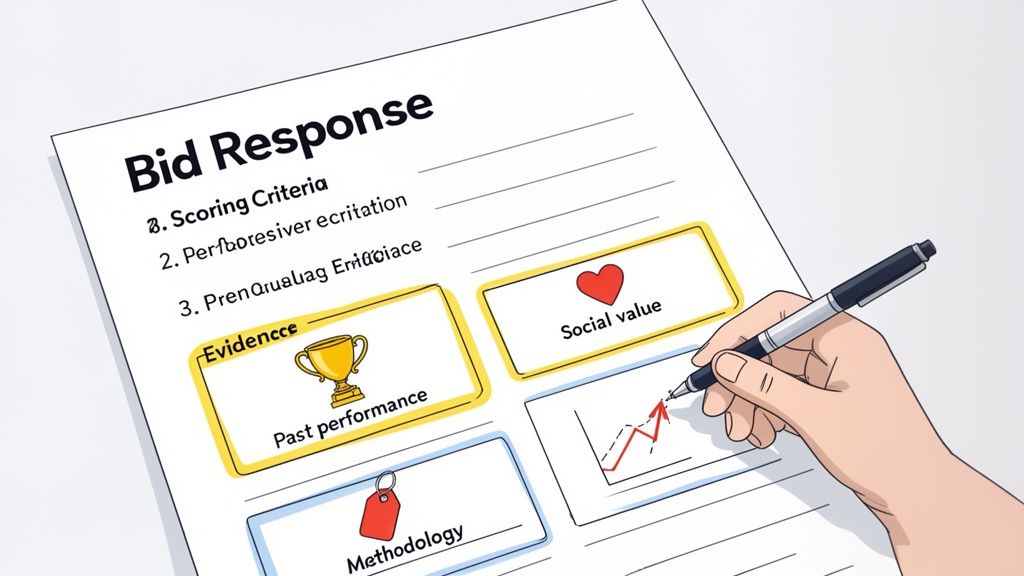
Saying "we deliver excellent customer service" is a waste of words. A winning bid says, "we achieve a 98% customer satisfaction rating, measured by monthly surveys, and have a dedicated account manager for each client". One is a claim, the other is a fact.
Answering the Question They Actually Asked
The biggest mistake bidders make is failing to answer the question directly. Evaluators score your bid against a rigid marking scheme. If you don't give them the information they've asked for, you get zero points.
Break down every question. Look for keywords like 'describe' or 'provide evidence'. Then, structure your answer to mirror the question. If a question has three parts, your answer needs three distinct sections. Make their job easy.
This is where your company's own data and past successes are powerful tools. A well-organised knowledge base is invaluable. Having case studies and performance metrics ready means you can pull specific, evidence-backed examples for any question.
Showcasing Your Social Value
Social value is no longer a 'nice-to-have' section. It's a critical part of the evaluation, often accounting for 10-20% of the total score. You must demonstrate how your company will bring benefits to the community.
So, what can you offer? Think about concrete actions:
- Creating local jobs or offering apprenticeships.
- Committing to use local suppliers in your supply chain.
- Implementing environmental initiatives, like reducing your carbon footprint.
- Volunteering staff time for local charities.
Your social value offer must be specific and measurable. Don't just say you'll "support the local economy." Commit to "spending 60% of the contract's material budget with suppliers within a 20-mile radius". That’s a promise they can measure.
Nailing the Methodology and Quality Sections
The methodology section is your chance to explain how you'll deliver the service. This is where you show your expertise. The evaluator needs to feel confident you can hit the ground running. It must be a clear and logical plan.
If you need to sharpen up this part of your response, our guide on how to write a method statement is a great place to start.
Your quality management section is just as important. It’s not enough to say you're ISO 9001 accredited. Explain how you'll apply those principles to this specific contract. Describe your processes for handling issues and ensuring continuous improvement.
Your response is a reflection of your company. A well-organised, clearly written bid suggests you're a professional company. A sloppy, vague response suggests the opposite.
A Smart Approach to Pricing
It’s a myth that you always have to be the cheapest to win. Evaluators look for the Most Economically Advantageous Tender (MEAT). This means they balance cost against quality.
Submitting a rock-bottom price can be a red flag. It might suggest you don't understand the work or that you'll cut corners. Your price should be competitive, but it must also be realistic. Be prepared to justify your costs.
To give you a better idea of how your proposal will be judged, here’s a look at common evaluation areas.
Common Government Tender Evaluation Criteria
The table below breaks down the typical scoring areas in a public sector bid. While weightings vary, this gives you a solid overview of what evaluators prioritise.
| Evaluation Area | Typical Weighting | What They're Looking For |
|---|---|---|
| Technical/Quality | 40-60% | A detailed methodology, relevant experience backed by evidence (case studies), qualified team members (CVs), and a clear understanding of the requirements. |
| Commercial/Price | 30-50% | A realistic, competitive price that offers clear value for money. The pricing schedule must be completed correctly and without errors. |
| Social Value | 10-20% | Specific, measurable commitments to local employment, supply chain spending, environmental sustainability, or other community benefits. |
| Compliance | Pass/Fail | Meeting all mandatory requirements (accreditations, insurance levels), correct formatting, and submission before the deadline. |
Understanding this balance is key. A slightly higher price can often be justified by a much stronger technical or social value offer.
Speeding Up the Writing Process with AI
Let’s be honest: writing a high-quality response takes a lot of time. A bid manager can easily spend 40 hours or more writing a tender from scratch. This is where you can get a serious advantage.
Instead of starting from a blank page, AI response generation tools like Bidwell can create a first draft much faster. The AI uses your company's own knowledge base—all your best past answers and case studies—to construct relevant responses.
This doesn't replace your human experts. It frees them from the basic drafting. Their time is then spent on review, tailoring answers, and adding the insights that make a bid stand out. Exploring AI-powered RFP response creation can make this process even more efficient.
Beyond the Bid: Advanced Tactics and What to Do After You Hit Submit
Hitting ‘submit’ feels like the end, but it’s just the halfway mark. What happens next? And how can you use this phase to get a competitive edge for the future?
Let’s get into some strategies that can improve your win rate.
For smaller businesses, one of the most powerful moves is to team up. It's a great way to go after larger contracts that might feel out of reach on your own.
Partnering Up: Consortiums and Subcontracting
If you can’t tick every box on a big tender, don’t walk away. Consider a consortium bid with other businesses whose services complement yours. This is where several companies join forces to put in a single, unified tender.
Another good route is to be a subcontractor to a larger prime contractor. The trick is to build relationships with these bigger players before tenders are published. Make sure they know what you specialise in, so your name comes to mind when they need support.
The Non-Negotiable Pre-Submission Checklist
Simple mistakes can get a brilliant bid thrown out. A forgotten signature or a missing document can undo weeks of hard work. A pre-submission checklist is essential.
Keep your checklist simple:
- Has every single question been answered?
- Are all required documents attached in the right format?
- Has the pricing schedule been double-checked for errors?
- Is the submission in the right file format (e.g., PDF, Word)?
- Has a senior team member given it one final proofread?
Think of this check as your last line of defence. Don’t skip it.
After You've Clicked Submit
Once your bid is in, the process enters a standstill period. For high-value contracts, this is a legally required pause, usually lasting 10 days. The buyer tells all bidders the outcome but doesn't formally award the contract yet.
This gives unsuccessful bidders a chance to ask for details and decide if they want to challenge the decision. Whether you've won or lost, what you do next is vital.
When You Win, and When You Don't
If you win, fantastic. Be ready to move fast on getting the contract signed.
But if you lose, your work isn’t over. You must request a debrief. The contracting authority has to give you feedback, explaining where your bid scored well and where it fell short compared to the winner.
This feedback is pure gold. It's a free, expert critique of your bidding strategy. A losing bid that you learn from is more valuable than a win you don't understand.
Take this feedback on board. If your pricing was off, review your commercial strategy. If your social value offer was weak, you know where to focus next time. This cycle of improvement is what separates long-term winners from those who give up.
Understanding the Reality of Public Procurement
It’s also important to be realistic. Not all government work is won through open tenders. In some sectors, established relationships and a proven track record are everything.
Take the Ministry of Defence. Non-competitive contracting is now their main procurement method. A recent report showed 49% of new MOD contracts were awarded through single-source arrangements. Competitive bidding only accounts for 35% of their core spending. You can see the details on the MOD contracting trends on the GOV.UK website.
This highlights why building your reputation is so critical. Every successful delivery becomes a powerful case study for the next bid.
Storing these proofs of performance in a central knowledge base, like the one inside Bidwell, makes them instantly accessible. You can then use the AI response generation feature to weave these success stories into future proposals, showing buyers you have a track record they can trust.
Your Bidding Questions, Answered
The world of public sector procurement can feel like a maze. We get asked a lot of questions by businesses starting out, so here are some straight answers to the most common ones.
How Long Does This Whole Bidding Thing Actually Take?
There’s no single answer. It really varies.
A simple quote might only give you a week. But for a large Invitation to Tender (ITT) for a complex service, you could be looking at 30 to 60 days to pull your response together.
As a rule of thumb, budget at least three to four weeks from finding a tender to the deadline. The writing is the biggest time-drain. Using a platform with a knowledge base and AI response generation can cut that writing time down, freeing your team to focus on strategy.
What’s the Difference Between Contracts Finder and Find a Tender?
It comes down to the contract's value. They’re for different scales of work.
- Contracts Finder is for public sector contracts in England. It lists opportunities over £12,000 for central government and over £30,000 for the wider public sector.
- Find a Tender (FTS) is the UK-wide service for high-value contracts. These are generally worth more than £138,000. If you're chasing larger projects, you have to watch FTS.
Of course, a good tender monitoring service, like the one in Bidwell, keeps an eye on both (and others) for you. You'll never miss an opportunity, no matter the contract size.
Can a Small Business Really Win a Government Contract?
Yes, absolutely. It's a myth that it's all sewn up by big companies. The government has a firm target to spend £1 in every £3 of its procurement budget with small and medium-sized enterprises (SMEs).
You'll also find many large contracts are now broken down into smaller 'lots' to make them more accessible to smaller firms. Local councils are often keen to award work to local suppliers. The trick is to find the right-sized opportunities and show the unique value you bring.
Don't count yourself out before you start. Thousands of SMEs win government work every year. Your size is often a strength, allowing you to be more flexible than a larger competitor.
What Is This "Social Value" Thing and Why Does It Matter So Much?
Social value is about the wider community benefits your business can deliver. It’s about how you can help the contracting authority achieve its bigger social, economic, and environmental goals.
This isn't a tick-box exercise. It's now a mandatory evaluation criterion and can be worth 10% or more of the total score. A weak social value offer can easily be the reason you lose a bid.
In practice, this could mean commitments like:
- Creating apprenticeships for local young people.
- Using other local businesses in your own supply chain.
- Taking specific steps to improve environmental sustainability.
A strong, specific, and believable social value promise is now essential.
Ready to stop wasting time on manual searches and endless writing? Bidwell finds the right tenders, stores your company knowledge, and uses AI to generate high-quality first drafts in a fraction of the time. See how you can win more government contracts by visiting https://bidwell.app.
Made with Outrank


