
How to Write a Method Statement That Wins UK Bids

Writing a method statement is simple. It's a step-by-step document explaining how you'll do a job safely, especially a high-risk one. Think of it as the script for the work.
It shows the sequence of tasks. It points out the hazards. And it details your control measures so everyone knows exactly how the work gets done.
Understanding the Method Statement's Role in Bids
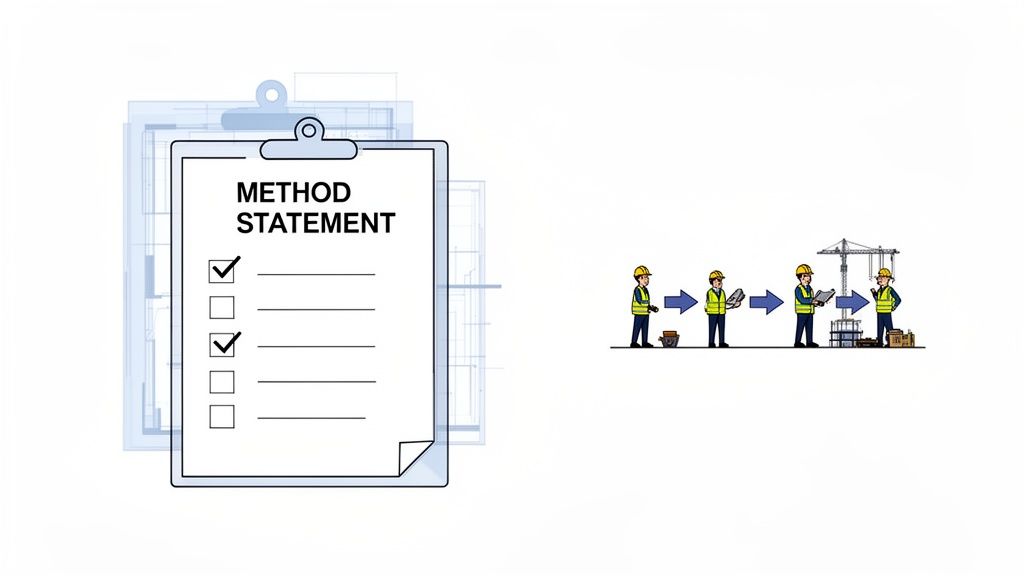
So, what is a method statement? It’s a document detailing the safe system of work for a specific task. A risk assessment identifies hazards, but the method statement gives clear instructions on how to manage them.
That’s why they're often bundled together as ‘RAMS’ (Risk Assessments and Method Statements).
In UK public sector bids, a method statement is more than a safety document. It's evidence that shows you're competent, professional, and you pay attention to detail. A bad or generic one is a huge red flag that can sink your entire bid.
A strong method statement doesn't just list safety rules. It tells a story of how you'll deliver the project safely and to a high standard. It’s your chance to prove you’re a contractor who can be trusted.
Why It’s Not Just More Paperwork
For high-risk industries like construction, method statements are essential. The work is varied, sites are always changing, and the risk of serious incidents is real. Your method statement proves you’ve thought about the unique challenges of this specific job.
To get it, you need to know the difference between policy and procedures. A method statement is a classic procedure – it’s the practical ‘how-to’.
A well-written statement offers serious advantages for your bid:
- It builds trust: A thorough plan shows the client you're organised and take their project seriously.
- It demonstrates expertise: It's your proof that you understand the practical steps and potential problems.
- It sets you apart: When bids are close, a clear, detailed method statement can put you ahead of competitors who submit vague plans.
Learning how to write a good method statement is a vital skill for winning public sector tenders. When a new opportunity from Bidwell’s tender monitoring service lands in your inbox, having a solid grasp of this document is often the first step to a winning response. You can even store your best-written sections in Bidwell’s knowledge base, making it faster to tailor them for future bids.
The Core Components of a Winning Method Statement
A great method statement is organised and easy to follow. You can't just throw details onto a page and hope the evaluator connects the dots for you.
Think of it like building a house. You need a solid foundation and a logical structure. This is where you prove you have a clear plan that your team can follow on site.
So, what does that structure look like? While every project is different, the core components are pretty consistent. Getting this right shows the procurement officer that you're thorough and professional.
Let's break down the essential sections.
Table: Essential Sections of a Method Statement
This table outlines what to include. It explains what each part should cover for a successful bid.
| Section Title | Purpose and Key Information |
|---|---|
| Project Details & Document Control | Sets the scene. Includes the project title, site address, key people (e.g., Project Manager), and a version number with a date. Ensures everyone has the right document. |
| Scope of Works | Clearly defines what work this method statement covers. Be specific to avoid confusion. |
| Required Resources | Lists the people (roles, qualifications), plant/equipment, and materials needed. Proves you've planned the job properly. |
| Risk Assessment & Control Measures | Links to your risk assessment. Details the specific hazards and the control measures you'll use to reduce them. This is a critical compliance check. |
| Step-by-Step Sequence of Operations | The core of the document. A numbered, logical sequence of tasks from start to finish, written in plain English. |
| Personal Protective Equipment (PPE) | Specifies the mandatory PPE for all tasks covered in the statement. |
| Welfare & First Aid Provisions | Outlines on-site arrangements for welfare (toilets, water) and first aid, including kit locations and named first aiders. |
| Emergency Procedures | Details procedures for emergencies like fire or accidents, including contact numbers and assembly points. |
| Permits to Work | Identifies any specific permits needed for high-risk activities (e.g., hot works, confined space entry) and how to get them. |
Getting these sections right provides a solid framework that evaluators can easily navigate. This scores you points for clarity.
Setting the Scene: Project Details
First, you need to set the context. This isn't just admin. It ensures anyone picking up the document knows exactly what it's for, where it applies, and who is in charge.
Your opening section should clearly state:
- Project Title: The official name of the project.
- Site Address: The exact location where the work will happen.
- Key Personnel: Names and roles of the project manager, site supervisor, and the person responsible for health and safety.
- Document Control: Include a version number and date. This is vital for making sure everyone is working from the current plan.
This upfront clarity prevents dangerous confusion. A site supervisor needs to be able to glance at the front page and confirm they have the right document for the job.
Defining the Scope and Resources
Next, detail exactly what work this method statement covers. Be specific. Instead of "electrical work," write "Installation of the primary ground floor lighting circuit, including chasing walls and fitting backboxes."
Once the scope is clear, list the resources you need. This isn't a shopping list; it’s proof you’ve properly planned the job. I always break this down into three clear categories:
- Personnel: Who will be doing the work? List their roles (e.g., two qualified electricians, one apprentice) and any specific tickets required, like IPAF.
- Equipment: What tools and plant will you use? Again, be precise. List everything from hand tools to a "3-tonne mini-digger with a breaker attachment."
- Materials: What materials will be used, and how will they be safely handled and stored?
When you're trying to build a solid structure for documents like this, looking at a proven standard operating procedure template can be a huge help. It forces you to think logically about how to present information.
The Step-by-Step Sequence of Operations
This is the heart of your method statement. You have to break down the job into a logical, sequential series of steps. Number each one clearly.
A good sequence is written in plain English, avoiding jargon. The goal is for a new team member to read it and understand exactly what to do, in what order, to get the job done safely.
A compelling method statement is crucial for UK public sector tenders. For instance, the ONS reported that total construction output fell by 1.1% in the three months to November 2025. This pressure means clients need contractors who manage every detail.
Finally, tie everything back to your risk assessment. For each step, reference the control measures you have in place. This shows you've moved from identifying risks to actively managing them. You can easily store these detailed, compliant sections in Bidwell’s knowledge base, ready to be pulled into future bids with the AI response generator.
Identifying and Controlling Risks Effectively
This section is where you often win or lose the bid. It’s the core of your method statement. Get it right, and you prove you understand the real-world dangers of the job.
A generic list of hazards just won't cut it. You need to show you’ve thought specifically about the task on that particular site. This means going beyond "working at height" and detailing risks like "working on an unprotected edge on the second-floor scaffolding during high winds."
This is about connecting your plan to reality.
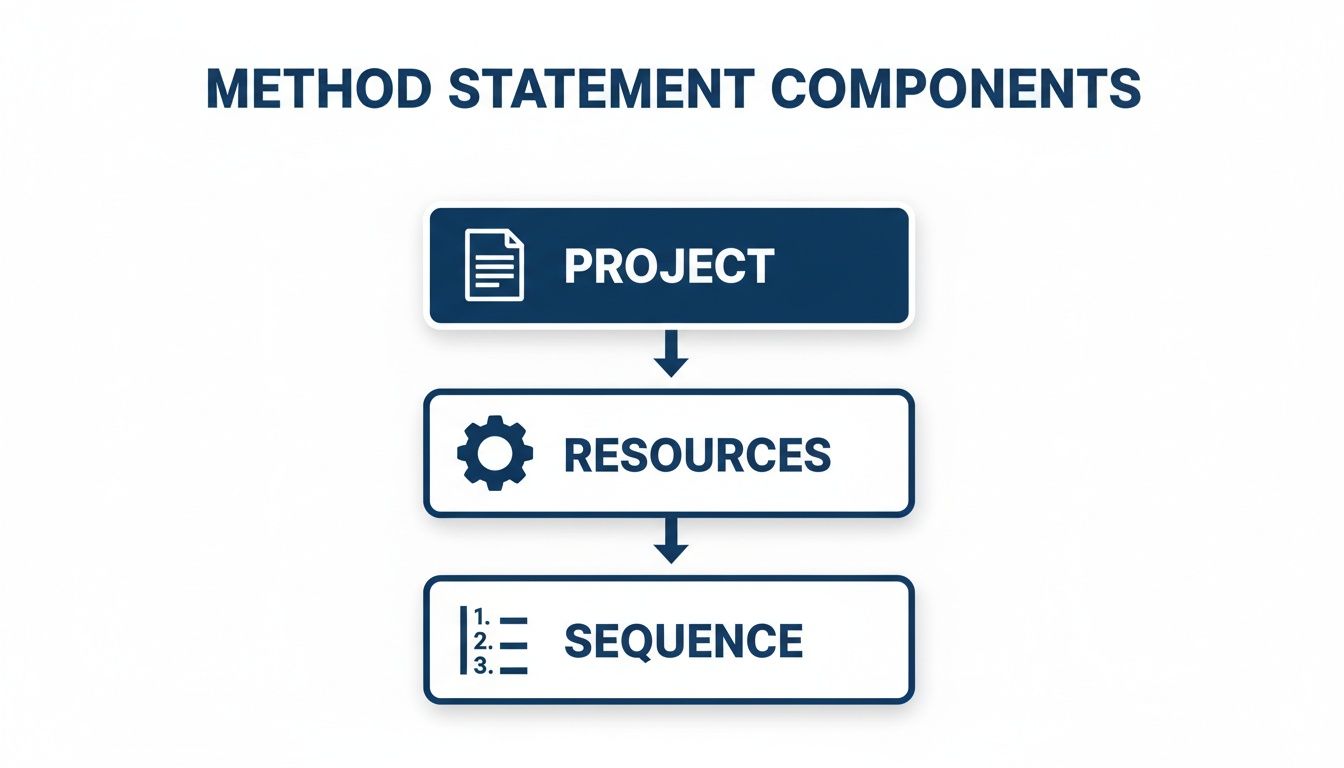
This visual shows how every decision must flow from the project's specific risks. It’s this link between planning and safety that evaluators look for.
In the UK construction sector, this focus is critical. Method statements are essential for safety in an industry with some sobering statistics. According to the HSE, there were 30 fatal injuries to workers in 2021-2022, with a five-year average of 36 fatalities annually. You can read more about these construction industry statistics to understand the context.
Applying the Hierarchy of Control
When you detail your control measures, you have to follow the hierarchy of control. This isn’t just best practice; it’s a required system for managing risks. Showing you understand it proves your competence.
The hierarchy, in order of effectiveness, is:
- Elimination: Can you remove the hazard completely? For example, assembling a component at ground level instead of at height. This is always the best option.
- Substitution: Can you replace the hazardous process with a safer one? For example, using a less toxic adhesive.
- Engineering Controls: Can you physically isolate people from the hazard? This includes installing guardrails or using machine guards.
- Administrative Controls: How can you change the way people work? This involves safe work procedures, training, or warning signs.
- Personal Protective Equipment (PPE): This is your last line of defence. It includes items like gloves, safety glasses, and harnesses.
Your method statement must show you've considered these options in order. Don't just jump straight to PPE. It’s a classic sign of a lazy response.
From Risk Assessment to Practical Control
Your risk assessment identifies hazards; the method statement explains the practical, step-by-step controls.
Let’s take a real-world example: cutting concrete slabs indoors.
- Hazard Identified: High levels of respirable crystalline silica (RCS) dust.
- Poor Control Measure: "Operatives to wear dust masks." This is lazy, vague, and jumps to the bottom of the hierarchy.
- Good Control Measure: "Use a saw with on-tool water suppression to damp down dust (Engineering Control). The area will be cordoned off and ventilated with an M-class dust extractor (Engineering Control). All operatives in the vicinity must wear FFP3 masks (PPE). The area will be monitored (Administrative Control)."
See the difference? The second example is specific and practical. It gives the site team clear instructions and gives the bid evaluator confidence.
A strong risk control section answers the "what if" questions before they're asked. It shows foresight and a proactive safety culture, which are valuable qualities to any public sector client.
Remember, the details matter. Instead of "use correct manual handling," describe the technique: "Materials will be broken into loads under 20kg. A trolley will move them. Two-person lifts will be used for any awkward items."
This level of detail is exactly the kind of content you should save in your Bidwell knowledge base. When a new tender comes in, the AI response generator can pull these pre-approved sections. It saves hours while ensuring quality.
Writing and Formatting for Maximum Clarity
Your method statement has two audiences. It needs to impress a procurement officer in an office, but also be understood by an apprentice on a noisy building site.
This isn’t the place for corporate waffle. Clear communication is safe communication. If your instructions are ambiguous, you're not just risking a poor score; you're putting people at risk. The goal is simple, plain English.
Keep It Simple and Direct
Think about the person on-site. They're busy and need information fast. They don’t have time to decode long, rambling sentences.
Consider the difference:
- Vague: "It is imperative that operatives ensure the appropriate utilisation of fall arrest systems when operating in elevated locations."
- Clear: "Anyone working above two metres must wear a harness and be clipped on at all times."
The second one is better because it's a direct instruction. Always choose clarity over trying to sound formal. A simple, well-written document is far more professional.
The best method statements are practical tools, not academic essays. If someone has to read a sentence twice to understand it, rewrite it. Clarity is king.
This is where building a knowledge base in Bidwell really pays off. When you write a clear, compliant section, you save it. Next time, Bidwell’s AI response generator can pull that perfect wording into your tender, saving hours of work.
Structure for Scannability
A solid wall of text is a massive turn-off. Nobody reads it; they scan it. You have to use formatting to guide their eyes to the critical information.
A few simple rules make all the difference:
- Use Headings and Subheadings: Break the document into logical chunks with clear, descriptive headings.
- Embrace Bullet Points: They’re perfect for instructions, PPE lists, or safety checks. They are far easier to scan than a dense paragraph.
- Keep Paragraphs Short: Aim for two to four sentences, max. This creates white space and makes it much easier to read.
- Use Bold Text Sparingly: Highlight critical warnings or key responsibilities. Think "do not operate above 15 mph winds".
Use Visuals When It Helps
Sometimes, a picture is genuinely worth a thousand words. Don't be afraid to add simple diagrams, site plans, or photos to make complex instructions clear.
For example, you could include:
- A site map showing first aid stations and assembly points.
- A diagram illustrating how to erect a piece of equipment.
- A photo showing exactly how a guard should be fitted.
These visual aids get rid of any ambiguity. They're especially helpful for team members who might have English as a second language.
If you're looking for more ways to make your bids stand out, we've got plenty of advice in our other tender tips articles.
Integrating Method Statements into Your Bidwell Workflow
Let’s be honest, writing a bespoke method statement for every tender is a huge time sink. It’s often the most time-consuming part of a bid. This is where you can start working smarter, not harder.
Instead of starting from a blank page, you can use Bidwell to build a powerful system for all your best content. This isn't just storage; it's an intelligent resource that helps you win more work.
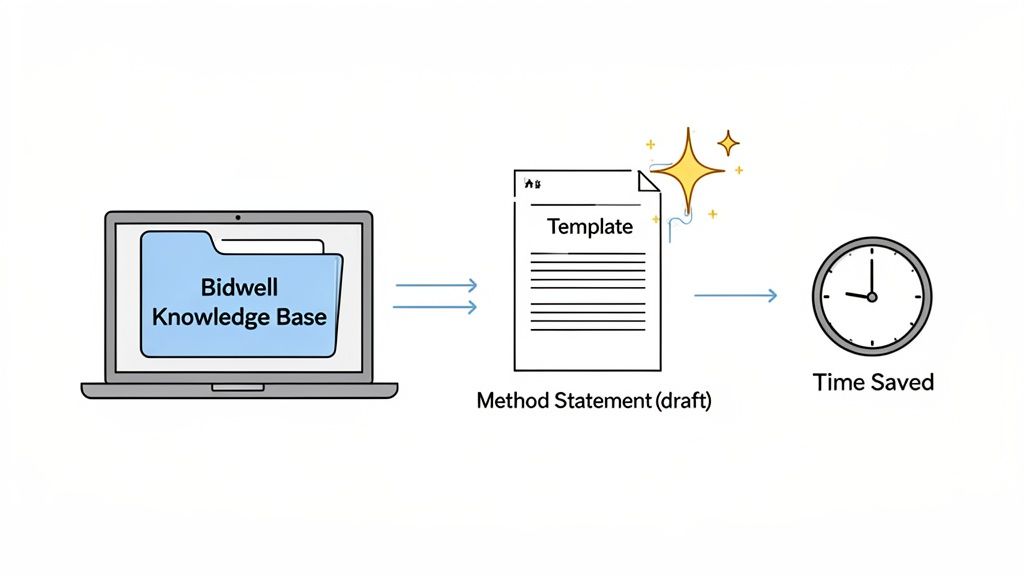
The process is simple. When you write a great, compliant section for one bid, you save it to your Bidwell knowledge base. This becomes your single source for approved procedures, risk controls, and step-by-step sequences.
Build Your Knowledge Base Proactively
Your knowledge base is your biggest asset. It’s where your company’s collective expertise lives. Every time you complete a successful project or write a winning bid, add the key components to this central hub.
Think about storing things like:
- Standard Operating Procedures: Your approved, step-by-step guides for common tasks.
- Risk Assessment Templates: Pre-filled templates for activities like working at height.
- Past Method Statements: Full examples from previous winning bids, organised by project type.
- Key Personnel CVs: Qualifications and experience records for your core team.
When a new alert arrives from Bidwell’s tender monitoring service, you're not scrambling. It's all there, ready to go. You’re starting from a position of strength.
Use AI to Draft Responses in Minutes
This is where the real efficiency kicks in. Once your knowledge base is populated, Bidwell’s AI response generator can do the heavy lifting. The AI scans the tender questions and pulls the most relevant information from your own knowledge base.
It then drafts a tailored method statement that's already 80% complete. It uses your own approved language and procedures to construct a new document that aligns with the tender's requirements.
A task that used to take a bid writer 20 hours can be cut to just a couple of hours of reviewing. This gives you a massive competitive edge, letting you bid on more contracts without burning out your team.
For sectors like construction, this efficiency is vital. The industry represents 6% of UK GDP, and clients check every detail. For example, recent ONS data showed that while overall construction output rose 3.3% year-on-year, it fell 6.0% month-on-month. You can find more the latest construction industry statistics to see how this data can inform your bids.
This integrated approach makes the entire process faster and far more consistent. It's not about cutting corners; it's about using your best work more effectively. You can find more practical advice in our guide on how to write a tender bid.
You've nailed the process, mapped the risks, and detailed the work sequence. Great. But before you submit, you need to do one last, ruthless review. All that hard work can be undone by a few careless mistakes.
Knowing these common traps is half the battle. When an evaluator sees a polished document, it tells them you have your act together. It’s that final check that makes your bid stand out.
Being Too Generic
This is the number one mistake we see. A buyer doesn't need a textbook definition of how to put up scaffolding. They need to know how you will put up scaffolding on their specific site, next to their active office building.
Your method statement must be tailored to the site and the task. If you could slap a different client's name on it and it still made sense, it's not good enough. Evaluators can spot a copy-and-paste job from a mile off.
Contradicting Your Risk Assessment
Think of your risk assessment and method statement as two halves of the same coin. They have to line up perfectly. A classic mistake is identifying a major risk and then offering a flimsy control measure.
For example, your risk assessment flags "exposure to asbestos fibres" as a high risk. But your method statement just vaguely says, "operatives to wear correct PPE." That’s a huge red flag.
A strong method statement directly tackles the hazards raised in the risk assessment with specific controls. If the two documents don't align, your entire safety case crumbles—and so does the buyer's confidence.
Poor Formatting and Waffling
Don't make the evaluator hunt for information. A huge wall of text is unprofessional and a nightmare to read. Break it up. Use short paragraphs, clear headings, and bullet points.
Keep your language simple and to the point. Ditch the jargon. The aim is clarity, not trying to sound like a legal document. A straightforward, concise statement is always more impressive.
Remember, every document you submit is an asset. When you create a great method statement, save it in Bidwell's knowledge base. This lets Bidwell's AI response generator pull from high-quality, approved content for future bids, ensuring you sidestep these pitfalls every time.
Lingering Questions?
Still have a few questions? You're not alone. Here are the answers to some of the most common queries we see from businesses trying to win UK public sector work.
What's the Real Difference Between a Method Statement and a Risk Assessment?
This is a classic point of confusion, but it's simple.
A risk assessment identifies the hazards and how serious the risk is. A method statement explains the exact, step-by-step process you’ll use to manage those risks and do the job safely.
Think of it like this:
- Risk Assessment: What could go wrong? (e.g., Someone falling from a ladder while installing signs).
- Method Statement: What are we doing about it? (e.g., "1. Erect a certified tower scaffold. 2. A competent person will inspect it before use. 3. Materials will be lifted using a gin wheel.").
They’re two sides of the same coin. That’s why you’ll often hear the acronym ‘RAMS’ (Risk Assessments and Method Statements).
Who Is Actually Qualified to Write One?
There’s no specific, legally required qualification. The official requirement is that it must be written by someone who is competent.
What does 'competent' mean? It’s someone with the right blend of practical experience, technical knowledge, and health and safety training. They need to understand the job inside-out.
While a safety advisor can help, the best method statements are often a team effort. Getting input from the people doing the work—like a site supervisor—is invaluable. Their hands-on knowledge makes the document practical.
How Often Should I Update a Method Statement?
A method statement is a live document, not something you file away forever. It must be reviewed and updated whenever anything significant changes.
This could be triggered by changes to the:
- Work sequence or the way you plan to do the job.
- Site conditions, like new hazards.
- People or equipment involved in the task.
- Relevant laws or industry guidance.
As a rule, review it at the start of every new project, even if the task is routine. This ensures it’s still relevant to the current site’s challenges.
Keeping these updated documents in your Bidwell knowledge base is a smart move. It means your AI response generator always has access to the most current and compliant information, ensuring your bids are consistently strong.
Stop drowning in tender paperwork. With Bidwell, you can build an intelligent knowledge base and use AI to generate tailored, high-quality bid responses in a fraction of the time. Find out how we can help you win more contracts at https://bidwell.app.
Prepared with the Outrank tool


