
How to Write a Tender Bid That Actually Wins
Writing a winning tender bid is more than filling in boxes. It's a strategic process that starts with one simple, brutal question: should we even bid for this?
The best bids come from being selective. It's about focusing your energy on opportunities you can genuinely win. You also need a solid system to respond efficiently when you find them.
Winning Tenders Starts Before You Write a Word
So, you're ready to learn how to write a tender bid. The first and most important lesson is that the real work begins long before your fingers hit the keyboard. It's all about preparation and making a smart ‘go’ or ‘no-go’ decision.
The UK public sector is a massive market, but it's also fiercely competitive. You can't win by bidding on everything that moves. That’s a fast track to burnout and a terrible win rate.
Assess Every Opportunity Ruthlessly
Your first job is to become a ruthless evaluator of opportunities. Don't get sucked into wasting dozens of hours on a bid you were never going to win. Before you commit a single minute of your team's time, you need to quickly and honestly assess if the opportunity is a good fit.
Get into the habit of asking some direct questions:
Do we meet 100% of the mandatory requirements? (e.g., turnover, specific accreditations, insurance levels)
Can we really deliver the entire scope of work, or are there gaps?
Do we have strong, relevant experience and the evidence to prove it?
Is this contract actually profitable and strategically important for us right now?
The foundation of any successful tender is how it aligns with your broader business and strategic planning. A quick, objective assessment against your company's goals will save you an incredible amount of wasted effort.
This simple decision tree shows the basic logic for making that initial choice.
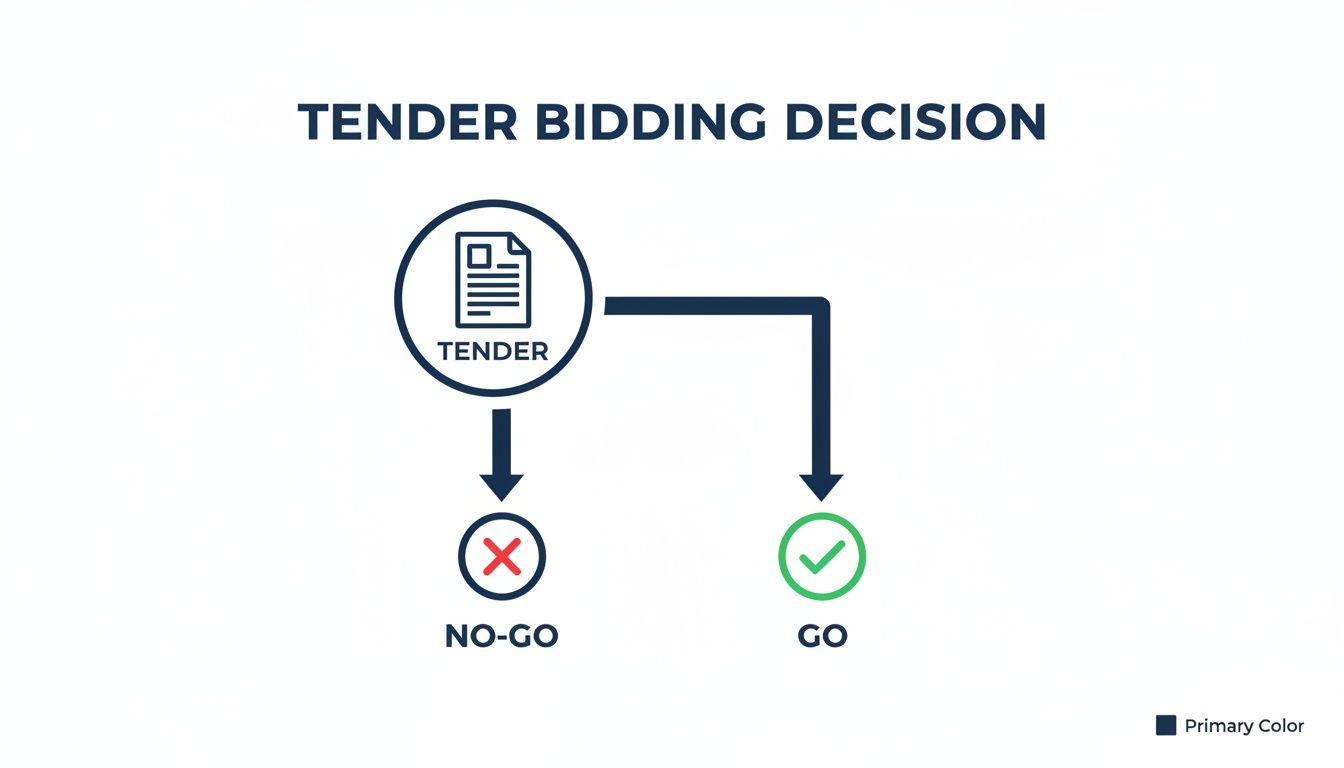
Running through this process forces you to be objective. It stops you from chasing unsuitable contracts based on emotion or ego rather than solid business sense.
To make this even easier, use a quick checklist for every tender that crosses your desk.
Go or No-Go Tender Checklist
Use this quick checklist to decide if a tender opportunity is worth pursuing before you commit resources.
| Check Point | What to Look For | Why It Matters |
|---|---|---|
| Mandatory Requirements | Turnover, accreditations, insurance, specific certifications, years of trading. | Fail on one of these and you're out instantly. No exceptions. |
| Scope of Work | Can you deliver 100% of the specification, including any niche requirements? | Promising to subcontract parts you can't handle weakens your bid. Buyers want a complete solution. |
| Relevant Experience | Do you have 2-3 specific case studies of similar work for similar clients? | Vague claims of "experience" are worthless. Evaluators need hard proof. |
| Profitability & Strategy | Does the contract align with your business goals? Is the margin worth the effort? | Chasing revenue for its own sake can damage your business. Only bid on profitable, strategic work. |
| Timescales & Resources | Do you have the team capacity to write a quality bid and deliver the contract if you win? | Overstretching your team leads to poor bids and, even worse, poor delivery. |
| Competition | Who are you likely up against? Is the incumbent re-bidding? | Understanding the competitive landscape helps you assess your realistic chances of winning. |
If you're getting green lights across the board, great. If you see more than one or two red flags, it’s probably time to walk away and wait for a better fit.
Get Your House in Order Before You Bid
The secret to efficient, low-stress bidding is having all your core information ready to go before a tender even lands. Think of it as creating your company's "bid library."
This library should contain everything from company accounts and insurance certificates to key staff CVs and detailed, evidence-backed case studies. When you’re organised, you aren't scrambling for documents at the last minute.
With a platform like Bidwell, this is built right into your workflow. Your central Knowledge Base stores all these crucial assets—past responses, policies, and proof points. When you decide to bid, you’re not starting from a blank page. You're pulling verified, high-quality information directly into your new submission.
Winning isn't about being the biggest company; it's about being the best prepared. A well-organised Knowledge Base is your single biggest advantage, turning a frantic writing exercise into a calm assembly process.
The sheer scale of UK public sector spending—£372 billion in a recent year—is incredibly tempting, but the competition is intense. You need every advantage you can get. Being prepared is the one that costs nothing but pays the biggest dividends.
Deconstructing the Tender Documents
So, you’ve made the ‘go’ decision. Fantastic. Now the real work begins. Your next job is to become an expert on the tender documents. Don't just skim them; you need to live and breathe this stuff.
The buyer has laid out exactly what they want and how they're going to score you. Think of the tender pack as an exam paper where all the questions and the marking scheme are provided upfront. Your job is to answer every single question, providing the evidence they ask for, in the precise format they demand.
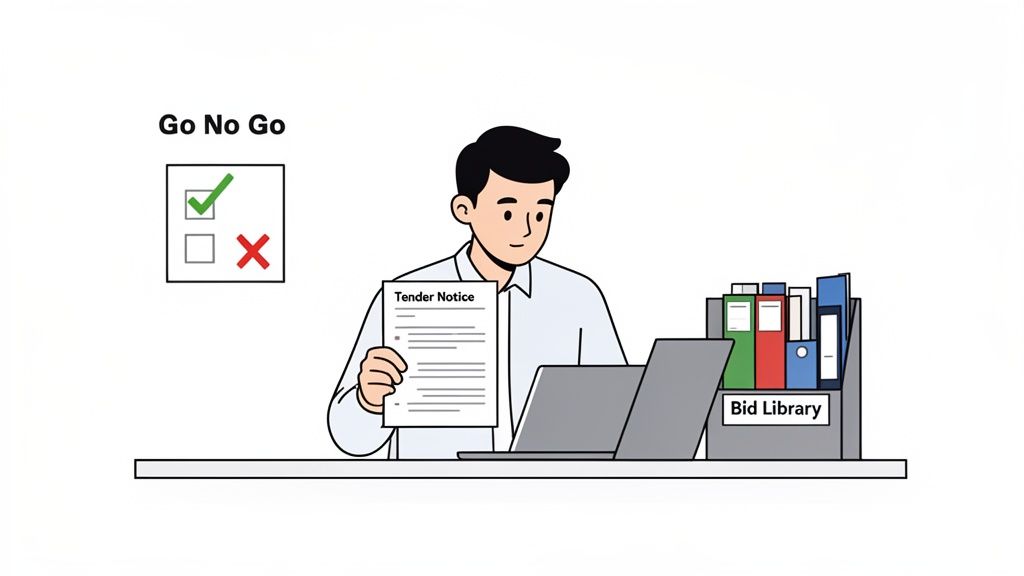
This initial analysis can feel like you're drowning in paper, especially with documents running to hundreds of pages. A good system gives you a massive head start. For instance, Bidwell's tender monitoring service uses AI to generate summaries that pull out key requirements, deadlines, and weightings, saving you hours of manual reading.
Spotting the Buyer's True Priorities
Every tender has its own personality. Some are obsessed with price, while others are all about quality, innovation, or social value. Your first task is to figure out what the buyer really cares about, and the evaluation criteria is where you'll find the answer.
The scoring matrix is your roadmap. It tells you exactly where to focus your effort.
Price/Quality Ratio: Look for the split, often shown as 60% Quality, 40% Price. If quality is weighted higher, you know a slightly higher price can be justified by a superior technical solution.
Question Weightings: Dig deeper into the quality section. A question worth 20% of the total marks demands far more detail and evidence than one worth only 5%.
Social Value: This is no longer a 'nice-to-have'. Public sector contracts almost always include a mandatory social value component, which can be 10% or more of the total score. Don't treat this as an afterthought.
Getting a firm grip on this breakdown stops you from wasting time writing a brilliant answer to a low-scoring question. It’s all about allocating your time where it'll have the most impact. You can explore more about the public sector landscape in our other articles.
Creating Your Bid Skeleton
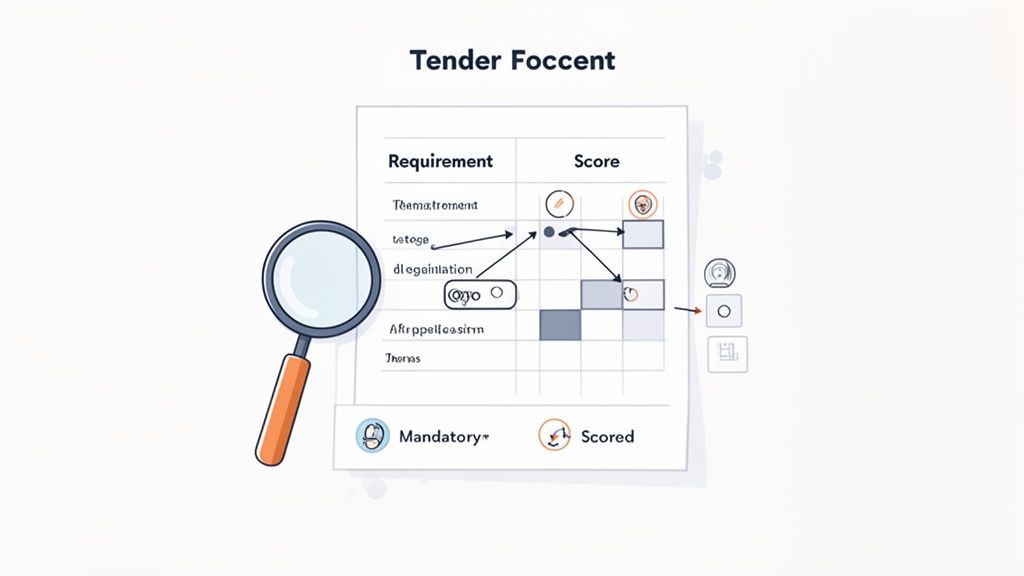
Once you understand the scoring, create a 'bid skeleton' or a compliance matrix. This is usually just a simple spreadsheet that breaks the entire tender down into individual requirements. It's the foundation of an organised and compliant bid.
Your skeleton should have columns for:
Requirement Number: The reference from the tender document (e.g., 3.1.4a).
Requirement Summary: A short, plain-English summary of what's being asked.
Mandatory or Scored? Is this a simple pass/fail check, or will it be marked?
Our Response Owner: Who on your team is responsible for drafting this answer?
Evidence Needed: What proof do they need? (e.g., specific case study, ISO certificate).
This document becomes your single source of truth for the bid. It ensures no requirement gets missed and forces your response to map directly to something the buyer has explicitly asked for. It imposes discipline and prevents you from going off-topic.
This process also highlights any gaps in your knowledge or evidence right at the start. Your Bidwell Knowledge Base is the perfect partner for this stage. As you map out the requirements, you can quickly search your library for pre-approved answers, policies, and case studies.
Structuring Your Answers for Maximum Impact
A winning tender bid isn't just a collection of facts; it’s a persuasive argument. You have to remember who you're writing for. Evaluators are often overworked, sifting through dozens of submissions under tight deadlines. Your job is to make their job easy.
This means structuring your answers to be clear, compliant, and compelling. It’s all about showing, not just telling. Vague corporate-speak won’t score any points. You need a simple, repeatable framework for each response that directly answers the question, explains your method, and provides cold, hard evidence.
The AMEB Framework for High-Scoring Answers
Think of every scored question as a mini-sales pitch. You need to convince the evaluator that you understand their problem and are the best choice to solve it. A simple framework like AMEB (Answer, Method, Evidence, Benefit) ensures you hit all the key points every time.
Here’s how it breaks down:
Answer: Start by directly answering the question. Use their own language back at them to show you've understood.
Method: Explain how you'll deliver what you've promised. Describe your process and the specific steps your team will take.
Evidence: This is the most critical part. Back up every claim with proof. This could be a case study, client testimonial, or performance data.
Benefit: Finally, connect the dots for the buyer. Explain why your method and evidence matter to them. How does it reduce their risk or save them money?
This structure makes your answers easy to read, easy to understand, and easy to score. You can find more advice in our collection of tender tips and guides.
Turning Vague Claims into Concrete Proof
Evaluators have seen it all before. Generic claims like "we provide excellent customer service" are meaningless without proof. You have to translate these fluffy statements into specific, evidence-backed points.
Let's look at an example.
Vague Claim: "We have a strong quality assurance process."
Evidence-Backed Answer: "We ensure quality through our ISO 9001:2015 certified process. For our recent contract with Acme Council, a dedicated Quality Manager conducted weekly audits, which reduced defects by 15% in six months. This approach ensures you get a fully compliant service with minimal disruption."
See the difference? The second answer uses the AMEB structure. It answers the question, describes the method, provides evidence, and explains the benefit.
Your Bidwell Knowledge Base is your secret weapon here. It should be your central library for these 'gold-standard' answers. Store your best case studies, statistics, and testimonials so you're not reinventing the wheel for every bid.
When you have this repository of proof points, writing high-quality responses becomes a simple assembly job. It’s no longer a stressful creative writing exercise.
Tailoring Your Responses with AI
Consistency is key, but you can't just copy and paste old answers. Every tender is different, and you need to tailor your content to match the buyer's priorities. Manually tweaking dozens of answers is slow and prone to error.
This is where AI can give you a significant advantage. Instead of starting from scratch, you can use Bidwell’s AI Response Generation to accelerate the process. The AI pulls the best-fit answers from your Knowledge Base and then intelligently rephrases them to align with the new tender's questions.
This doesn't replace the need for a human expert. Your job shifts from being a writer to being a strategic editor. You review the AI-generated draft and add the final layer of customisation. It’s about using technology to handle 80% of the repetitive work, freeing you to focus on the 20% that makes a difference.
Crafting a Compelling Social Value and Commercial Offer
Two parts of your bid can make or break it: your social value commitments and your commercial offer. These aren't just afterthoughts. In modern public sector bidding, they are often heavily weighted sections that demand a proper strategy.
Get them right, and you'll put yourself streets ahead of the competition. Get them wrong, and even the best technical solution won't save you.
Making Your Social Value Offer Count
Social value has become a deal-breaker. A vague promise to "support the local community" is worthless. It scores zero.
Buyers want specific, measurable, and relevant commitments that align with their local priorities. This is now a mandatory part of most UK public sector contracts, often worth 10% or more of the total score. Don't treat it lightly.
First, do your homework. Go to the council's website and find their Social Value Policy. They'll spell out exactly what they care about, whether that's tackling youth unemployment, improving green spaces, or supporting local health initiatives.
Your offer has to be linked to how you’ll deliver the contract. It’s not about writing a cheque to a charity. It's about delivering the service in a way that creates extra social, economic, and environmental benefits.
For example, don't just say you'll hire locally. Commit to something tangible:
"We will create two paid apprenticeships for local school leavers (aged 16-18) from the Hackney borough for the duration of this three-year contract."
"We will dedicate 50 volunteer hours per year, using staff on this contract, to support the Ancoats Community Gardens project."
"We will procure at least 20% of our required materials from suppliers located within a 15-mile radius of the contract site."
See the difference? These promises are specific, measurable, and tied to the local area. This is what evaluators are looking for.
Your social value commitments become contractual obligations if you win. Make sure you can deliver on what you promise. Be ambitious but realistic.
Pulling together these commitments takes time. This is where tools give you an edge. For instance, Bidwell's AI Response Generation can help you structure these sections. You feed in the buyer's priorities, and the AI will generate an organised draft for you to refine with specific numbers.
Justifying Your Price and Demonstrating Value
When it comes to the commercial side, it’s almost never about being the cheapest. Public sector procurement focuses on the Most Economically Advantageous Tender (MEAT). This is a calculated balance of price and quality.
Your job isn't just to fill in a pricing schedule. It's to present a clear, transparent, and justified price that screams "value for money".
So many bids fail here because of simple mistakes. Bidders might leave a cell blank, misread a formula, or forget to include all costs. Any of these can lead to an instant fail. You have to double-check, and then triple-check, every number.
Beyond getting the numbers right, you need to articulate the value your price represents. Explain why your solution is worth the cost. This is your chance to connect your price back to the quality and reliability you’ve described in your bid.
For instance, you could justify your pricing like this:
Higher staff costs? "Our proposed day rate reflects our commitment to the Real Living Wage. This allows us to retain experienced staff, ensuring you get a consistent, high-quality service."
Investing in better equipment? "The capital cost for the XYZ machine is included. This machine is 30% more energy-efficient than the industry standard, which will reduce the contract's carbon footprint and contribute to your net-zero targets."
This approach reframes price from a simple cost into an investment in quality and reliability. It shows the evaluator you’ve thought everything through. By using your Bidwell Knowledge Base to store previous pricing justifications, you can build these commercial arguments much faster.
The Final Polish and Submission Checklist
You’ve poured hours, maybe even weeks, into writing your bid. Don't fall at the final hurdle. A simple, avoidable mistake can get your entire submission disqualified before anyone even reads it.
This final stage is your pre-flight check. It’s all about being meticulous and nailing every last detail. The final human polish is what separates a good bid from a winning one.
The Red Team Review
Before you think about the submission portal, you need a fresh pair of eyes. This is where a ‘Red Team Review’ comes in. After staring at the same document for days, you’re too close to it to spot all the errors.
Find a colleague who hasn't been involved in the writing process. Their job is to read the entire submission from an evaluator's perspective. They aren't just looking for typos; they're checking for clarity, compliance, and consistency.
Here’s what they should be asking:
Does this answer actually address the question?
Is the language clear, or is it full of jargon?
Are our key benefits obvious in every section?
Is there any conflicting information between sections?
This review provides an invaluable, objective perspective. It highlights gaps in your logic and awkward phrasing you’ve become blind to.
The Red Team’s only job is to break your bid. They should be ruthless in finding weaknesses. It’s better for your team to find them now than for the evaluator to find them later.
Your Pre-Submission Checklist
Once the Red Team review is done and you’ve made the final edits, it's time for administrative checks. A single mistake here can be fatal, so take your time and be thorough.
With average bid windows now just over 10 days, there’s no room for error. This is where you get the payback for drafting quickly, giving you more time for these critical final checks.
Your final checks should include:
File Naming Conventions: Have you named every file exactly as requested? A mistake as small as
_v2instead of_finalcan cause a submission to be rejected by some portals.Document Formatting: Are all documents in the correct format (e.g., PDF, Word)? Are file sizes within the specified limits?
Completeness Check: Go back to your bid skeleton one last time. Cross-reference every required document to ensure nothing is missing.
Final Proofread: Run one last spell check and grammar check. Read key sentences aloud to catch awkward phrasing. It really works.
As you near submission, ensuring all parts of your bid are compiled into a coherent packet is essential. There are some great resources available for assembling your complete application packet correctly.
Below are some of the most common—and entirely avoidable—errors we see time and time again.
Top 5 Common and Avoidable Bid Submission Errors
| Error | Potential Consequence | How to Avoid It |
|---|---|---|
| Last-Minute Submission | Technical failure; portal crashes; missed deadline. | Aim to submit at least 24 hours early. Upload a draft version beforehand to test the portal. |
| Incorrect File Naming | Automated rejection by the procurement portal. | Double-check the tender instructions for the exact naming convention required. No exceptions. |
| Missing a Mandatory Document | Immediate disqualification on compliance grounds. | Use a checklist based on the tender documents and have a colleague verify everything is present. |
| Exceeding File Size Limits | Upload failure; incomplete submission. | Check the portal’s size limits early. Compress large PDFs or images if necessary. |
| Ignoring Formatting Instructions | Bid is deemed non-compliant and not scored. | Adhere strictly to specified fonts, page limits, and file types (PDF, Word, etc.). Don't get creative. |
These mistakes might seem small, but they can instantly derail weeks of hard work. A systematic checking process is your best defence.
Don't leave submission to the last minute. Internet connections fail and portals crash. Aim to upload everything at least 24 hours before the deadline. This gives you a buffer to handle any technical glitches without panic.
Find more practical advice in our other guides to winning public contracts.
Any Lingering Questions About Writing Tender Bids?
If you've still got a few things on your mind, you're not alone. Here are some of the most common questions we get from businesses across the UK who are getting serious about winning public contracts.
How Long Does It Really Take to Write a Tender Bid?
This is the big "how long is a piece of string?" question. The honest answer is it varies hugely depending on the contract's complexity.
A straightforward bid might take a focused 20 hours. A major, multi-faceted proposal for a long-term framework could easily swallow 50+ hours of your team's time.
The goal isn't just to get it finished; it's to do it well without bringing the rest of your business to a halt. That's why having a solid system is non-negotiable. Using a tool like Bidwell's AI Response Generation, for example, can slash the initial drafting time from days down to a few hours of expert review.
What's the Single Biggest Reason Bids Fail?
It sounds almost too simple, but the most common reason bids fail is this: they don't actually answer the question that was asked. In procurement speak, this makes your bid ‘non-compliant’.
So many bidders fall into the trap of shoehorning in generic answers that dance around the specific requirements instead of addressing them head-on.
Remember, evaluators are just people with a scoresheet. If your response doesn't give them what they need to tick their boxes, you get a zero for that section. Other classic blunders include missing the deadline (even by one minute) or making a tiny error in the pricing schedule.
Should I Just Get AI to Write My Entire Tender Bid?
Absolutely not. You shouldn't rely on any AI tool to write a full bid without a human expert in the driver's seat. Think of AI as a powerful assistant or a junior team member, not a replacement for your own strategic brain.
AI does the heavy lifting. It can generate well-structured, relevant drafts using your own company's information. This frees up your team to focus on adding the strategic insights, local context, and winning details that only a human can provide.
A platform like Bidwell is designed for this exact partnership. It uses your own curated Knowledge Base to make sure the AI's output is grounded in your proven content. You then step in as the expert editor, turning a good draft into a compelling submission.
Is It Worth Paying for a Professional Bid Writer?
For a single, must-win tender, hiring a professional can be a smart investment. But the costs can be steep, and it’s rarely a sustainable model for SMEs that need to bid regularly.
A more cost-effective strategy is to build your own in-house capability. Using a platform that helps you organise your evidence and automates the gruelling first drafts empowers your own team. It allows you to produce consistently high-quality bids without the high recurring cost of external consultants.
Ready to stop wrestling with documents and start winning more contracts? Bidwell finds relevant tenders, organises your company knowledge, and uses AI to generate first-draft responses in hours. Find out more and book a demo at https://bidwell.app.


