
A Guide to UK Public Procurement Procedures
Public procurement procedures are the rules public bodies follow when buying goods or services. Think of them as a system for fair play. They're designed to get taxpayers the best value for money and prevent favouritism.
If you're a UK business, understanding these rules is the first step to winning government contracts. It's not as complex as it sounds.
Why Procurement Procedures Matter to Your Business
It’s easy to see these procedures as just red tape. But they're your gateway to a huge, reliable market. The rules aren't there to trip you up. They exist to create a level playing field where every business gets a fair shot.
The whole point is to make sure public money is spent wisely. This idea is built on a few core principles. You'll see them in every tender document you find.
The Guiding Principles of Public Procurement
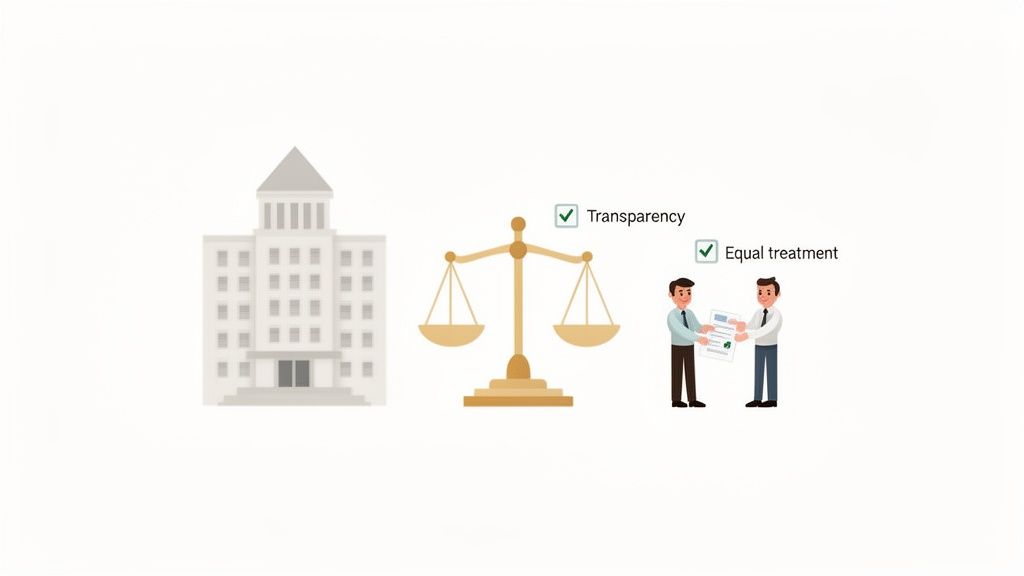
At their heart, all public procurement procedures are about fairness and openness. They ensure every potential supplier has a real chance, no matter their size. The main pillars are:
- Transparency: All opportunities have to be advertised publicly. The decision-making process must be clear, documented, and open to scrutiny.
- Equal Treatment: Every bidder must be treated exactly the same. You can't give one company extra information or an advantage over another.
- Non-Discrimination: The process must never discriminate against suppliers based on their location within the UK.
- Proportionality: The demands of the tender must fit the contract. A £10,000 contract shouldn't have the same paperwork as a £10 million one.
These aren't just vague ideas. They're legally enforceable rules that dictate how every tender is structured, evaluated, and awarded. Getting to grips with them is the real starting line.
A Market Ripe for New Suppliers
The UK public sector is a massive opportunity. In the 2024/25 fiscal year, it spent £249 billion on procurement. But only 10% of that went to the largest suppliers, and their share is shrinking.
The government is actively breaking up huge contracts. This opens the door for SMEs to compete for smaller, more manageable pieces of work. You can look at the data yourself over on Tussell.com.
This is where Bidwell's tender monitoring is so valuable. Our platform scans key portals daily so you don't miss a relevant opportunity. We find the right tenders for you, so you can focus your energy on winning them.
For a good introduction, this guide on What Is Tendering and How to Win Government Contracts in Australia breaks down the process. You can also read our detailed article on what is public procurement.
The Legal Framework: What You Actually Need to Know
To get anywhere with public procurement in the UK, you have to understand the rules. You don't need a law degree. But you do need to know the basic framework that dictates how buyers must behave.
Right now, the most important piece is the Procurement Act 2023. This is a major shake-up, designed to remove complexity and make the system simpler.
A huge part of its mission is to level the playing field for small and medium-sized businesses (SMEs). For too long, public contracts have felt like a closed shop. The new Act is trying to fix that.
How the Procurement Act 2023 Changes Things
So, what does this mean in practice? The most immediate change is a single, central digital platform. All public contract notices will now be published in one place. That's a huge relief. No more bouncing between dozens of websites.
The Act also pushes buyers to break down huge contracts into smaller lots. This is great news for SMEs. It creates bite-sized chances to get a foot in the door and stops a few massive suppliers from scooping up all the work. It also ties into a growing focus on things like how social value is evaluated in public procurement.
At its heart, the Procurement Act is about shifting focus. It moves from just picking the cheapest option to finding what creates the most public good. A big part of that is helping more local and small businesses join the supply chain.
Why Financial Thresholds Matter
Another core concept you'll see is financial thresholds. These are value limits set by the government. If a contract's estimated worth is above a certain threshold, the buyer must follow the full, formal procurement procedures.
Contracts below these thresholds still have to be awarded fairly. But the process is usually much simpler and faster.
Knowing these numbers is vital. It tells you how complex a tender is likely to be. This helps you decide where to focus your bidding efforts. Bidwell's tender monitoring doesn't just flag an opportunity; it gives you the context, like contract value, so you know what kind of process you're looking at.
A New Era of Transparency and Data
The Procurement Act 2023 started on 24 February 2025, and it’s changing how data is shared. Early figures from March to May 2025 show big shifts. Below-threshold contracts and direct awards are now logged on the new central platform.
The proportion of direct awards, for example, climbed from 15% in March to 24% by May. The Act also increased data collection, expanding the number of fields by 143 to 551. This adds new details on everything from SME suitability to social value.
Navigating the financial compliance side is critical. Getting it wrong can disqualify a perfect bid. Tools like an AI Finance Compliance Advisor can help check that every regulation is met, minimising the risk of costly errors.
Understanding Different Procurement Procedures
Not all tenders are the same. Public bodies use different procedures depending on what they're buying. You’ll need to adapt your approach for each one.
The route a buyer chooses depends on the contract's complexity, value, and nature. Knowing the difference is vital. It tells you whether you're in for a one-stage sprint or a two-stage marathon, which helps you plan.
The Open Procedure: Straightforward and Direct
The Open Procedure is the most common and simplest route. It’s a single-stage process. Any interested supplier can respond to the contract notice and submit a full tender right away.
This procedure is used for standard goods or services where the requirements are clear. For example, a council buying 50 new laptops would likely use the Open Procedure.
It’s your most direct shot at a contract. You find the opportunity, write your bid, and submit it. This is where having your company information properly organised is a massive advantage. With Bidwell’s knowledge base, you can quickly pull in standard responses, saving you time.
The Restricted Procedure: A Two-Stage Process
The Restricted Procedure is a two-stage process. First, you complete a Selection Questionnaire (SQ). This is where the buyer checks your financial stability, experience, and technical ability.
Only the suppliers who pass this check—usually a shortlist of at least five—are invited to submit a full tender. This process is used when lots of suppliers are expected to be interested. A major hospital procuring a new IT system would probably go this route.
Competitive Procedures with Negotiation
Sometimes, a buyer knows their problem but isn't sure of the best solution. This is where the Competitive Procedure with Negotiation comes in. It's used for complex projects like large-scale construction or specialised software.
It starts with a selection stage. Shortlisted bidders then submit an initial tender, which becomes the basis for negotiation. The buyer discusses and refines the proposals with bidders before asking for final tenders.
This procedure is a dialogue. It gives you a chance to showcase your expertise and co-create a solution with the buyer. This can be a huge advantage if you have an innovative approach.
Here's a quick comparison of the most common procedures.
UK Public Procurement Procedures at a Glance
This table breaks down the key features of each procedure.
| Procedure Type | Who Can Bid? | Key Feature | Best For |
|---|---|---|---|
| Open | Anyone | Single stage – full tender from the start | Standard, well-defined goods and services. |
| Restricted | Anyone (initially), then a shortlist | Two stages – SQ followed by ITT for the best candidates | Projects where many bidders are expected and capability needs checking. |
| Competitive with Negotiation | Anyone (initially), then a shortlist | Dialogue with shortlisted bidders to refine solutions | Complex projects where the buyer needs supplier expertise. |
| Framework/DPS | Anyone can apply (at the start for Frameworks, anytime for DPS) | A pre-approved list of suppliers for future work | Recurring needs for goods or services over a longer period. |
Understanding these differences helps you decide where to focus.
Framework Agreements and Dynamic Purchasing Systems
Framework Agreements and Dynamic Purchasing Systems (DPS) are critical to understand. They are umbrella agreements with a group of pre-approved suppliers.
Framework Agreements: Think of these as a catalogue of approved suppliers for a specific type of work over a set period (usually up to four years). Once on the framework, you can be awarded contracts through 'call-offs' without the full tender process each time. For more detail, you can learn all about what a framework agreement is in our guide.
Dynamic Purchasing Systems (DPS): A DPS is similar but more flexible. It’s an electronic system for common goods, and unlike a framework, suppliers can join at any time.
Finding these opportunities is the first challenge. Bidwell’s tender monitoring service tracks all these types. It alerts you to new frameworks and DPSs so you can get pre-qualified. Then, when it’s time to bid, our AI response generation helps you create tailored proposals quickly.
Navigating the Tendering Process Step by Step
Understanding the routes is one thing; navigating the process is another. Every tender follows a predictable path from advertisement to award. Getting this journey right is about methodical, organised execution.
Let's break down the key stages. Missing a single detail can get your bid disqualified before it’s even read.
Stage 1: The Contract Notice and Finding Opportunities
It all begins with an advert. A public body decides it needs something and publishes a contract notice. These are posted on portals like Find a Tender Service (FTS) and Contracts Finder.
This is your starting pistol. These notices contain the crucial details: who the buyer is, what they want, and the deadlines. Manually tracking every portal for the right fit is a full-time job.
This is why Bidwell's tender monitoring is so essential. We scan all the major UK portals and send you daily alerts with AI-summarised opportunities. You stop searching and start bidding.
Stage 2: The Selection Questionnaire (SQ)
Once you've found a tender, your first task is usually the Selection Questionnaire (SQ). This isn't about your price or solution yet. It’s about proving you are a credible supplier.
The SQ is a hurdle you have to clear. Expect questions covering:
- Company Information: Your registration details and accounts.
- Financial Standing: Evidence you're stable enough to deliver the contract.
- Technical Ability: Proof of your experience, including case studies.
- Compliance: Confirmation you adhere to laws on health and safety and equality.
This stage filters out any businesses that don’t meet the minimum requirements. It’s a box-ticking exercise, but a critical one. A single missing document can mean an early exit.
Stage 3: The Invitation to Tender (ITT)
If you pass the SQ, you'll receive the Invitation to Tender (ITT). This is the main event. The ITT document contains everything you need to build your proposal. It will detail the buyer's requirements and the evaluation criteria.
The evaluation criteria tell you exactly how your bid will be scored. It’s usually a mix of price and quality, often weighted. For instance, a bid might be scored 60% on quality and 40% on price. Your job is to answer every question and hit every point in the specification.
This is where your bid strategy comes to life. You’re no longer just proving you can do the work. You’re explaining how you will deliver outstanding value.
This infographic shows how the most common procurement procedures flow.
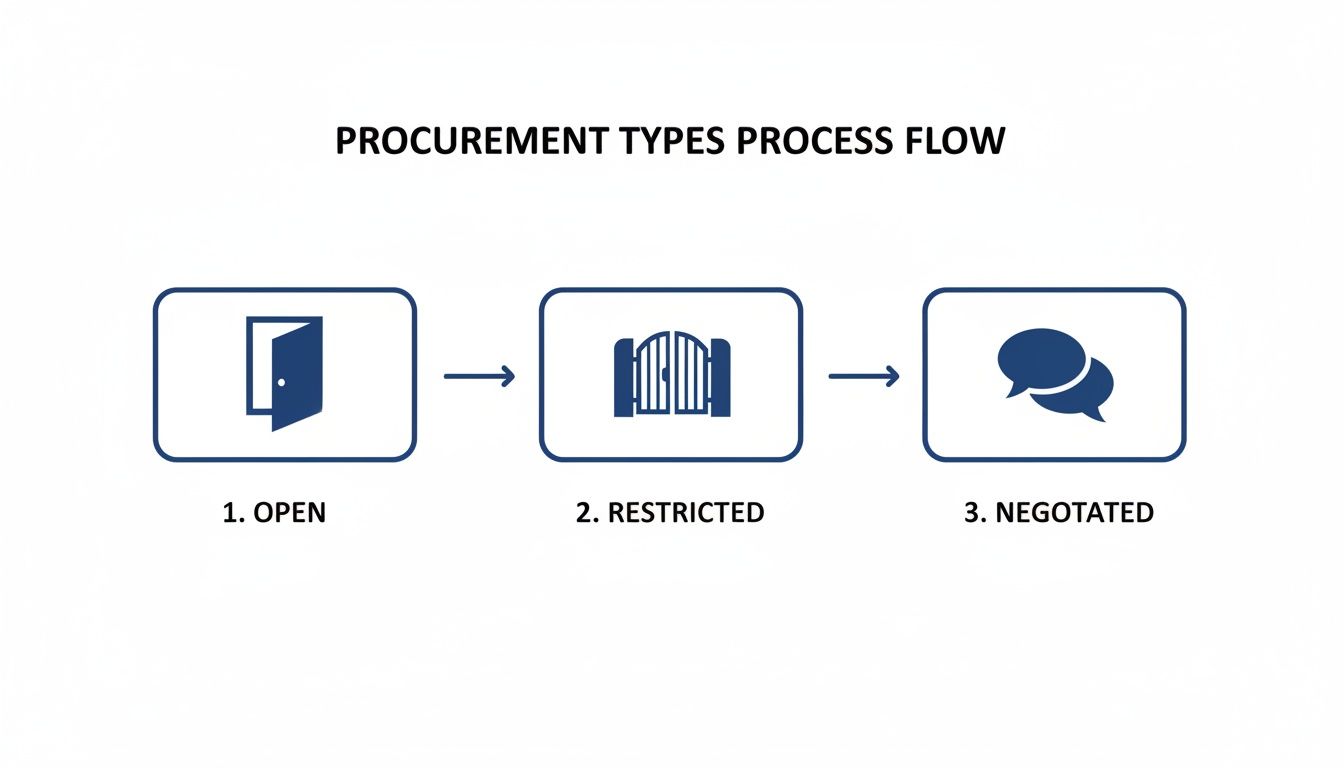
As you can see, the Open route is a direct path. Others like the Restricted route involve extra steps to filter suppliers.
This is where an organised Bidwell knowledge base becomes your secret weapon. Instead of writing every policy and case study from scratch, you can pull pre-approved content directly into your response. This frees up your team to focus on tailoring the proposal.
Stage 4: Evaluation and Award
After the deadline, the buyer's evaluation panel gets to work. They score each bid strictly against the published criteria. They can't introduce new criteria or show favouritism.
Once the scores are finalised, the buyer identifies the winning bid. They then issue award notification letters to all bidders, informing them of the outcome.
Stage 5: The Standstill Period
If you get an unsuccessful bidder letter, you’re entitled to feedback. For higher-value contracts, there's a mandatory 10-day "Standstill Period" between the award notice and the final contract signing.
This gives unsuccessful bidders a chance to review the decision. If they believe the rules were broken, they can legally challenge the outcome. It's a final layer of transparency.
Common Bidding Mistakes and How to Avoid Them
Winning public contracts is often about being ridiculously reliable. I’ve seen countless good businesses fail because of simple, preventable mistakes. It’s a gut-wrenching way to lose work.
The first step to winning more is knowing how you can lose. From missing a deadline to submitting a generic proposal, these errors get bids thrown out.
Let’s walk through the most common blunders and how to sidestep them.
Missing the Submission Deadline
It sounds obvious, but this is the most common and brutal mistake. Procurement portals are automated. If the deadline is 12:00, submitting at 12:01 means you’re out. No exceptions.
The fix is simple: work backwards from the deadline. Plan to submit at least 24 hours before the cut-off. That buffer saves you from last-minute technical glitches.
Failing to Answer Every Single Question
Evaluators don't have time to be detectives. They use a rigid marking sheet. If a question is left blank or answered with "see attached," you’ll score a zero for that section.
This is where Bidwell’s AI response generation makes a huge difference. The AI doesn’t skim-read. It scans the tender and generates a first draft that addresses every requirement. This turns a potential failure into a complete response, ready for your team to polish.
A half-answered bid is an automatic failure. Your job is to make the evaluator's life easy by giving them what they asked for, where they expect to find it.
Submitting a Generic, One-Size-Fits-All Proposal
Buyers can spot a generic proposal a mile off. It shows you haven’t bothered to understand their specific problems. They don’t want your marketing brochure; they want to know what you can do for them.
Your bid must feel like it was written just for them. Use their language and show you've done your homework. This is where an organised Bidwell knowledge base is so useful. It stores all your best content, which the AI then uses to craft a draft that is focused on the tender.
Making Unsubstantiated Claims
Saying you're "the leading provider" is just noise. It means nothing without proof. Every claim you make needs evidence. If you say you improve efficiency, show the numbers.
- Weak Claim: "We provide high-quality customer support."
- Strong Claim: "We provide 24/7 customer support with a 98% satisfaction rating, as measured by our last 12 monthly client surveys."
Your bid should be packed with facts and figures. This builds the credibility that gives the evaluator confidence you can deliver.
Ignoring New Data Transparency Rules
Since the Procurement Act started in February 2025, the game has changed. The UK has a central platform with huge insight into public spending. Ignoring this intelligence is a massive strategic error.
You can get more details on how the new rules are shaping the public sector procurement landscape on TechUK's site.
This data helps you understand what a buyer cares about. A tender monitoring service like Bidwell plugs into this intelligence. It ensures you’re not just finding opportunities, but understanding the context behind them.
Building Your Winning Bid Strategy
So, how do you go from understanding procedures to winning contracts? It’s about building a smart strategy, not just reacting to tenders. A winning approach is organised and efficient.
It all starts with finding the right opportunities. You can't win a tender you don't know about. This is where a service like Bidwell’s tender monitoring is crucial. You get a daily, AI-summarised list of relevant contracts sent to you.
Creating a Bid-Ready Foundation
The second pillar is being prepared before a tender lands. The worst time to gather your company's credentials and policies is when you're against a tight deadline.
This is why a centralised knowledge base is so important. By storing all your approved bidding content in one place, you create a single source of truth. When a new opportunity arrives, you’re not starting from scratch.
A proactive bid strategy means you spend time tailoring your proposal, not scrambling to find basic company information. It turns a chaotic process into a manageable workflow.
Using AI to Accelerate Your Response
Once you have a relevant opportunity and your content is organised, the final piece is speed. This is where AI changes your bidding operation. Instead of your team spending 20-40 hours writing a bid, you can generate a first draft in a couple of hours.
Bidwell’s AI response generation connects your knowledge base to the tender’s requirements. The AI reads the questions and crafts a response using your content. This frees up your experts to refine and strategise.
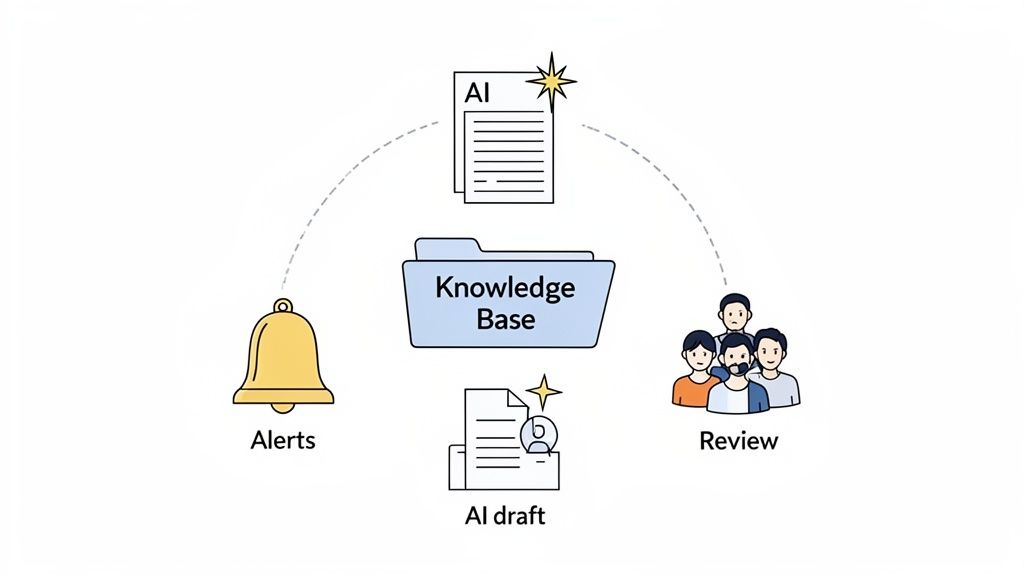
This three-step process creates a powerful system:
- Find the Best Tenders: Use automated monitoring so you don't miss an opportunity.
- Be Instantly Ready: Maintain a knowledge base so your content is at your fingertips.
- Respond in Hours: Use AI to create drafts quickly, giving your team more time for review.
This isn’t about replacing your team. It’s about giving them the right tools to win. It turns the complexity of public procurement into a business advantage.
Got Questions About Public Procurement?
Stepping into public procurement can feel like learning a new language. It’s normal to have questions. We’ve answered some of the most common ones we hear.
How Long Does the Procurement Process Usually Take?
There’s no single answer to this. A simple Request for Quotation (RFQ) might be done in a couple of weeks. But a complex, high-value tender using a multi-stage process could easily take six months or longer.
The good news is, you're never left guessing. The timeline is always in the tender documents. Your job is to find it and build your own internal schedule, with plenty of breathing room.
What is a Standstill Period and Why is it Important?
The Standstill Period is a mandatory 10-day pause. It happens after a buyer announces their decision but before they sign the contract. This is a legal requirement for higher-value contracts.
Think of it as a cooling-off period. It gives unsuccessful bidders a chance to ask for feedback. If they feel the rules weren't followed correctly, they can formally challenge the outcome. It's designed to keep everything transparent.
Can I Challenge a Procurement Decision if I Think it Was Unfair?
Yes, you can. If you believe a contracting authority has broken the rules, you have a legal right to challenge them.
The first move is to ask for a detailed debrief. Often, this clarifies things. If you still have serious concerns, you can launch a legal challenge. You have to be quick; this usually needs to happen during the Standstill Period. It's a big step, so get legal advice first.
The right to challenge is a cornerstone of UK public procurement. It holds public bodies to account, ensuring they apply the rules fairly for every bidder.
Keeping track of these moving parts is tricky. A platform like Bidwell is built to manage this. Our tender monitoring ensures you have the correct deadlines. The knowledge base helps you pull together answers quickly, and our AI response generation creates solid first drafts.
Stop searching and start winning. Bidwell finds the right public sector contracts and helps you write winning responses in a fraction of the time. Discover how our AI-powered platform can change your bidding process at https://bidwell.app.


