A Practical Guide to Public Sector Procurement Frameworks
Ever heard of public sector procurement frameworks? If you're trying to sell to government, you'll come across them a lot.
Think of them as a pre-approved list of suppliers. Public bodies use them to buy goods and services much faster. It avoids a full, costly tender process for every single purchase.
What Exactly Are Public Sector Procurement Frameworks?
A framework is a long-term agreement between public bodies and a group of suppliers. It sets out the terms and conditions for future purchases. These purchases are known as 'call-offs'.
It’s like getting into an exclusive club. Once you win a place, you can compete for work from any public body using that framework. You don't have to go through the full procurement process every time.
Imagine a local council needs new IT equipment. They can use a technology framework, like one run by the Crown Commercial Service (CCS). They simply invite the suppliers already on that list to bid.
For suppliers, especially Small and Medium-sized Enterprises (SMEs), this is a big advantage. It lowers the barrier to entry. It gives you a direct route to contract opportunities you might otherwise never see.
Why Are Frameworks So Common?
Public bodies use frameworks for a few practical reasons. They help deliver better value for money by pooling demand and getting competitive pricing. They also simplify the buying process, which is a massive help for busy procurement teams.
The main benefits for buyers are clear:
- Speed: Buying from a framework can cut procurement times from months to weeks.
- Lower Costs: The administrative work of running a full procurement is greatly reduced. This saves taxpayer money.
- Guaranteed Compliance: Every supplier on the list has already been checked for financial stability, quality standards, and legal compliance.
This pre-vetting means a buyer can act fast. They're confident they're choosing from a pool of capable and reliable businesses.
Finding the Right Framework Opportunities
Here’s the catch: you have to know which frameworks are open for applications. New ones are announced all the time. If you miss the window to apply, you could be locked out for up to four years.
You can't win a place on a framework you don't know about. The application window is often short, so being prepared is essential.
This is where Bidwell’s tender monitoring is so useful. We track all the major UK portals and send you alerts for relevant framework opportunities. It means you never miss a chance to get your business onto these valuable lists.
The next step is having your company information ready to go. You need to move quickly when the right opportunity appears. We'll cover that later.
Understanding the Different Types of UK Frameworks
You'll see the term “procurement framework” pop up everywhere in public sector work. But not all frameworks are the same. Knowing the difference helps you target the right ones for your business.
The basic idea is simple. A public sector body creates a pre-approved list of suppliers they can buy from. This speeds things up and means they work with vetted companies.
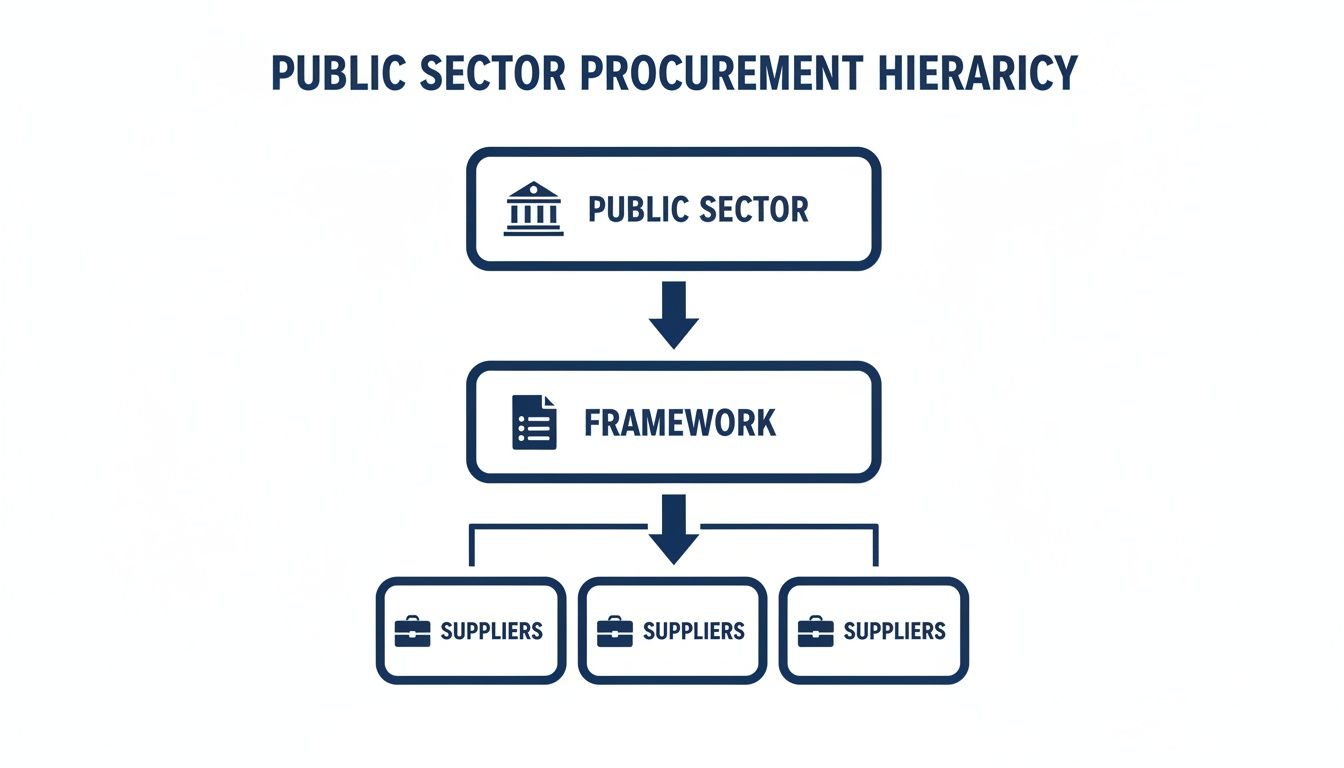
For you, it means passing one big test to get on that list. Once you're on, you can compete for smaller contracts without repeating the full procurement process. Here's a quick rundown of the most common types.
Key UK Framework Types at a Glance
| Framework Type | What It Is | Best For Suppliers Who... | How to Join |
|---|---|---|---|
| National Frameworks (e.g., CCS) | Large-scale agreements for common goods/services across the entire public sector. | Can operate at a national level and handle high volumes of work. | Apply during a fixed window when the framework is created or renewed (typically every 4 years). |
| Dynamic Purchasing System (DPS) | An 'approved list' for common purchases that suppliers can join at any time. | Are SMEs or growing businesses that need more flexibility than fixed-term frameworks offer. | Meet the selection criteria and apply to join the electronic system at any point during its lifetime. |
| Regional Consortiums (e.g., NEPO) | A group of local authorities or public bodies team up to buy goods/services together. | Have a strong regional focus and want to build relationships with local buyers. | Apply when the consortium opens the framework, similar to national frameworks but on a smaller scale. |
Each type offers a different route to market. Choosing the right one depends on your business's size, specialism, and where you want to work.
National Frameworks and the Crown Commercial Service
The biggest players are the national frameworks. The most dominant is the Crown Commercial Service (CCS). CCS acts as the central buying organisation for the UK public sector. They arrange huge agreements for things everyone needs, from cloud hosting to temporary staff.
Getting onto a CCS framework is a big deal. It gives you a direct line to a massive market, including central government, local authorities, and the NHS. For instance, the Technology Services 3 (RM6100) framework is used by thousands of public bodies.
The catch? These frameworks often run for a fixed term, usually four years. Competition for a spot is intense. If you miss the application window, you have to wait until it's renewed.
Dynamic Purchasing Systems
A Dynamic Purchasing System (DPS) is much more flexible. Unlike a rigid framework, a DPS stays open for new businesses to join at any point. This is ideal for SMEs who weren't ready to apply when a standard framework first launched.
A DPS is an electronic system for buying common goods and services. It's an 'approved supplier list' you can join whenever you're ready, as long as you meet the basic criteria.
A local council might run a DPS for electrical contractors. Any qualified electrician can apply to join at any time. When the council needs a small job done, they’ll invite everyone on the DPS to bid.
This flexibility is a massive plus, but you still need to watch for opportunities. If this sounds like a good fit, learn more about what a dynamic purchasing system is.
Regional and Local Consortium Frameworks
Not every framework is national. Many are set up by groups of public bodies, like local authorities or universities. These are known as consortium frameworks.
They're a great route to market if your business is regionally focused. Well-known examples include:
- ESPO: A purchasing body owned by six local authorities in the Midlands.
- NEPO (North East Procurement Organisation): Serves twelve local authorities in the North East.
- Fusion21: Specialises in procurement for the social housing sector.
These agreements cover everything from building maintenance to professional services on a local scale. They offer a fantastic chance to build strong relationships with buyers in your area.
How to Get Your Business onto a Framework
Getting your business onto a public sector framework is the first big hurdle. It’s less about a creative sales pitch and more about proving your business is stable and compliant. The process is competitive, but it’s achievable if you’re prepared.
Think of it as applying for a high-stakes business licence. The buying authority needs to see you’re a safe pair of hands. This means having all your company information, policies, and evidence organised and ready to go.
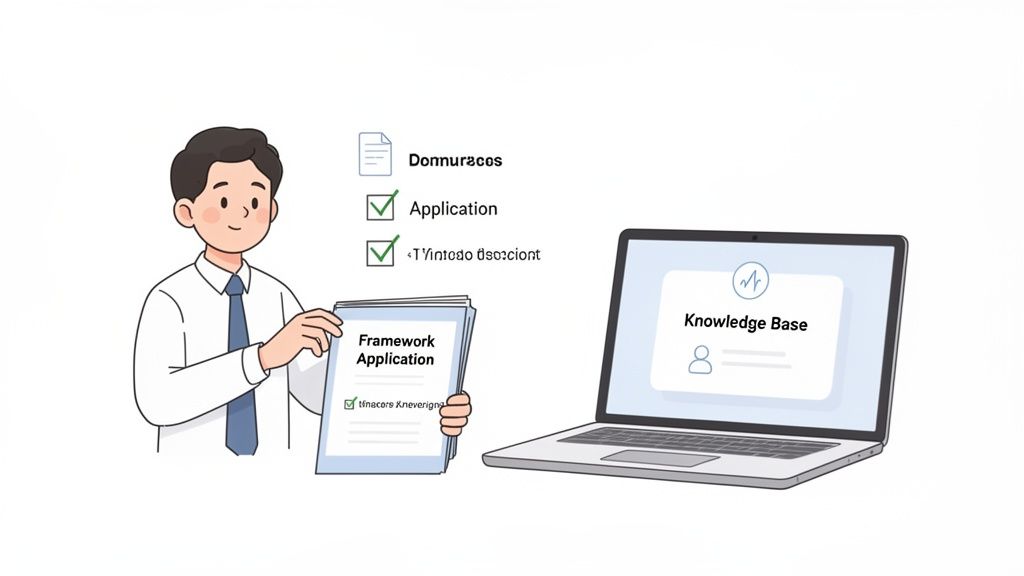
The application is usually a Pre-Qualification Questionnaire (PQQ) or Selection Questionnaire (SQ). This is a standard form used to filter out businesses that don't meet the minimum requirements.
Finding the Right Opportunities
You can’t apply for a framework you don’t know exists. First, you must actively monitor for new framework notices. These opportunities appear on portals like Contracts Finder and Find a Tender, but they're easy to miss.
This is where Bidwell's tender monitoring helps. It scans these portals for you and sends alerts for opportunities that match your business profile. You hear about them right away, giving you maximum time to prepare a quality submission.
Remember, most frameworks only open for applications every few years. Missing the deadline means you're locked out of all potential work until it's renewed. That could be up to four years away.
Preparing Your Core Information
Once you've spotted a framework, the real work begins. The application will ask for a lot of information about your business. To get on the list, you need a good grasp of public sector requirements, including compliance and risk assessment.
You’ll typically need to provide:
- Company Details: Registration number, VAT number, and address.
- Financial Standing: Several years of audited accounts.
- Insurance: Proof of public liability, employer's liability, and professional indemnity cover.
- Policies and Accreditations: Your health and safety policy, quality certificates (like ISO 9001), and environmental policies.
- Case Studies: At least three recent, relevant examples of similar work.
Gathering this information can be a huge time-drain. It’s a common reason why many SMEs give up halfway through an application.
The Power of a Centralised Knowledge Base
This is where having a central spot for your bidding information makes a massive difference. Bidwell’s Knowledge Base is designed for exactly this. You can store all your policies, certificates, case studies, and standard answers in one organised, searchable place.
When a framework opportunity appears, you don't waste days hunting for documents. You can pull everything you need from your Knowledge Base in minutes. This saves a huge amount of time and keeps your answers consistent. Learn more about these initial stages in our guide to pre-qualification questionnaires.
By getting organised, you turn a frantic search into a structured process. This frees you up to focus on tailoring your answers and proving you're the right choice.
What Happens After You're on a Framework?
Right, you’ve done the hard work and landed a spot on a public sector framework. So… now what?
Getting listed is a huge win, but it doesn't mean contracts will automatically start rolling in. Think of it less as a guaranteed job and more as a licence to compete. You're now on a pre-approved shortlist.
Your next job is to turn that prime position into actual, paying projects. The good news is that the procurement marathon is now a sprint. You’ve already cleared the main hurdles, so buyers know you’re a capable, compliant business.
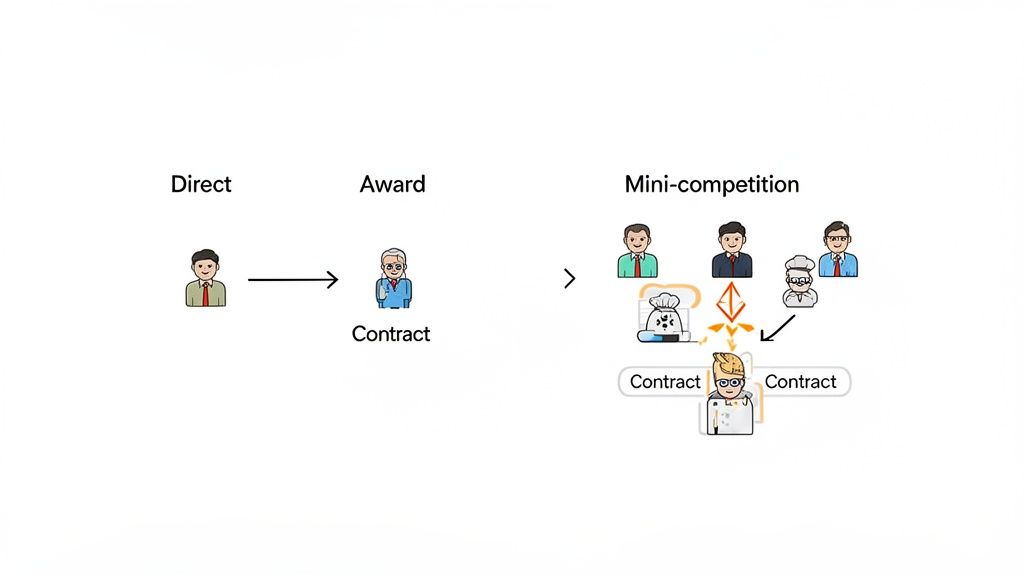
Once you're on a framework, work comes in two main forms: direct awards and mini-competitions. Understanding how each works is key to winning your share.
Direct Awards: The Quickest Route to a Contract
A direct award is just what it sounds like. A public body can pick a single supplier from the framework list and give them the contract directly. No further competition is needed.
This usually happens when one supplier’s price or service is obviously the best fit. The framework agreement will have clear rules on when a direct award is allowed.
What does this mean for you? Your pricing and capabilities must be sharp and clearly defined from day one. If a buyer can see you offer the best value based on the pre-agreed terms, you could win work with very little extra effort.
Winning Mini-Competitions: The Main Event
Most of the time, work is handed out via a mini-competition. The buyer invites all relevant suppliers on the framework to submit a scaled-down proposal for a specific project. It’s a tender, but only for the exclusive club you just joined.
This is where you need to be at your best. You're not up against the whole market anymore, just the other businesses on the framework. You’ll need to send back a proposal explaining how you’ll deliver, what it will cost, and why you’re the best choice.
The key here is speed and quality. The turnarounds are often quick—sometimes just a week or two. You've got to be ready to produce a sharp, compelling response at short notice.
This is where preparation really pays off. Having a well-organised library of your best content—case studies, team CVs, technical answers—is essential.
This is exactly what Bidwell’s platform is built to handle. Your Knowledge Base acts as your central library, storing that crucial information. For preparing bids, precise estimating tools can be a lifesaver, particularly for things like fixtures and equipment, where services like Exayard FFE procurement estimating come in handy.
When a mini-competition lands, our AI Response Generation tool can use your Knowledge Base to produce a high-quality draft in hours, not days. This lets your team focus on refining the proposal and tailoring it to the buyer's needs. For more advice on this, check out our guide on how to write a tender bid.
The Pros and Cons of Frameworks for SMEs
Public sector frameworks can be a great route to market, but they’re not right for every business. It’s worth looking at the good and the bad before you invest your time. A little strategy now can save you a lot of wasted effort.
Let’s be clear: getting on a framework is just the start. It guarantees you nothing. Think of it as earning a spot on the starting line; you still have to run the race to win.
The Major Benefits for SMEs
For many small businesses, the upside of joining a framework is huge. They can open doors that would otherwise be firmly shut.
The most obvious win is a more predictable pipeline of work. Once you’re on the list, you get invited to bid on relevant contracts through mini-competitions. You’re competing against a much smaller, pre-vetted group of suppliers.
Other key advantages include:
- Shorter Procurement Times: Mini-competitions are far quicker than full tenders. You spend less time bidding and get a decision in weeks, not months.
- Reduced Bidding Costs: You’ve already done the hard work to get on the framework. The effort for each mini-competition is lower.
- Increased Credibility: Being an approved supplier on a government framework is a powerful stamp of approval. It's something you can use in your marketing.
The Potential Drawbacks to Consider
It’s not all smooth sailing. Frameworks have their own challenges.
The biggest issue is the lack of guaranteed work. You can spend months getting onto a framework only to find it's very quiet. There’s a real risk of putting in a massive amount of effort for zero return.
Another big hurdle is competition. Price often becomes the deciding factor in mini-competitions. If you can’t operate on thin margins, you might find it tough to win.
Pros and Cons of Joining a Framework
For SMEs weighing up the opportunity, it helps to see the pros and cons side-by-side.
| Potential Benefits | Potential Drawbacks |
|---|---|
| Access to a steady stream of pre-qualified opportunities. | No guarantee of work, even after a lengthy application. |
| Reduced bidding costs and time for each mini-competition. | Intense price competition can squeeze profit margins. |
| Increased credibility and market visibility. | Frameworks can be dominated by a few incumbent suppliers. |
| Simpler, standardised procurement processes. | The initial application process can be complex and resource-heavy. |
| Builds a track record in the public sector. | Low call-off volume can mean a poor return on investment. |
The decision to pursue a framework should be a calculated one. It depends on your capacity, your pricing model, and your tolerance for risk.
You might be one of twenty or more suppliers on a single lot. To succeed, you need an efficient way to handle a higher volume of smaller bids without sacrificing quality.
This is where your internal processes make all the difference. Having your case studies and company info in a Knowledge Base means you're always prepared. Using AI Response Generation to create a solid first draft lets your team respond to more mini-competitions, increasing your odds of winning.
The UK public sector market is enormous, with the government spending around £385 billion every year. The Procurement Act 2023 is designed to open this market up. Top strategic suppliers now receive just 10% of the total spend, showing there's more opportunity for SMEs than ever. You can see this from the government's plans for growing British industry and skills.
Common Framework Mistakes to Avoid
Getting onto a public sector framework is a big win. But too many businesses secure their spot and then wonder why no work comes through. It usually comes down to a few predictable mistakes.
The biggest mistake? Treating every framework the same. A scattergun approach stretches your team thin and leads to weak, generic bids.
It’s far better to be selective. Pick a handful of frameworks that are a perfect match for what you do. One great, focused application is worth ten half-hearted attempts. Tender monitoring helps here by cutting through the noise and showing you only the right opportunities.
Forgetting the 'Who' Behind the 'What'
Another common trap is thinking your job is done once you’re on the list. Many suppliers just sit back and wait. This is too passive. Your competitors are out there building relationships with the contracting authorities.
Buyers are people. People prefer to work with suppliers they know and trust.
Don't just be a name on a list. Go to 'meet the supplier' events. Ask smart questions. That kind of visibility makes a huge difference when buyers are deciding who gets the work.
Building these relationships takes time. You can only find that time by making other parts of your process more efficient. When you use AI Response Generation to draft a bid, you get back hours that are better spent on networking.
Sending the Same Bid to Everyone
Finally, the most common mistake in mini-competitions is the copy-and-paste response. Buyers can spot a boilerplate answer a mile off. It shows you haven’t really read their requirements.
Every mini-competition is a fresh chance to prove your worth. You have to tailor your response to the project in front of you. Show you understand what they’re trying to achieve.
This is where being organised is your secret weapon. Using a central Knowledge Base means all your best content is ready to go. You can grab the right building blocks quickly and spend your time tailoring the bid.
Got Questions? We've Got Answers
We've covered a lot, but a few questions always come up. Here are the most common ones we hear.
How Long Does a Framework Actually Last?
Most UK frameworks run for a maximum of four years. You might see some for two years with an option to extend, but four years is the general rule.
When the framework expires, it’s usually re-procured. You have to go through the whole tender process again to get back on. Bidwell’s tender monitoring gives you a heads-up when a framework you rely on is up for renewal.
Is There a Limit on How Many Suppliers Get On?
Yes, for most standard frameworks, there is. The tender documents will state the number of suppliers they plan to appoint. This keeps the list manageable for the buyer.
The big exception is a Dynamic Purchasing System (DPS). A DPS stays open for new suppliers to join at any point during its life, as long as you meet the minimum standards. They’re a great route for SMEs.
If I'm Not on a Framework, Am I Locked Out of Public Contracts?
Not at all. Frameworks are a huge part of the market, but not the only part. Plenty of contracts are procured as one-off, standalone tenders on portals like Contracts Finder.
Missing out on a framework doesn’t exclude you from public sector work. The trick is to have a complete picture of the market. A good monitoring tool will track both framework opportunities and individual contract notices.
Winning work through public sector frameworks isn't about luck. It's about having an organised and efficient process. From spotting opportunities with Bidwell's tender monitoring, to building bids with our Knowledge Base and drafting responses with our AI, we give you the tools to compete and win.
See how Bidwell can help you secure your spot on more frameworks.