
A Guide to UK Public Sector Procurement Regulations
Public sector procurement is governed by a set of rules. Government bodies have to follow them when they buy anything, from paperclips to new hospitals. Think of it as the official playbook for a market worth over £300 billion a year in the UK. The point of these rules is to keep the process fair, open, and deliver real value for taxpayers' money.
Understanding UK Procurement Regulations
When a local council needs to build a school, they can't just ring up their favourite supplier. They have to follow a structured, legally-binding process. That’s what public sector procurement regulations are all about.
These regulations are designed to give your business a fair shot at winning contracts, no matter your size. They exist to stamp out corruption and favouritism. For you, it means the winning bid should be the one offering the best value, not the one from the best-connected company.
The Core Principles Driving The Rules
The entire system is built on a few simple ideas. You’ll see these principles in every tender document you come across. Getting your head around them helps you understand why the process is set up the way it is.
The main principles are:
- Equal Treatment: All bidders must be treated exactly the same. A buyer can't give one company extra information unless they offer it to everyone.
- Transparency: The process must be open and clear from start to finish. Buyers have to publish contract opportunities and spell out exactly how they will evaluate bids.
- Proportionality: Tender requirements have to be relevant and reasonable. A buyer can't ask a small catering company for £10 million in public liability insurance for a one-off event.
These rules aren't just red tape. They are the bedrock of a competitive market, creating a level playing field where SMEs can compete with larger corporations.
The scale here is enormous. In 2023-24, UK government procurement from the private sector hit £341 billion. That's 32% of all public spending. For businesses looking to navigate these complex rules, exploring regulatory compliance solutions is a smart move.
This is where Bidwell helps. Our tender monitoring service makes sure you never miss an opportunity. Our knowledge base gets all your compliance documents organised, and our AI response generation tool helps you build bids that speak to these core principles.
The Procurement Act 2023 is Coming. Here’s What You Need to Know.
Big changes are on the horizon for anyone bidding on UK public sector contracts. The new Procurement Act 2023 is set to replace the old rulebook. The point is to create a simpler, more flexible, and more open system.
For businesses, especially small and medium-sized enterprises (SMEs), this is a big deal. The Act has been designed to make it easier for you to compete for and win public contracts.
So, what does this mean for your day-to-day bidding? Let's break down the key shifts.
A Fresh Set of Guiding Objectives
The old rules were incredibly prescriptive. They were about following a rigid, multi-step process. The new Act flips this by introducing a set of guiding objectives that buyers must consider. This moves the focus from just following rules to achieving better outcomes.
These objectives include:
- Delivering public benefit: Buyers now have to think about how a contract will benefit society and the environment. It’s no longer just about the price tag.
- Maximising value for money: This is still crucial, but it's now seen in a broader sense than just the lowest price. It includes quality, innovation, and whole-life cost.
- Acting with integrity: This doubles down on the need for fairness, transparency, and ethical behaviour.
- Sharing information: The Act aims to make contract data far more accessible. This will help you see what’s been bought before and from whom.
This shift means your bids need to do more than just meet a technical spec. You need to tell a story about the wider value you bring. Using Bidwell's knowledge base, you can store proof of your social value initiatives and case studies, making it simple to pull this information straight into your responses.
Introducing the Competitive Flexible Procedure
One of the most practical changes is a new procurement route called the 'competitive flexible procedure'. This one procedure replaces a whole raft of old, clunky ones.
For you, this means buyers have more freedom to design a tender process that fits the contract. They can negotiate with bidders or run multi-stage competitions. It’s far less of a one-size-fits-all approach.
This new flexibility can be a huge advantage for SMEs. It gives you a better platform to showcase your expertise and innovative ideas in a more dynamic way.
For instance, a buyer could hold an initial round to shortlist suppliers, then invite them to demonstrate a prototype. Keeping on top of these varied processes is vital. Bidwell's tender monitoring AI-powered alerts and summaries will clearly outline the specific procedure for each new opportunity, so you always know what’s coming.
A Central Platform and Easier Bidding
A major headache under the old system was the mess of different portals and inconsistent data. The new Act brings in a single central digital platform for all procurement notices. This will be the one-stop shop for finding opportunities.
This centralisation makes the whole market much more accessible. It will be easier to see upcoming pipelines and find out who won past contracts. All this transparency helps you make smarter choices about which tenders are worth your time.
The Procurement Act 2023, scheduled to go live on 24 February 2025, specifically aims to help SMEs compete for a slice of the £300 billion annual public spend. For example, it mandates that buyers assess suitability throughout the contract lifecycle. This could mean you only need to show proof of certain insurance levels when you win, not just to submit a bid. You can explore more on these efficiency measures with insights from the National Audit Office.
That change alone cuts the upfront cost and risk of bidding. Our AI response generation tool is built to adapt to these new requirements, making sure your bids are compliant and compelling from day one.
Understanding Procurement Thresholds And Procedures
Not all public contracts are created equal. The most important factor determining the rules is the contract's estimated value.
Think of it like weight classes in boxing; the bigger the prize, the more stringent the rules. This value is known as the procurement threshold.
If a contract’s value is above the threshold, it triggers more formal, complex procedures. These big-ticket opportunities have to be advertised UK-wide and follow strict processes. If the value is below the threshold, buyers can use simpler, quicker methods.
What Are The Current Thresholds?
These thresholds are updated every two years to account for currency fluctuations. They also vary depending on who’s buying (central government or other public bodies) and what they’re buying (goods, services, or works).
Here's a simplified guide to the current VAT-exclusive thresholds you need to know.
Key UK Public Procurement Thresholds
This table breaks down the key contract value thresholds that dictate which set of procurement rules a buyer must follow. All values are shown exclusive of VAT.
| Type of Contract | Central Government Threshold | Other Public Sector Bodies Threshold |
|---|---|---|
| Goods & Services | £139,688 | £214,904 |
| Works | £5,372,609 | £5,372,609 |
| Social & Other Specific Services | £663,540 | £663,540 |
Knowing these numbers is vital. For example, a services contract worth £210,000 from a local council falls below their £214,904 threshold, meaning a simpler process. But that same contract from central government would be above its £139,688 threshold, triggering the full, formal procedure.
Spotting these details in a tender notice can feel like finding a needle in a haystack. This is what Bidwell's tender monitoring is for. Our AI-powered summaries pull the contract value right to the top, so you can see instantly if a tender fits your strategy.
Navigating Different Procurement Procedures
Once you know whether a contract is above or below the threshold, you need to understand the specific procedure the buyer is using. This dictates the timeline, the documents you need, and how you’ll be evaluated.
This flowchart shows how the new Procurement Act organises these procedures around its core principles.
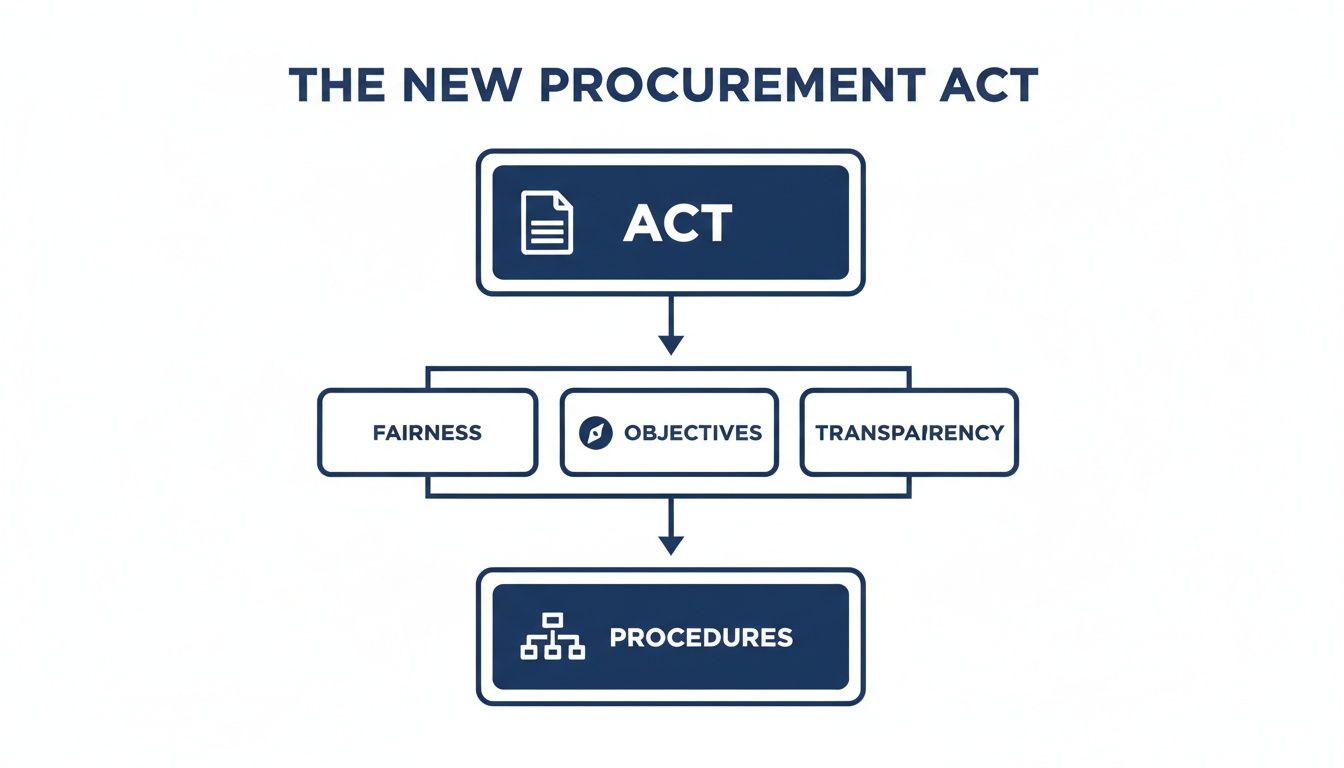
As you can see, everything flows from overarching goals like fairness and transparency.
Under the new Act, things are much simpler. The main route you'll see for above-threshold contracts is the Competitive Flexible Procedure. This gives buyers a huge amount of freedom to design a process that fits what they need.
They might ask for an initial submission and then invite shortlisted bidders to present their solution. Or they might enter into negotiations. You’ll also still see the straightforward Open Procedure, where anyone can submit a full tender in one go.
Understanding the chosen procedure is half the battle. It tells you how much time and effort a bid will demand, helping you decide if it's a good use of your resources.
For lower-value, below-threshold contracts, buyers often use a simpler Request for Quotation (RFQ) process. They might invite three or more suppliers to provide a price. If you want to find out more, you can learn more about how framework agreements work in our detailed guide.
No matter the procedure, having your company information ready is critical. Bidwell’s knowledge base acts as your central library. When a tender with a tight deadline appears, our AI response generation tool uses this organised information to build a high-quality first draft.
Avoiding Common Pitfalls in Public Tenders
Winning a public contract is about dodging easy mistakes as much as writing a brilliant bid. Too many businesses trip up on compliance hurdles that knock them out of the race before their proposal is even read.
Think of it like an obstacle course. There are specific hurdles you must clear. Clip just one, and you can be instantly disqualified. These aren't suggestions; they are rigid rules.
Misinterpreting the Tender Specification
One of the most common errors is not answering the question that's been asked. Buyers spend a long time writing a specification to describe exactly what they need. If you submit a proposal for something different, you're likely to be marked as non-compliant.
It’s crucial to read every document, every appendix, and every clarification. Don't skim. If a buyer asks for a service to be delivered within a 10-mile radius and you propose a 15-mile radius, you've failed that part of the test.
It sounds basic, but this is where bids fall apart. The buyer has a checklist, and your submission has to tick every single box.
This is where a central store of information becomes your best defence. Bidwell’s knowledge base lets you keep all your standard company information, policies, and certificates in one place. It ensures every answer you give is consistent and accurate.
The Perils of Poor Paperwork and Late Submissions
Public procurement runs on deadlines, and they are completely inflexible. Submitting your bid one minute past the deadline means it will not be considered. Portal clocks are unforgiving, and excuses like "my internet was slow" just don't work.
Filling out all the required forms correctly is just as critical. From the Selection Questionnaire to the pricing schedules, every field needs an answer. A blank box isn't just a missed detail; it can be grounds for immediate disqualification. Our guide on the Pre-Qualification Questionnaire is a useful start.
Here are a few common paperwork traps:
- Missing Signatures: Forgetting to sign a declaration form is an instant fail.
- Incorrect Formatting: Submitting a PDF when a Word document was requested can lead to rejection.
- Incomplete Pricing: Leaving lines blank in a pricing schedule can make your bid non-compliant.
Building a simple compliance checklist for every bid is a great habit. It forces you to double-check these small but critical details before you hit submit.
Underestimating Social Value and Other Requirements
It's no longer just about price and quality. Social value is now a mandatory consideration in all central government procurement, often accounting for 10% of the total score. You have to show how your company will deliver wider community benefits, like creating local jobs.
Simply saying "we're a good company" won't cut it. You need to provide specific, measurable commitments and back them up with solid evidence. This requires preparation and a clear understanding of what the buyer wants to achieve.
Bidwell’s knowledge base is perfect for organising your social value policies, case studies, and environmental certificates. When a tender asks for this evidence, our AI response generation tool can instantly pull that verified information into your draft.
The UK public procurement market is massive. Over the five years to 2022-23, spending grew by 22% in real terms to reach £393 billion. You can discover more about the scale of public spending and its economic impact and see why avoiding these pitfalls is so critical.
How To Prepare Your Business To Win Tenders
Winning a public contract rarely happens by chance. The businesses that consistently win are ‘bid-ready’ long before an opportunity exists. It’s about having your house in order, so you can move fast when the right contract goes live.
Being bid-ready is the difference between a panicked scramble and a calm, organised submission. It means you can pour your energy into writing a persuasive response rather than wrestling with admin under pressure.
Building Your Bid Library
First, create a central library for all the documents you'll need again and again. Think of it as your bid toolkit. When a tender asks for these standard files, you can grab them instantly.
This isn't just about speed; it's about professionalism. A well-kept bid library makes sure every submission uses the most up-to-date information, presenting a consistent image of your company every time.
Your essential document checklist should include:
- Company Accounts: Your last two or three years of audited accounts.
- Insurance Certificates: Up-to-date proof of your Public Liability and other key insurance.
- Key Policies: Your documented policies for Health and Safety, Quality Management, and Environmental Sustainability.
- Accreditations: Any certifications like ISO 9001 or Cyber Essentials.
This is what Bidwell's knowledge base is designed to handle. You can securely store all of these documents in one place. When a tender drops, the information is verified, current, and ready to go.
Proving Your Experience With Case Studies
Buyers don't just want to know what you can do; they want proof you've done it before. This is where a strong library of case studies becomes one of your most powerful bidding assets. They are hard evidence of your ability to deliver results.
Each case study should tell a short story: the client's problem, your solution, and the positive outcomes. Be specific and use numbers. Saying you "reduced operational costs by 15%" is much stronger than claiming you "made things more efficient".
A good case study demonstrates your problem-solving skills and gives a public sector buyer confidence in appointing you.
Start building this library now. After every successful project, take an hour to document it in a consistent format. When a tender asks for relevant experience, you can pick the perfect examples.
Setting Up Effective Tender Monitoring
You can't win a contract you don't know about. But manually checking multiple procurement portals is a huge drain on your time. It’s repetitive, and it’s easy to miss the perfect opportunity amongst all the noise. For more detail, see our complete guide to public sector tendering.
An automated system isn't a luxury; it's essential. This is where Bidwell’s tender monitoring service comes in. We check all the major UK portals for you, every day. Our system uses AI to filter out irrelevant notices, sending you a daily alert with only the opportunities that match your profile.
This proactive approach puts you back in control. You get a steady stream of relevant, pre-qualified leads delivered straight to your inbox. This frees up your team to focus on preparing high-quality bids.
Using AI To Navigate Procurement Regulations
The rules are complex and the paperwork is immense. Trying to keep up with public sector procurement regulations by hand is a recipe for long hours and mistakes. This is where technology can lend a hand.
An AI-powered platform like Bidwell is built to tackle these challenges. It’s not about replacing your expertise; it’s about giving you the tools to apply it more effectively. Let's look at how that works.
Finding The Right Opportunities
First, you have to find the right tenders without it turning into a full-time job. Manually sifting through thousands of notices is horribly inefficient.
Bidwell's tender monitoring service uses AI to do the heavy lifting for you.
- It scans all the major UK portals, every day.
- It intelligently filters opportunities based on your business profile.
- You get a single, clean email with only the contracts that matter to you.
This means no more manual searching. You can focus your energy on the opportunities you have a real chance of winning.
Using technology to automate compliance isn't just about speed; it’s about accuracy. It systematically reduces the risk of human error.
Organising Your Company Knowledge
Next, you need all your company information ready to go. When a tender lands, you can't afford to waste time chasing down insurance certificates.
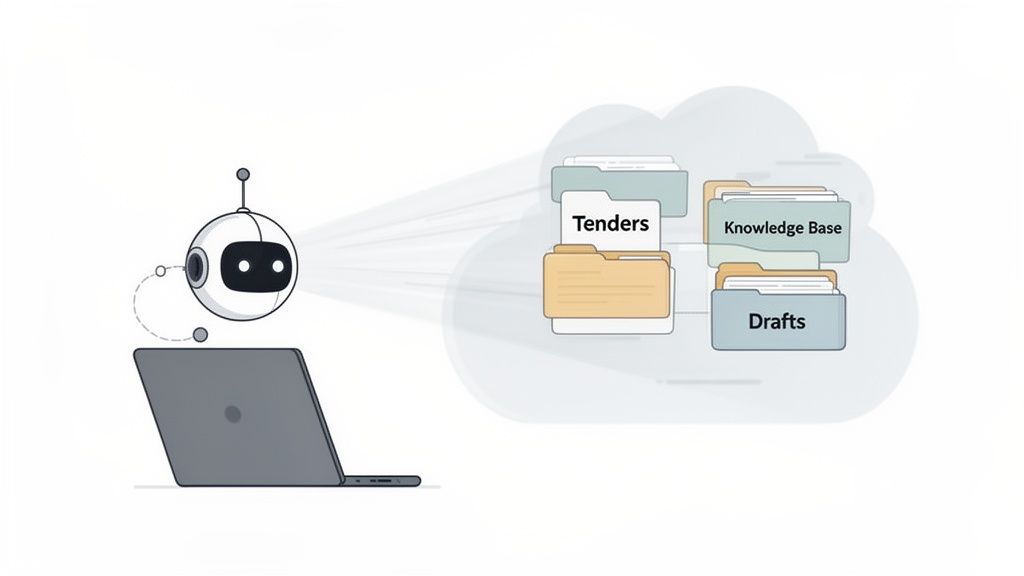
Bidwell's knowledge base acts as your company's single source of truth. Think of it as a central, organised library for all your credentials, policies, and past responses. This ensures every bid is built on consistent, accurate, and up-to-date information. You can explore methods for using AI chatbots to improve compliance with regulations to see how this works.
Accelerating Your Bid Writing
Finally, there's the massive task of writing the response. This is where the pressure really mounts.
Our AI response generation tool connects directly to your knowledge base. It uses that verified information to create a high-quality first draft of your tender response. What normally takes 40 hours of writing can be cut to just 4 hours of reviewing and refining.
That shift frees you up to bid on more contracts, all while staying fully compliant.
Your Questions, Answered
Jumping into public sector procurement can feel like learning a new language. It’s no surprise a few questions pop up. We’ve tackled some of the most common ones here.
What’s The Biggest Change For SMEs In The New Procurement Act?
In a word: access. The Procurement Act 2023 is a real effort to knock down the barriers that have kept smaller businesses out.
There's a new duty for buyers to actively consider SME participation. That means less frustrating stuff, like demanding excessive insurance levels just to get a foot in the door. The Act also bakes in prompt payment terms. A new central digital platform is coming too, designed to make finding work simpler.
Where Do I Actually Find Public Sector Tenders In The UK?
The official go-to portals are Contracts Finder for England, Public Contracts Scotland for Scotland, and Sell2Wales for Wales. For high-value contracts anywhere in the UK, you’ll need to watch Find a Tender (FTS).
But manually tracking all these portals is a massive time sink. This is why services like Bidwell’s tender monitoring exist. We automate the whole process, checking every portal daily and sending only the relevant opportunities your way.
How Long Does A Typical Public Procurement Process Take?
It really depends. The timeline is dictated by the contract's value and complexity. A straightforward, low-value job using a simple Request for Quotation might be wrapped up in just a few weeks.
A major, high-value contract can easily stretch out over three to six months, sometimes longer. The good news is the tender documents will always lay out the key deadlines you have to hit.
Get a feel for the timeline early on. It helps you plan your resources so you're not scrambling at the last minute.
What Is A Procurement Framework, And Should I Bother With One?
Think of a framework agreement as a pre-approved shortlist of suppliers. Public bodies can buy from this list without running a full tender process every time. Getting onto a relevant framework can be a brilliant way to build a pipeline of future work.
The initial application to join a framework can be just as tough as a full tender. But if you make it on, you could be looking at multiple contracts over several years with far less bidding effort each time. It's a fantastic strategic move.
Stop drowning in regulations and start winning contracts. Bidwell gives you the tools to find the right tenders, organise your company knowledge, and write winning bids faster than ever before. Find your next opportunity at https://bidwell.app.


