
A Practical Guide to UK Public Sector Tendering
When the government needs to buy something, they can't just pick their favourite supplier. They have to run a formal competition. This makes sure taxpayer money is spent fairly.
That competition is what we call public sector tendering. It's a structured process for buying goods, works, or services.
What Public Sector Tendering Means for Your Business
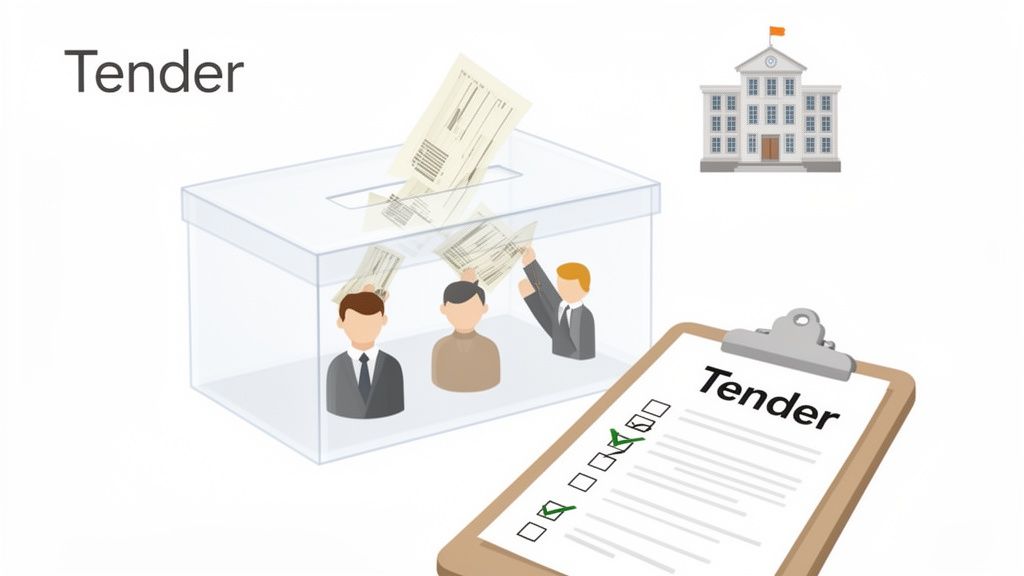
Think of it like this. If you need a builder, you might get a few quotes and choose one. The public sector does the same, but on a huge, highly regulated scale.
The whole process is designed to be fair and transparent. This gives every business an equal shot. It’s a very different world from selling in the private sector.
For businesses, this structured world is a huge opportunity. The UK public sector is a massive market, with spending hitting £407 billion in 2023/24. This money is spread across thousands of buyers, from central government to your local council.
The Core Principles You Need to Know
To get anywhere in public sector tendering, you have to grasp the principles that drive it. Buyers aren't just looking for a cheap deal. They're legally bound to evaluate every bid against criteria they publish upfront.
Everything rests on three core pillars:
- Transparency: Every opportunity has to be advertised publicly. The rules of the game—how your bid will be scored—are laid out from the start.
- Fairness: Every supplier gets treated exactly the same. There's no room for favouritism. The contract must go to the company that best meets the requirements.
- Value for Money: This is often misunderstood. It doesn't just mean the lowest price. It means the best mix of cost and quality over the contract’s life.
The biggest mindset shift is realising it's not a sales process; it’s a compliance process. You win by following their rules and proving you can deliver exactly what they've asked for.
To give you a head start, here’s a quick rundown of the key terms you’ll see.
Key Tendering Concepts at a Glance
This table breaks down the jargon into what it actually means.
| Concept | What It Means in Practice |
|---|---|
| Invitation to Tender (ITT) | The main document pack. It contains all the instructions, questions, and specifications you need to respond to. |
| Specification | The detailed description of what the buyer needs. This is where you find the technical and service requirements. |
| Evaluation Criteria | How your bid will be scored. It shows the weighting for sections like price (e.g., 40%) vs. quality (e.g., 60%). |
| Clarification Questions | Your chance to ask the buyer questions about anything unclear. Always use this if you’re unsure. |
| Compliance | Meeting all the mandatory requirements. Fail a single one, and your bid is out. |
| Most Economically Advantageous Tender (MEAT) | The winning bid that offers the best balance of price and quality, not just the cheapest. |
Understanding these terms is the first step. They’re the building blocks of every tender.
Getting Started the Right Way
Trying to navigate this world can feel overwhelming. Thousands of live contracts are scattered across dozens of different websites. Just finding the right opportunities is the first big hurdle.
You can't win contracts you never see. For a deeper look at the fundamentals, check our guide on the definition of tendering.
This is where a dedicated service is essential. Trawling through portals every day is a waste of time. A tool like Bidwell’s tender monitoring automates the search. It scours all UK portals and drops relevant opportunities into your inbox.
You stop wasting hours searching. You start spending your time crafting bids you can win.
How to Find Tendering Opportunities
You can't win contracts you don't know about. Finding the right public sector tendering opportunities is the first real hurdle. The good news is that the government is legally required to advertise most contracts.
The bad news? They’re scattered across several official websites. Each has its own clunky search function. Knowing where to look is half the battle.
The Main UK Tendering Portals
Public contract notices are published on specific government websites. Which one you need depends on the contract’s value and where the buyer is based.
Here are the essential ones you need to know:
Find a Tender Service (FTS): This is the big one. FTS is the UK's official portal for high-value contracts, typically over £138,760 for central government. If you're chasing larger work, this is your primary hunting ground.
Contracts Finder: This portal is for lower-value contracts in England. If a central government contract is over £12,000 (including VAT), it has to be published here. It's a great place for SMEs to find smaller opportunities.
Public Contracts Scotland: As the name suggests, this is the national portal for all public sector contract opportunities in Scotland.
Sell2Wales: This is the equivalent portal for Wales, advertising opportunities from the Welsh public sector.
Searching these sites manually is a real chore. You have to check them religiously to avoid missing a deadline. It's easy to burn hours sifting through irrelevant notices.
Here's what you're up against on the Find a Tender Service portal.
Notice the sheer volume of results. You have to wrestle with filters just to narrow the search down.
The Problem with Manual Searching
Relying on manual searches isn't just time-consuming; it's risky. You could mistype a keyword or forget to check a portal. The window to bid is often short, so a delay of a few days can be critical.
Trying to track opportunities manually is like trying to catch rain in a bucket full of holes. You'll get some, but you're guaranteed to miss more. An automated approach is the only way to be sure you see every relevant contract.
A dedicated service completely changes the game. For more context, you can learn about what public procurement is in our detailed article.
A Smarter Way to Find Tenders
Instead of you hunting for tenders, the tenders should come to you. This is what a tender monitoring service does. It’s a core feature we’ve built at Bidwell.
Our system scours all major UK portals every day. We use your criteria to filter out the noise. We identify only the opportunities that are a perfect fit for your business.
You get a daily email with a list of relevant tenders. We don't just send you a link. Each alert includes an AI-generated summary, so you can decide in seconds if it’s worth a closer look.
This frees you from the daily grind of searching. You can focus your energy where it counts: building a winning bid with your organised knowledge base and our AI response generation.
Understanding the Tendering Lifecycle
The public sector tendering process follows a clear, predictable path. Once you understand the stages, you can plan your time and resources properly. Think of it as a structured marathon, not a sprint.
Every tender starts with the Contract Notice. This is the official public announcement of the opportunity. It gives you the essentials—what the buyer wants, the contract value, and the deadline.
This is your first filter. A good tender monitoring service is crucial here. It sifts through thousands of notices to bring you only the ones that matter to your business.
This timeline shows a typical journey for responding to a public tender in the UK.
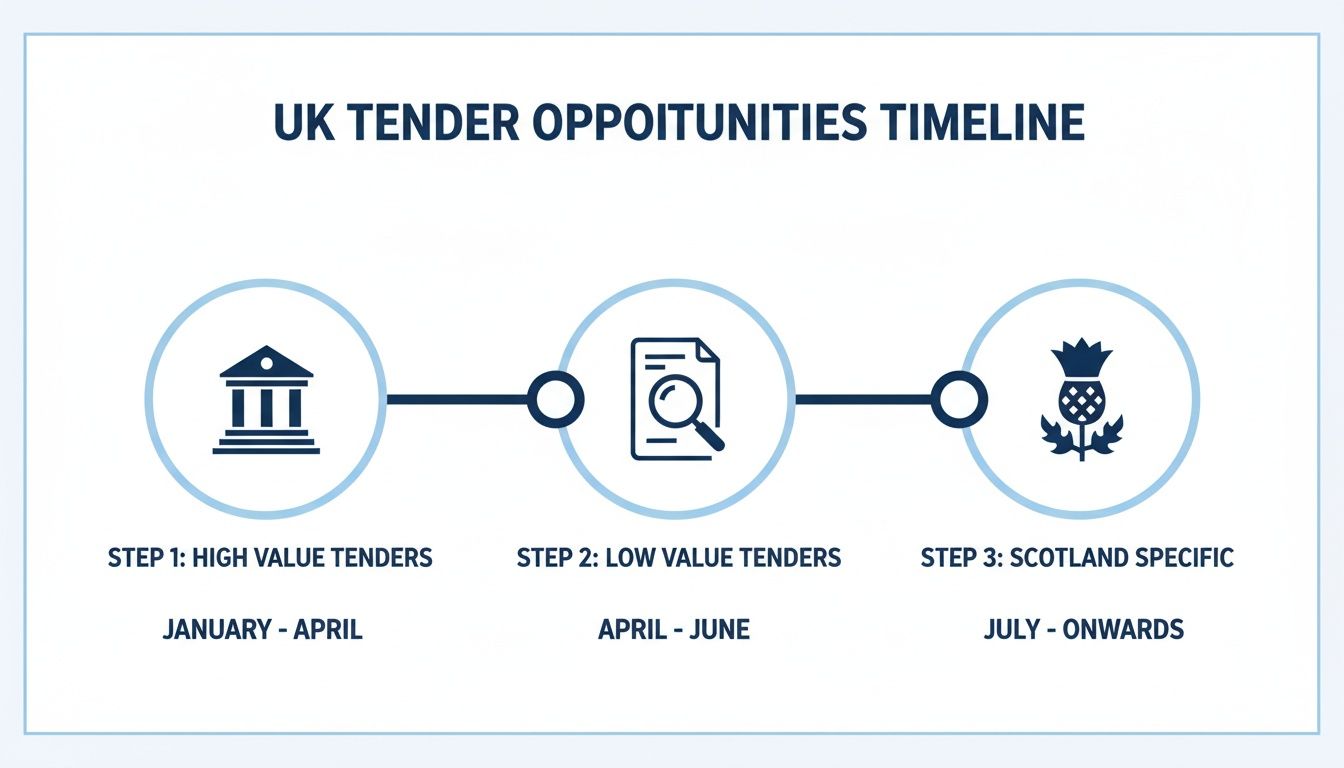
The visual makes it clear that different tenders are found in different places. This is why a comprehensive way to monitor the market is so important.
The Selection Stage: Sifting the Contenders
Once you find a notice, the first hurdle is the Selection Stage. Before they look at your proposal, the buyer needs to know you’re a stable and capable business.
This usually means completing a Selection Questionnaire (SQ). It can feel like a box-ticking exercise, but it’s a critical one. You’ll be asked for:
- Company information: Registration details, VAT number, and contacts.
- Financial standing: Turnover figures for the last two or three years.
- Grounds for exclusion: A check to confirm you haven’t been convicted of bribery or have unpaid taxes.
- Technical ability: Evidence of relevant experience, often through case studies.
- Compliance: Proof of insurances like Public Liability.
This stage is your ticket to the main event. Having a well-organised knowledge base is a massive help here. Storing your compliance documents and company details in one place means you can answer these standard questions in minutes.
The Award Stage: Your Full Proposal
If you pass the selection stage, you’re invited to submit your full bid. This is the Award Stage, where you receive the Invitation to Tender (ITT). It's your chance to convince the buyer you’re the best choice.
The ITT is a detailed document pack with everything you need to know. It contains the full specification, the questions, and how you’ll be scored.
Your response will have two main parts:
- Quality Submission: You answer detailed questions about your methodology, team, and experience.
- Commercial Submission: This is your pricing. You’ll fill out their template to show your costs.
There’s usually a clarification window. If anything in the ITT is unclear, you can submit questions. The buyer’s answers are shared with all bidders to keep things fair.
A common mistake is to dive straight into writing. Always read the entire ITT pack first, paying close attention to the evaluation criteria. This tells you what the buyer cares about, so you can focus your effort where it earns the most points.
Writing a good ITT response takes time, typically 20-40 hours of focused work. For some longer-term contracts, you might want to learn more about what a framework agreement is and how it works.
A Typical UK Tendering Timeline
Here’s a simplified breakdown of what to expect.
| Stage | Typical Duration | What You Need to Do |
|---|---|---|
| Contract Notice | N/A | Find the opportunity. Decide if it's a good fit (Bid/No-Bid). |
| SQ Submission | 2-4 weeks | Complete the Selection Questionnaire with your company details and evidence. |
| ITT Period | 4-6 weeks | Write your detailed Quality and Commercial responses. Ask clarification questions. |
| Evaluation Period | 4-8 weeks | The buyer scores all submitted tenders against the evaluation criteria. |
| Award Notification | N/A | You receive a letter informing you whether you have been successful. |
| Standstill Period | 10 days | A mandatory pause before the contract is signed, allowing for challenges. |
This is just a guide. Timelines can vary, but it gives you a solid baseline for planning.
The Final Steps: Award and Standstill
After the submission deadline, the buyer evaluates all the bids. Once they’ve chosen a winner, they issue award and rejection letters.
Before the contract is officially signed, there’s a mandatory standstill period of at least 10 days. This gives unsuccessful bidders a chance to ask for feedback or legally challenge the decision. Once the standstill period ends, the contract is officially awarded.
How Buyers Evaluate Your Bid
Winning a public sector tender isn't just about being the cheapest. Buyers use a structured framework to find the best overall value for the taxpayer.
This framework is called the Most Economically Advantageous Tender (MEAT). It’s a formal name for a simple idea. It’s a weighted scoring system that balances price against quality and social value.
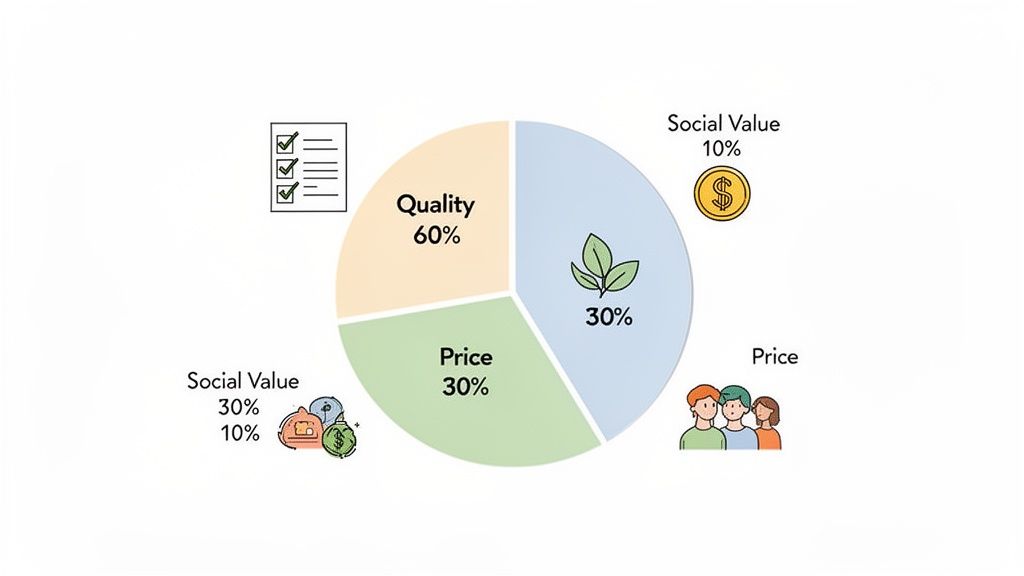
Understanding this scoring is critical. If you focus on being the cheapest when price is only worth 30% of the marks, you're setting yourself up to fail.
Breaking Down the Evaluation Criteria
Every tender is different, but a typical split is 60% Quality, 30% Price, and 10% Social Value. Buyers have to tell you the exact weightings in the tender documents. There are no secrets.
Let’s look at what each section means.
Quality (60%): This is where you prove you can do the job well. It's not a generic sales pitch. It’s a detailed, evidence-backed response to specific questions.
Price (30%): This is your commercial submission. The cheapest bid gets the full 30%, and all other bids are scored relative to it.
Social Value (10%): This is about the extra community benefit you bring. You need to show how you'll create local jobs, support apprenticeships, or reduce carbon emissions.
This weighted system means a supplier with a higher price can still win. If their quality and social value offering is much better, the maths will work in their favour.
The Gatekeeper: Compliance
Before any scoring begins, your bid has to pass a crucial test: compliance. This is a pass-or-fail check. If you miss a single document or question, your entire bid can be thrown out.
Think of compliance as the ticket that gets you into the stadium. Without it, you don't get to play the game. It’s the single biggest reason why inexperienced bidders fail.
A well-organised knowledge base is your most valuable asset here. A tool like Bidwell lets you store all your compliance documents—insurance certificates, policies, accreditations—in one place. You can find and attach them in seconds.
Proving Your Quality and Value
The quality section is your moment to shine. Buyers want detailed, evidence-based answers. Vague promises won’t cut it. You have to back up every claim with concrete proof.
You'll be asked to provide things like:
- Case Studies: Detailed examples of similar projects you've completed.
- Team CVs: Profiles of the key people who will work on the contract.
- Method Statements: Step-by-step descriptions of how you will deliver the service.
Pulling all this together from scratch for every bid is a nightmare. This is another area where a central knowledge base pays dividends. Storing your best case studies, CVs, and previous answers means you're not reinventing the wheel.
When you're ready to write, Bidwell's AI response generation can draw directly on this organised content. It uses your proven information to draft high-quality, relevant answers. This turns a week-long writing marathon into a few hours of review.
Common Bidding Mistakes to Avoid
Public sector tendering can feel like a minefield. It’s easy to make simple mistakes that get your bid thrown out. Knowing what they are is a huge advantage.
The most common errors are often the most basic. Miss the submission deadline by one minute, and you’re out. Fail to answer every part of a question, and you'll watch your score plummet. Evaluators can spot a generic, copy-pasted response from a mile away.
Why Presentation and Compliance Matter
Ignoring small things like formatting and word counts is a classic mistake. Think about it from the buyer’s perspective. A submission that’s badly organised or full of typos makes their job harder. It looks unprofessional.
To stop these errors, it pays to build some solid knowledge management best practices. Having an organised system for your information ensures everyone uses the right content.
A great place to start is with a Bid/No-Bid checklist. This forces you to be honest about an opportunity before you commit weeks of work. Can you meet the deadline? Do you have the required accreditations? If you’re hesitating, your time is probably better spent on another bid.
Top Pitfalls and How to Sidestep Them
Let’s get specific. Here are the most frequent mistakes, and how you can dodge them.
- Misreading the Question: You have to answer the question they asked. If it has three parts, your answer needs to clearly address all three.
- Forgetting Attachments: It's easy to forget a mandatory document like an insurance certificate. Make a checklist at the start and tick items off as you go.
- Making Unproven Claims: "We provide excellent customer service" is worthless without proof. Instead, write "we achieved a 98% customer satisfaction rating last year, as shown in our survey results." Specifics win.
- Ignoring Social Value: Social value isn't a fluffy extra anymore. It’s a scored part of the tender. You need a specific, measurable plan showing how you’ll benefit the community.
These aren't minor slip-ups. They are fundamental errors that get strong bids thrown out.
Bidwell helps you build discipline. The AI response generator is designed to analyse the buyer’s questions. It then pulls evidence-based content from your knowledge base to build a tailored response that proves your claims.
The landscape is changing. The UK Procurement Act 2023 is now in play. Direct awards jumped from 15% of procedures in March 2025 to 24% by May 2025. This reinforces the need to be sharp and avoid simple mistakes in the competitive tenders that remain.
Your Public Sector Tendering Questions Answered
The world of public sector tendering can feel full of tripwires. If you’ve got questions, you’re not alone. Here are the straight answers to the things we hear most often.
How Much Does It Cost to Bid for a Public Tender?
There’s no fee to submit a tender. The real cost is your time.
A straightforward bid might take one person 20-30 hours. A complex bid for a multi-year framework could easily swallow over 100 hours of work.
This is the hidden cost of bidding. Bidding on tenders you have no real chance of winning is painful. A tool that cuts down drafting time, like Bidwell's AI response generation, has a big impact.
Can My Small Business Realistically Win a Government Contract?
Yes, absolutely. It’s a myth that all big contracts go to corporate giants.
The government has a target to spend £1 in every £3 with small and medium-sized enterprises (SMEs). In 2021/22, that added up to £37.9 billion. Public sector buyers often want the agility and specialist knowledge that SMEs bring.
The key is to play to your strengths. Focus on smaller, local opportunities where your expertise is an advantage. A good tender monitoring tool can filter for these, so you only see opportunities that are a perfect fit.
What Is a Framework Agreement and How Does It Work?
Think of a framework agreement as a pre-approved list of suppliers. A buyer runs one big tender process to select a group of businesses. They've all proven they can provide a certain service to a high standard.
Once you’re on that list, you’re in an exclusive club. When the buyer needs work done, they can run a much simpler 'mini-competition' among the suppliers on the framework. Sometimes they can even award work directly.
Frameworks are a great way to build long-term business. Getting onto one is hard work, but it can lead to a steady stream of work for years with far less bidding effort.
The initial tender to get on a framework is usually very detailed. A well-organised knowledge base is a lifesaver. You can pull together the huge amount of required information quickly.
What Should I Do If I Have a Question During the Tender?
You must use the official clarification process. Every tender has a specific window for bidders to ask questions.
You submit questions via the procurement portal. The buyer then publishes their answer for all bidders to see. Don't try to call or email the buyer directly about the tender.
Asking questions is a sign of a professional. If a requirement is ambiguous, chances are other bidders are confused too. Your question could help everyone submit a better bid.
What Is the Best Way to Start With Public Sector Tendering?
The best way to start is to go small and be strategic. Don't bid for the first contract you see. Spend some time getting your house in order first.
Start by building your own knowledge base of essential documents.
- Get all your compliance documents in one place (insurances, policies, accounts).
- Write three or four powerful case studies showcasing your best work.
- Polish the CVs for your key team members.
Once you have this library of core content, you can respond to opportunities much more quickly. Then, use a tender monitoring service to find a low-value contract that is a perfect match for what you do best. This lets you learn the process on a lower-risk opportunity.
Ready to stop searching and start winning? Bidwell uses AI to find your perfect tenders, organise your knowledge, and write tailored responses in hours, not weeks. See how it works.


