
The Top 10 Request for Proposal Questions UK Businesses Face

Winning public sector contracts isn't just about having the best service. It's about providing the best answers. The request for proposal questions you face aren't random hurdles. They're designed to test your company’s experience, reliability, and value. Answering them poorly means you're out of the running.
So, what are evaluators really asking? A question about 'quality assurance' is a test of your internal processes. A question on 'social value' checks if you're a responsible partner for spending public money. Understanding the intent is key to crafting a winning response. This guide breaks down the 10 most common types of questions you'll see in UK tenders. We'll show you what evaluators want and how to build strong, evidence-backed answers.
We'll explain how to structure your responses and prepare the right proof. We'll also show how a dedicated tool can speed this up. For instance, Bidwell's knowledge base lets you store your best-performing answers for instant reuse. Its AI response generation can then tailor that content into a high-quality first draft. This turns a week-long writing marathon into a focused, few-hour review.
1. Company Experience and Relevant Case Studies
Your track record is your most powerful asset. Request for proposal questions in this category are designed to weed out bidders who can't prove they’ve done this type of work before. They ask for evidence of past performance, similar project scope, and measurable results.
These questions test your ability to not just do the work but to prove you’ve done it well. Think of it as the evaluator's first and most critical due diligence step. A strong response here builds immediate trust.
Why It Matters
Past performance is the best predictor of future success. Procurement teams want to minimise risk by choosing a partner with a proven history of delivering on their promises, on time and on budget. Vague claims of expertise won't cut it. They need hard evidence and quantifiable outcomes.
Sample Questions
- "Provide a minimum of three case studies from the past five years for projects of a similar scope and value (£[specify value])."
- "Describe your experience delivering [specific service] to a public sector organisation, detailing the challenges and outcomes."
- "Please detail your company's experience in managing contracts that involve [specific requirement, e.g., TUPE transfers, multi-site logistics]."
Public Sector Adaptation
For a public sector tender, you'll need to be even more specific. Reference projects with other local authorities, NHS trusts, or central government departments. Highlight your understanding of public procurement regulations and social value. Mention your security credentials like Cyber Essentials.
Quick Tips for Responding
- Quantify Everything: Don't just say you "improved efficiency." Say you "reduced operational costs by 15% within the first six months."
- Structure Your Evidence: Your Bidwell knowledge base is perfect for this. Store every project outcome, testimonial, and key metric so it's ready to go.
- Customise with AI: Use Bidwell’s AI to find the most relevant case studies from your knowledge base. It can tailor the narrative to match the specific pain points mentioned in the tender document.
2. Technical Specifications and Capability Requirements
These questions act as a technical gatekeeper. They move beyond your company history to scrutinise the specific tools, certifications, and methodologies you use. This section of request for proposal questions is designed to confirm you have the essential technical credentials to even start the job.
This isn’t about impressing the buyer; it’s about meeting a non-negotiable standard. Failing to provide evidence for a mandatory certification often results in an automatic fail, no matter how strong the rest of your bid is.
Why It Matters
Buyers need absolute confidence that your technical infrastructure and processes are fit for purpose. For projects involving sensitive data, complex IT, or regulated services, there is zero room for error. A required certification like ISO 27001 isn't just a "nice-to-have". It's proof that your organisation has an audited system for managing information security.
Sample Questions
- "Does your organisation hold a current ISO 27001 certification? Please provide a copy of the certificate."
- "Describe your team's experience with Agile project management methodologies, specifically in a cloud migration context."
- "Confirm your organisation's compliance with PCI DSS for handling payment card information."
Public Sector Adaptation
Public sector bodies are extremely risk-averse and rely heavily on formal accreditations. Expect to see mandatory requirements for things like Cyber Essentials Plus for IT contracts or CQC registration for adult social care. They want verifiable proof, not just promises.
Quick Tips for Responding
- Don't Waffle: If a question asks for a specific certificate, provide it. A simple "Yes, certificate attached" is better than a long paragraph about your commitment to security.
- Maintain a Register: Use your Bidwell knowledge base as a central compliance register. Store all current certifications, policy documents, and methodology statements for instant access.
- Automate Matching: Let Bidwell’s AI scan the tender for technical requirements. It can instantly flag mandatory certifications and pull the correct evidence from your knowledge base.
3. Pricing, Cost Structure, and Value for Money
Beyond the total figure, evaluators need to understand how you arrived at your price. Request for proposal questions in this category demand a transparent breakdown of your costs and pricing model. They are designed to scrutinise your commercial viability and ensure there are no hidden fees.
These questions test your commercial transparency and ability to connect cost directly to the service. A detailed, well-justified pricing schedule shows you’ve thoroughly costed the project and aren't just guessing a number.
Why It Matters
Clarity on pricing is fundamental to good governance. Procurement teams need to compare apples with apples and understand exactly what is included for the proposed price. A comprehensive breakdown allows them to assess your financial model, identify potential risks, and evaluate the overall value for money.
Sample Questions
- "Please provide a detailed cost breakdown, including all one-off and recurring charges, unit costs, and any potential variable fees."
- "Describe your pricing model and any assumptions made. Explain the mechanism for any proposed price adjustments during the contract term."
- "How will you ensure your proposal delivers maximum economic value and cost-effectiveness for the duration of the contract?"
Public Sector Adaptation
For UK public sector tenders, "Value for Money" (VfM) or Most Economically Advantageous Tender (MEAT) is the standard, not just the lowest price. You must explicitly link your costs to the quality of your service and the social value you deliver. Reference your financial stability and efficient processes.
Quick Tips for Responding
- Be Transparent: Clearly state all assumptions you've made. If your cost for waste management is based on a specific tonnage, say so.
- Build Pricing Templates: Store your core pricing frameworks and unit cost models in your Bidwell knowledge base. This lets you generate consistent and accurate pricing schedules rapidly.
- Justify with AI: Use Bidwell’s AI to generate a clear narrative that connects each cost component to a specific deliverable in the tender. Knowing how to write a tender bid that wins involves justifying your price with compelling evidence of value.
4. Service Delivery, Implementation Timeline, and Project Plan
A great idea is nothing without a solid plan. This category of request for proposal questions tests your operational readiness. Evaluators want to see a detailed, credible roadmap from contract award to full service delivery.
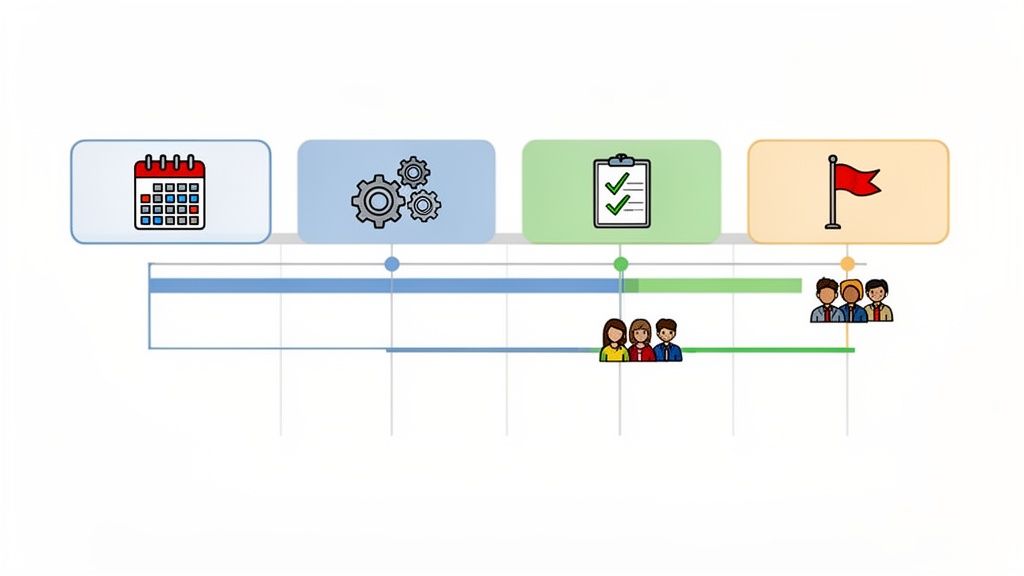
These questions focus on the 'how' and 'when'. A weak or generic project plan suggests you haven't grasped the specific needs of the contract. A strong plan shows you're ready to start work on day one.
Why It Matters
Procurement teams are deeply risk-averse. They need assurance that your proposed solution can be implemented smoothly and on schedule. A detailed implementation plan, complete with milestones and resource allocation, demonstrates your competence and foresight. It’s tangible proof you can turn your proposal into a reality.
Sample Questions
- "Provide a detailed project plan, including key milestones and resource allocation, for the first 90 days post-contract award."
- "Describe your methodology for migrating [e.g., HR data, IT systems] from the incumbent supplier, including your risk mitigation strategy."
- "Submit a timeline for the phased rollout of [specific service] to [number] of sites/users, detailing your communication and training plan."
Public Sector Adaptation
For public sector bids, your plan must show an understanding of their governance processes. Factor in time for stakeholder consultations and council committee approvals. Mentioning specific protocols like PRINCE2 or Agile methodologies demonstrates you speak their language.
Quick Tips for Responding
- Be Realistic: Build in buffer time for client-side delays and unforeseen challenges. An overly optimistic timeline can look naive.
- Identify Dependencies: Clearly state what you need from the client, such as access to systems or key personnel availability.
- Use Your Knowledge Base: Store modular project plans and methodology templates in your Bidwell knowledge base. This allows you to quickly generate a customised, detailed timeline.
5. Quality Assurance, Performance Metrics, and Key Performance Indicators (KPIs)
How will you prove you’re delivering a quality service after the contract is signed? Request for proposal questions in this category demand clear, measurable commitments to performance. They focus on what you will do, week in, week out.
These questions test your operational rigour and your commitment to transparency. A strong response isn't just a list of metrics. It's a demonstration of a solid quality management system.
Why It Matters
Buyers need assurance that service quality won't dip once the contract is awarded. KPIs and performance metrics create a non-negotiable framework for accountability. They transform subjective ideas like "good service" into objective, reportable data.
Sample Questions
- "Propose a minimum of five relevant KPIs to measure the quality of the [specific service]. Define the target, measurement methodology, and reporting frequency."
- "Describe your quality assurance processes for monitoring service delivery, including how you identify and rectify failures."
- "How will you guarantee performance standards are met in a care service? For example, what percentage of visit start times will be within a 15-minute window?"
Public Sector Adaptation
For a public sector tender, your KPIs must directly align with the specified service outcomes and social value commitments. This could mean linking waste management metrics to recycling targets. You’ll need to show how your quality framework integrates with their existing performance management systems.
Quick Tips for Responding
- Be SMART: Ensure your proposed KPIs are Specific, Measurable, Achievable, Relevant, and Time-bound. Vague targets are a red flag.
- Link KPIs to Outcomes: Don't just measure activity (e.g., "85% of calls answered in 20 seconds"). Link it to the desired outcome ("...resulting in a 90% customer satisfaction score").
- Consult Your Knowledge Base: Use your Bidwell knowledge base to pull pre-approved quality assurance methodologies and successful KPI frameworks from similar past contracts.
6. Organisational Structure, Staffing, and Key Personnel
Evaluators need to know exactly who will be delivering the service. Request for proposal questions in this category scrutinise your team's composition and the qualifications of key individuals. They're checking if you have enough skilled people to do the job properly.
These questions test the credibility of your delivery model. A fantastic solution is worthless without the right team to manage it. A strong answer here demonstrates reliability and reduces the client's perceived risk of service failure.
Why It Matters
The client isn't just buying a service; they're entering into a partnership with your team. They need assurance that key personnel have the right experience. They also need to know that your company has the depth to cover absences and scale if needed.
Sample Questions
- "Provide an organisational chart for the proposed contract team, including names, roles, and reporting lines for all key personnel."
- "Submit CVs for the proposed [e.g., Contract Manager, Lead Engineer], highlighting their experience on similar contracts."
- "Describe your staffing model, including the total number of staff, their qualifications, and your plan for covering staff absences."
Public Sector Adaptation
Public sector tenders, especially in fields like social care, will be highly prescriptive. They'll often specify minimum qualification levels for key roles. Be prepared to detail your safeguarding procedures and staff vetting processes like DBS checks.
Quick Tips for Responding
- Be Specific: Don't just list roles. Name the individuals where possible and highlight their relevant experience. For example, "The contract will be led by Jane Smith, our Service Delivery Manager with 15 years' experience managing NHS IT contracts."
- Align with Cost: Ensure the staffing levels you propose here match the labour costs in your commercial proposal. Any discrepancy is a major red flag.
- Use Your Knowledge Base: Store anonymised CVs and role profiles in your Bidwell knowledge base. You can then use Bidwell's AI to quickly pull the most relevant examples for the new bid.
7. Risk Management, Insurance, and Compliance
Evaluators aren't just buying your service; they're buying peace of mind. Request for proposal questions in this category are designed to verify you're a safe pair of hands. They test your ability to foresee problems and confirm you have adequate financial protection.
A strong answer here demonstrates professionalism and foresight. It shows you've thought beyond the basic delivery and have systems in place to protect the client from operational, financial, and legal risks.
Why It Matters
No project is without risk. Procurement teams need certainty that you can identify, manage, and mitigate potential issues. Proof of sufficient insurance is non-negotiable, and compliance with standards like GDPR or Health & Safety is a fundamental requirement.
Sample Questions
- "Provide evidence of your current insurance coverage, including Public Liability (£[specify value]), Professional Indemnity, and Employers' Liability."
- "Submit your risk register for a similar project, detailing how you identified, assessed, and planned to mitigate key risks."
- "Describe your processes for ensuring compliance with [specific regulation, e.g., ISO 27001, GDPR, Ofsted requirements]."
Public Sector Adaptation
For a public sector bid, this is a critical gatekeeping section. You must explicitly reference your compliance with specific UK legislation, such as the Health and Safety at Work Act 1974. Expect to provide copies of certificates and policy documents as appendices.
Quick Tips for Responding
- Be Specific: Don't just state you have a risk process. Describe it. Mention your risk matrix, review frequency, and who has ownership. A detailed explanation shows you have a clear plan.
- Centralise Documents: Keep your latest insurance certificates and policy documents organised in your Bidwell knowledge base for instant access.
- Show, Don't Tell: Instead of saying you're compliant, attach the GDPR Data Processing Agreement or the ISO audit report that proves it.
8. Social Value, Sustainability, and Community Impact
Social value is no longer a "nice-to-have" section. It’s often a mandatory, scored component. These request for proposal questions assess how your work will benefit the wider community, support environmental goals, and contribute to social good.
These questions test your commitment to being a responsible partner. A strong response demonstrates that your company’s values align with the buyer's. It also shows you have a concrete plan to deliver tangible local benefits.
Why It Matters
Buyers, especially in the public sector, are legally required to consider social value. It allows them to use their purchasing power to achieve broader social, economic, and environmental outcomes. They want to see how awarding you the contract will create jobs or reduce carbon emissions in their community.
Sample Questions
- "Detail your plan to create [number] apprenticeships for local young people during the contract term."
- "How will you commit to spending at least [e.g., 30%] of the contract value with local small and medium-sized enterprises (SMEs)?"
- "Describe the specific initiatives you will implement to achieve net-zero carbon delivery for this contract."
Public Sector Adaptation
This category is already heavily focused on the public sector. The UK’s Social Value Act makes it a critical evaluation criterion. You'll need to align your offer with the buyer’s specific social value priorities, whether that’s local employment for a council or carbon reduction for an NHS Trust.
Quick Tips for Responding
- Be Specific and Measurable: Don't say you'll "support local charities." Say you'll "provide 50 hours of pro-bono support to [Named Local Charity] annually."
- Build a Social Value Library: Use your Bidwell knowledge base to store pre-approved social value commitments, case studies, and partner details.
- Align with Your Strengths: Choose commitments that reflect what your business does best. A logistics provider offering an electric fleet is more credible than one making vague promises about digital inclusion.
9. Data Security, Privacy, and Cybersecurity Protocols
In an era of constant digital threats, questions about data security are non-negotiable. These request for proposal questions scrutinise your ability to protect sensitive information and comply with regulations like GDPR. They’re designed to assess your technical defences and your organisational commitment to privacy.
This isn't just an IT issue; it’s a fundamental test of trust. A weak response can disqualify you instantly, especially when handling personal, financial, or government data. A strong, evidence-backed answer shows you're a responsible and secure partner.
Why It Matters
A data breach can cause catastrophic financial and reputational damage to the buyer. Procurement teams need absolute confidence that your systems are secure and your processes are watertight. They are looking for proof of certifications and regular audits.
Sample Questions
- "Provide evidence of your ISO 27001 or equivalent certification and describe your Information Security Management System (ISMS)."
- "Detail your data breach incident response plan, including communication protocols and timescales for notification."
- "How do you ensure GDPR compliance, particularly regarding data subject access requests and the location of data processing?"
- "Please supply evidence of recent penetration testing (within the last 12 months) and a summary of the remediation actions taken."
Public Sector Adaptation
Public sector bids demand even higher standards. You’ll be asked for specific accreditations like Cyber Essentials Plus or compliance with the NHS Data Security and Protection Toolkit. Be prepared to detail how you segregate data and vet staff with data access.
Quick Tips for Responding
- Centralise Your Certificates: Store all your certifications (ISO 27001, Cyber Essentials) and audit reports in your Bidwell knowledge base for instant access.
- Create Template DPAs: Have a pre-approved Data Processing Agreement (DPA) ready. This shows you're organised and proactive about compliance.
- Use AI for Consistency: Use Bidwell's AI to pull precise, pre-vetted security information from your knowledge base. This ensures every bid response is consistent and accurate.
10. Contract Management, Governance, and Relationship Management
Winning the contract is just the start. Delivering it successfully is what matters. Request for proposal questions in this category scrutinise your plans for managing the ongoing relationship. They test your operational maturity and communication protocols.
These questions are about demonstrating partnership, not just service provision. Evaluators want to see a clear plan for communication, issue resolution, and performance reporting. A strong response proves you’ve thought about a long-term, collaborative relationship.
Why It Matters
Poor contract management leads to scope creep and missed KPIs. Procurement teams want a partner who is proactive, transparent, and organised. They need assurance that there's a clear governance framework, with defined roles, responsibilities, and escalation paths. A comprehensive Contract Management Workflow can ensure smooth operations.
Sample Questions
- "Provide a governance and communications plan, including meeting frequency, attendees, reporting formats, and escalation procedures."
- "Describe your approach to relationship management. Who will be the single point of contact, and what is their authority?"
- "How will you measure and report on key performance indicators (KPIs) and service level agreements (SLAs) throughout the contract term?"
Public Sector Adaptation
Public sector bids require a robust governance structure. You should propose steering groups that include key stakeholders. Clearly reference your commitment to transparency through open-book accounting or detailed performance dashboards.
Quick Tips for Responding
- Be Proportionate: Design a governance structure that fits the contract's value and complexity. A £1m partnership needs more than a £50k supply contract.
- Define Triggers: Be specific about escalation. For example, "A critical P1 incident unresolved within 4 hours triggers an automatic escalation to the Service Director."
- Template Your Frameworks: Store your proven governance models and communication plans in your Bidwell knowledge base. This allows you to quickly adapt them for new tenders.
- Generate with AI: Use Bidwell's AI to generate a draft governance section based on previous successful bids for similar contract types.
10-Point RFP Questions Comparison
| Item | 🔄 Implementation Complexity | ⚡ Resource Requirements | ⭐ Expected Outcomes | 📊 Ideal Use Cases | 💡 Key Advantages |
|---|---|---|---|---|---|
| Company Experience and Relevant Case Studies | Moderate — needs structured archives and metric extraction | Low–Moderate — knowledge base, client references, regular updates | High — strong past-performance evidence and credibility | Sector-specific procurements where track record is weighted (20–30%) | Rapid customisation via Bidwell AI; maintain structured, quantified case studies |
| Technical Specifications and Capability Requirements | High — strict compliance and certification mapping (often pass/fail) | High — certifications, technical staff, documented capability evidence | Essential — determines eligibility and reduces compliance risk | Regulated or security-sensitive contracts (IT, healthcare, data) | Early filtering of non-viable bids; use AI to flag capability gaps |
| Pricing, Cost Structure, and Value for Money | High — detailed, defensible cost breakdowns and assumptions | Moderate–High — finance input, pricing templates, market benchmarks | High — transparent VFM case and negotiation stability | Cost-weighted public procurements and long-term service contracts | Reusable pricing frameworks; document assumptions and link to outcomes |
| Service Delivery, Implementation Timeline, and Project Plan | Moderate — Gantt charts, milestones, contingency planning required | Moderate — project managers, methodology templates, resource plans | High — demonstrates operational readiness and feasibility | System migrations, phased rollouts, large implementations | Modular templates for rapid tailoring; include realistic buffers |
| Quality Assurance, Performance Metrics, and KPIs | Moderate–High — KPI design, monitoring, and verification systems | High — QA teams, reporting tools, possible third-party audits | High — measurable performance and continuous improvement | Outcome-driven services (care, contact centres, waste) | Reuse proven QA frameworks; align KPIs to contract outcomes |
| Organisational Structure, Staffing, and Key Personnel | Moderate — org charts, CVs, retention and continuity plans | Moderate — qualified staff, HR records, contingency staffing | Medium — shows capacity and relevant expertise | Staff-intensive services and specialist roles (care, IT, FM) | Templates for role descriptions; ensure staffing aligns with pricing |
| Risk Management, Insurance, and Compliance | High — comprehensive risk registers and compliance evidence | High — insurance coverages, compliance officers, audit reports | High — reduces liability and shows robust mitigation | High-liability or heavily regulated contracts (childcare, data, construction) | Demonstrates maturity; keep insurance and compliance docs up to date |
| Social Value, Sustainability, and Community Impact | Moderate — target setting, partnerships, and reporting mechanisms | Variable — depends on commitments (program delivery, partners) | Medium–High — can significantly boost evaluation scores | Public sector tenders with social value weighting | Differentiator when credible; align to mission and measure delivery |
| Data Security, Privacy, and Cybersecurity Protocols | High — technical controls, certifications, incident response plans | High — security architecture, ISO/Cyber certifications, pen-testing | High — reduced breach risk and regulatory compliance | Contracts with sensitive personal or government data (NHS, finance) | Standardisable templates; maintain certifications and DPAs for speed |
| Contract Management, Governance, and Relationship Management | Moderate — governance frameworks, escalation and reporting cadence | Moderate — contract managers, dashboards, scheduled reviews | High — clearer delivery, fewer disputes, proactive relationship handling | Long-term or complex contracts needing stakeholder engagement | Templated governance structures; use portals and clear escalation triggers |
Turn Your Answers Into Winning Bids
You've now got a comprehensive toolkit of request for proposal questions. From proving your company’s experience to detailing your pricing structure, each question is an opportunity. It’s your chance to show not just what you do, but how you think and the real value you deliver.
Answering these questions well is the core of any successful bid. But crafting compelling, accurate, and tailored responses for every tender is a huge drain on time and resources. The real challenge isn't just knowing what to write. It's being able to produce winning content efficiently and consistently, without your bid team burning out.
From Good Answers to a Great System
The difference between a sporadic winner and a consistent one is a system. A reliable process removes the frantic, last-minute rush and replaces it with structured, strategic work. It all starts with finding the right opportunities. You can’t afford to waste days sifting through irrelevant contracts on portals like Find a Tender or ContractsFinder.
Once you’ve found a tender worth your time, the next bottleneck is creating the response. Manually searching through old documents and rewriting the same core answers again and again is a recipe for inefficiency. This is where so many SMEs falter. They have the expertise, but they lack the operational capacity to bid effectively.
Building Your Bidding Engine
A truly effective system has three core components:
- Intelligent Opportunity Sourcing: Don't just find tenders; find the right tenders. Bidwell's tender monitoring finds relevant contracts and provides AI-powered summaries so you can qualify an opportunity in minutes.
- A Centralised Knowledge Base: Stop reinventing the wheel. Your best case studies, policies, and technical answers should live in one organised, searchable place. Your Bidwell knowledge base becomes your single source of truth.
- AI-Powered Response Generation: Use that knowledge base to automate the heavy lifting. Bidwell's AI can draft the first 80% of your response, freeing your team to spend their time on tailoring and strategy.
By systematising your approach, you turn bidding from a chaotic art into a repeatable science. You reduce the administrative burden and give your experts the time they need to focus on what they do best: demonstrating your unique value.
The goal is to move beyond simply answering request for proposal questions. It's about building a bidding engine that works for you, tender after tender. This shift in approach doesn't just save you time. It changes your capacity to grow, allowing you to bid on more of the work you're perfectly suited to win.
Ready to stop the frantic copy-pasting and start winning more tenders? Bidwell combines tender monitoring, a smart knowledge base, and AI response generation to turn your expertise into winning bids, faster. Find your next opportunity with Bidwell today.


