
A Winning Response Template for RFP Success in the UK

A good response template for RFP success isn't just a document. It’s a system. It stops you from reinventing the wheel for every single bid.
Think of it as a framework. It combines your company's best answers, case studies, and compliance details into an organised format. This lets you build winning proposals much faster.
Why Your Current RFP Method Is Costing You Contracts
Let's be blunt. If you're still writing every tender response from scratch, you're falling behind. Winning UK public sector work is tough. It’s no secret that many bids get abandoned before they’re even finished.
The time commitment alone is a huge issue. It often takes 20-40 hours to complete a single bid. That's enough to put anyone off.
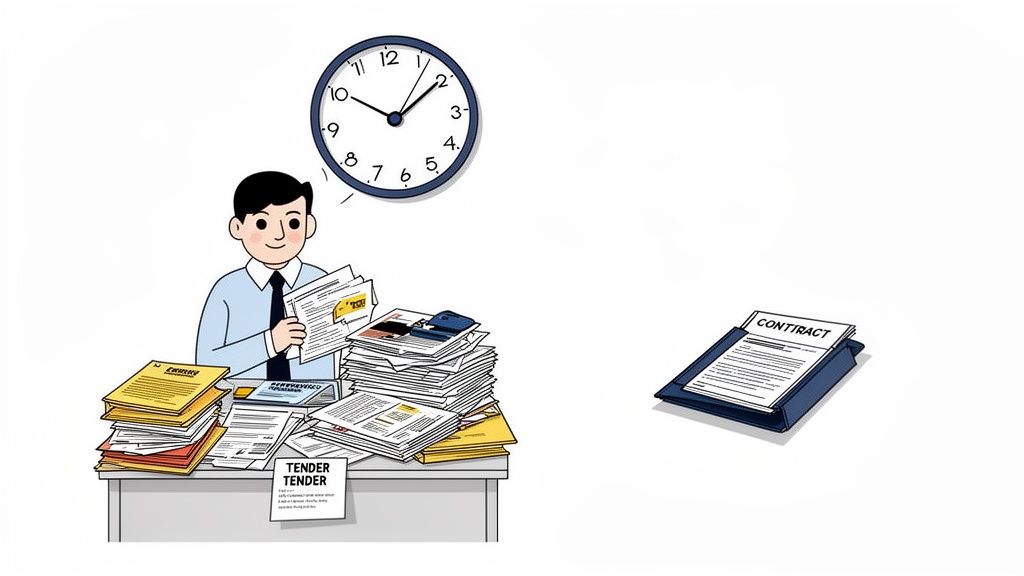
The numbers back this up. UK organisations are seeing a real drop in RFP completion rates. The average number of RFPs a company submits each year has fallen from 175 to 153.
That 12.6% plunge signals a growing frustration that leaves millions of pounds on the table. To make things worse, average win rates have also slid from 53% down to around 44% recently. This is exactly where a structured approach becomes your secret weapon.
The Real Cost of an Unorganised Process
When you don’t have a system, every new tender feels like starting from square one. You’re hunting through old documents for that killer answer you wrote six months ago. You're chasing colleagues for the latest case study.
This manual chaos leads to all the usual problems:
- Wasted Time: Hours are lost searching for information that should be at your fingertips.
- Inconsistent Quality: Your bid quality depends on who’s available, not on a proven, winning standard.
- Missed Deadlines: Rushing at the last minute invites simple, disqualifying errors.
- Burnout: Your best people get bogged down in repetitive admin instead of focusing on strategy.
A good guide to responding to an RFP can offer a broader perspective on avoiding these pitfalls.
From Chaos to Control with a Smart System
The only way to compete seriously is with a repeatable system. You need a process powered by your own company’s data. Instead of facing a blank page, you start with a strong, compliant draft that’s already 80% there.
This is where a platform like Bidwell changes everything. It connects tender monitoring with an organised knowledge base. Then it uses AI response generation to build a tailored first draft for you.
Suddenly, that 40-hour writing slog becomes a focused review job. It gives you back the time to actually strategise and win. For more details on this, check out our guide on how to bid for government contracts.
The Anatomy of a High-Scoring UK Tender Response
Right, let’s get into the structure of a response that actually wins. A solid template for a UK public sector tender isn't about filling in boxes. It’s about telling a clear story that solves the buyer's problems.
Imagine the evaluator. They're reading dozens of these submissions. Yours needs to be the clearest, most direct, and most convincing one they see.
Let's break down the essential parts. We'll talk about how to make each one score maximum points. First, here’s a quick overview of the core sections your template should cover.
Core Sections of Your RFP Response Template
| Section | Purpose | Key Elements to Include |
|---|---|---|
| Executive Summary | To grab the evaluator's attention and prove you understand their core needs from the very first paragraph. | A direct summary of their problem and your solution's key benefit. Mention specific outcomes (e.g., "reduce downtime by 30%") and reference key credentials. |
| Understanding of Requirements | To show you've not just read the tender, but understood the context and implications behind their requests. | Go beyond repeating their words. Explain the "why" behind their requirements and how your approach addresses those underlying drivers. |
| Proposed Solution | To detail exactly what you will do, how you will do it, and why your method is the best choice. | A logical, jargon-free breakdown of your services. Use subheadings that mirror their tender sections for easy evaluation. |
| Implementation Plan | To build confidence by showing you have a credible, low-risk plan for delivery and mobilisation. | A clear timeline with phases and milestones, named contacts, and a brief risk management summary. This proves you're a safe pair of hands. |
| Company Experience & Case Studies | To provide concrete, quantifiable proof that you have successfully delivered similar projects before. | Two or three relevant case studies, ideally with other public sector clients. Focus on measurable results (cost savings, efficiency gains, etc.). |
| Pricing | To present your costs in a clear, transparent, and compliant format that is easy for the buyer to understand. | A simple, itemised table breaking down one-off and recurring costs. Ensure it matches the format requested in the RFP exactly. |
Getting these sections right provides the foundation. Now let's look at how to bring each one to life.
The Executive Summary: The Hook
This is your first impression. Frankly, it's the most important section. An evaluator might only skim this part before deciding if the rest of your bid is worth their time.
It needs to be short, confident, and focused on the buyer's main problem. Don't just summarise your proposal. Instead, make a powerful case for why you're the best choice.
Let’s imagine a tender from 'Anytown Council' for new IT support. A strong opening would be:
"Anytown Council requires a responsive IT support partner to reduce system downtime by a target of 30% and improve resident data security. Our proposal outlines a fully managed service, backed by our ISO 27001 accreditation and a dedicated local engineering team, designed to meet these exact objectives within the first six months."
This immediately shows you get it. You've understood their specific goals from page one.
Understanding of Requirements: Showing You've Listened
This is where you prove you’ve done your homework. Many companies fail here by just repeating the requirements back to the buyer. What a waste of everyone's time.
Your goal is to show you understand the context behind what they're asking for. You have to go deeper. If the tender asks for "improved reporting," talk about what that really means for them.
For our Anytown Council example, you could write:
"We realise that the requirement for 'improved reporting' is driven by the need for greater transparency in budget allocation and to provide councillors with clear, non-technical data on service performance. Our proposed dashboard will provide real-time metrics on ticket resolution times and system uptime, directly supporting these governance objectives."
A high-scoring response doesn't just list features. It connects every proposed action back to a specific problem or goal stated in the tender documents. This mapping is crucial for showing the evaluator you're not just selling a service, but a genuine solution.
This approach shows genuine insight. It adds value before you’ve even talked about your solution.
Proposed Solution: Presenting Your Answer
Now it’s time to lay out your solution. This section needs to be organised, logical, and easy for a non-expert to follow. Ditch the jargon.
A great tip is to structure your answer to mirror the requirements in the tender. This makes it simple for the evaluator to tick off their criteria.
For each requirement, explain:
- What you will do: Be specific. "We will install monitoring software on all critical servers."
- How you will do it: Briefly explain the process. "This is done using our standard agent, deployed remotely to minimise disruption."
- Why you do it this way: Justify your approach. "This method provides instant alerts, allowing us to resolve 95% of critical issues before staff are even aware of them."
This is where your knowledge base in a platform like Bidwell is useful. Its AI response generation can instantly pull in your best explanations for standard services. This gives you a strong, detailed draft to work from.
Implementation Plan: Proving You Can Deliver
An idea is worthless without a credible plan to make it happen. The implementation section is your chance to build trust. It shows you’re a safe pair of hands.
Your plan should include:
- A clear timeline: Use a simple chart or list key phases with estimated durations (e.g., Phase 1: Discovery (Weeks 1-2)).
- Key milestones: What are the major checkpoints?
- Named personnel: Who is the project manager? Who is their main point of contact?
- Risk management: Briefly identify 2-3 potential risks and explain how you'll mitigate them.
This shows you're organised and professional. You don't need to write a novel. Just provide enough detail to prove you have a solid process. You can find more tips in our guide on how to write a tender bid.
Company Experience and Case Studies: Your Proof
This is your evidence locker. It's where you back up every claim with hard proof. Don't just say you're experienced; show it.
Pick two or three highly relevant case studies of similar projects. Ideally, choose ones with other UK public sector clients.
Each case study needs to tell a mini-story:
- The Client and Their Problem: "The Borough of Somewhere had an ageing server infrastructure, leading to frequent outages."
- Our Solution: "We migrated their services to a secure cloud environment over a single weekend."
- The Outcome: "This resulted in a 99.9% uptime and reduced their annual IT operating costs by £50,000."
Quantifiable results are everything. Numbers are more powerful than vague statements like "we improved efficiency." Your Bidwell knowledge base should store your best case studies, staff CVs, and accreditations, all ready to go.
Pricing: The Final Piece
Finally, the money. Be clear, be transparent, and double-check your figures. Public sector buyers dislike hidden costs and ambiguity.
Present your pricing in a simple table. Break it down into one-off setup costs and ongoing monthly or annual fees. Make sure your pricing structure aligns perfectly with the format they’ve requested in the RFP. Any deviation can get you disqualified.
How to Customise Your Template Without Starting Over
A great RFP response template is a starting point, not a finished product. Its real power comes from how quickly you can adapt it to each specific tender. You don’t need to start from scratch, but you must tailor the content.
The goal is to move from a solid foundation to a highly specific, compelling bid without wasting days. This is where you combine smart analysis with the right tools. It’s about making your template work for you, not the other way around.
Analysing the Tender Documents for Key Themes
Before you write a single word, dissect the tender documents. Don't just skim them. Your job is to pull out the key themes, pain points, and scoring metrics.
Look for the words they repeat. Is it "efficiency," "resident safety," or "cost reduction"? These recurring phrases are your signposts. They tell you what the buyer truly cares about.
Highlight them and make a list. Keep it front and centre as you customise your template. This ensures your final document speaks their language.
Think of it like this: if the tender mentions "sustainability" 15 times, your response better have a strong, dedicated section on your environmental credentials. Ignoring these clues is like ignoring the most important questions in an exam. You’re just throwing away marks.
This initial analysis is the most critical step. It dictates which parts of your template need the most attention.
Building Your Centralised Knowledge Base
This is where the real efficiency comes from. A template is static, but a knowledge base is a living library of your company's best content. Think of it as a central hub for all your credentials, past answers, policies, staff CVs, and case studies.
Without one, you're constantly reinventing the wheel. With a knowledge base, you write something once, perfect it, and then pull it in whenever you need it. This is a core function of Bidwell, designed to stop this exact kind of repetitive work.
Your knowledge base should be organised, easily searchable, and contain:
- Your best past answers: Every time you write a great, high-scoring answer, save it.
- Company credentials: Accreditations like ISO 27001 and Cyber Essentials.
- Case studies: Your top 5-10 success stories, focused on measurable outcomes.
- Key staff CVs: Short, tailored biographies of the people who will deliver the work.
This organised library becomes the fuel for your rapid response process.
Generating Your First Draft with AI
Once you have an organised knowledge base, technology can do the heavy lifting. Instead of you manually searching for the right content, an AI tool can do it in seconds. This is how you go from a 40-hour writing marathon to a much shorter review process.
Bidwell's AI response generation is built for this. It reads the tender's questions, then scans your entire knowledge base to find the most relevant information. It builds a tailored first draft that already reflects the tender's specific needs.
Here’s a look at how a typical response framework is built, combining your analysis with AI-powered drafting.
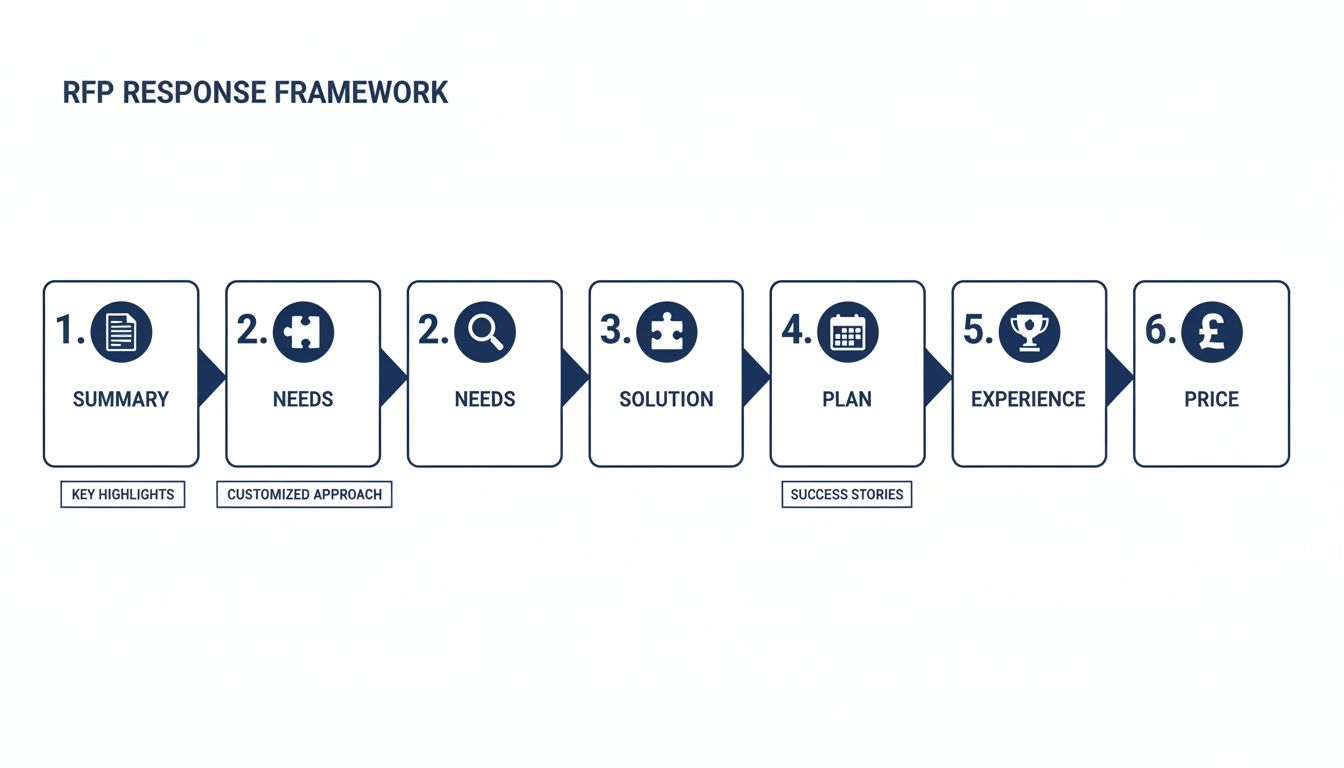
This process shows how each step builds upon the last to create a cohesive bid.
The result is a complete document that’s already 80% there. Your job is no longer to face a blank page but to act as a strategic editor. You can focus your energy on refining the solution and adding that final human touch that wins the contract. This is the key to customising your response for RFP success without starting over.
Common Pitfalls That'll Get Your Bid Thrown Out
Winning a public sector tender isn’t just about having the best service. It’s often about dodging simple, unforced errors.
I’ve seen it happen countless times. A great company loses out not because they weren’t good enough, but because they tripped over a hurdle they never even saw.
It’s a high-stakes game, but the odds are better than you might think. In the UK public sector, the average RFP win rate is a surprisingly high 46%. That means if you get your bid right, you stand a real chance. For small and medium-sized businesses, that number is still a very solid 42%.
This tells us that SMEs can absolutely compete with the big players, provided their submission is sharp and error-free. Let's walk through the most common mistakes.
You Didn't Actually Answer the Question
This is the number one reason bids score poorly. It sounds obvious, but it’s easy to misread a question or paste in a standard answer that doesn't quite fit. The evaluator has a checklist, and if your answer doesn’t tick their box, you get zero points.
Imagine a local council asks: "Describe your process for managing resident complaints and ensuring resolution within 48 hours."
- A weak answer: "We have a comprehensive customer service policy and a dedicated support desk." This is just marketing fluff. It’s vague and tells the evaluator nothing.
- A strong answer: "All resident complaints are logged in our CRM. A ticket is assigned to a case manager who must make contact within 4 hours. Our SLA dictates a 48-hour resolution, with automated escalations to a senior manager at the 36-hour mark." Now that is a process.
Your response template for RFP success needs to be a framework, not a script you copy and paste blindly.
You Ignored the Rules (Non-Compliance and Formatting)
Public sector procurement runs on rigid rules. If they ask for the price to be in a separate document, you do it. If they specify a font size, you use it. Deviating from instructions is often an instant disqualification.
A classic mistake is forgetting to complete a mandatory form or missing a signature. It’s a tiny detail that can invalidate all 40 hours of your hard work. A structured review process is your only real safety net here.
A platform like Bidwell can save you here. Building your response within a structured system ensures every required section gets completed. The AI can pull the right data from your knowledge base, reducing the chance of human error. Our guide on how to write a method statement can also help keep your technical sections on point.
Your Bid Was Inconsistent and Lacked Proof
Your bid needs to read like one cohesive document, written with a single voice. If you call your service the "Gold Support Package" in one section and the "Premium Care Plan" in another, it looks sloppy. This usually happens when different people contribute without a central editor.
Just as damaging is making big claims without backing them up. Saying "we deliver excellent results" means nothing to an evaluator. You have to prove it.
- Weak Evidence: "Our clients are very satisfied with our service."
- Strong Evidence: "For the London Borough of Bexley, we reduced critical IT incidents by 42% in the first year, as detailed in the attached case study."
Specifics beat vague claims, every single time. A centralised knowledge base in Bidwell is your tool for consistency. When the AI response generation kicks in, it uses the correct, approved information every single time.
Using AI to Speed Up Your RFP Responses
Let's talk about speed. The bidding world moves fast. If you're not using the right tools, you're getting left behind. A solid response template for RFP success is your foundation, but technology is what gives you the edge.
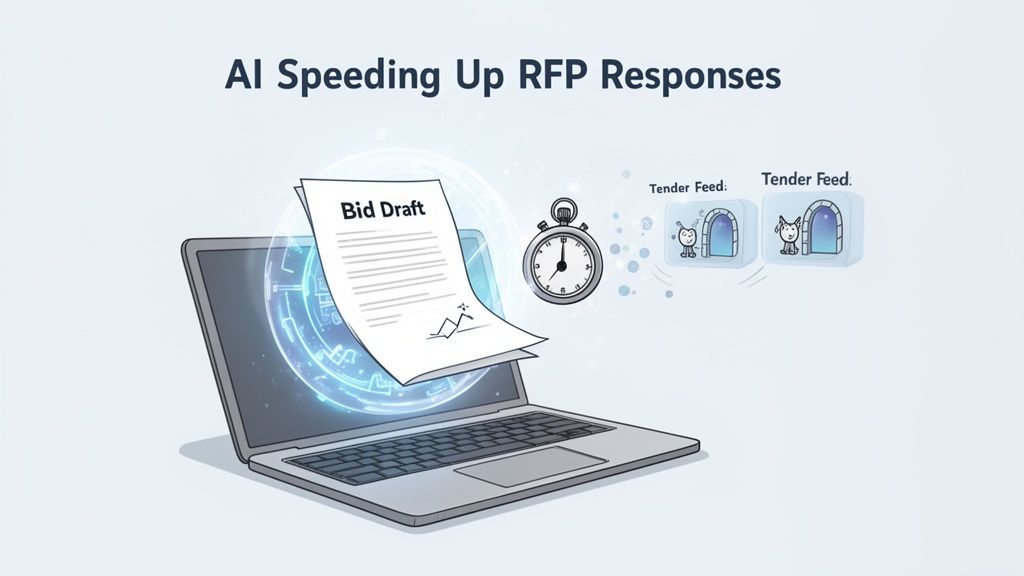
This isn’t about replacing bid writers. It’s about giving them tools that handle the repetitive tasks. This frees them up to focus on strategy.
Never Miss a Relevant Opportunity Again
The first bottleneck is simply finding the right tenders. Manually sifting through portals every day is a grind. You can waste hours reading specifications only to find an opportunity isn't a good fit.
Smart tender monitoring changes this. A platform like Bidwell automates this process. It scans all the major UK portals and sends you a daily alert with only the tenders that match your profile.
Instead of you hunting for opportunities, the best ones land straight in your inbox. Each alert includes an AI-generated summary, so you can decide in minutes whether it's worth pursuing.
This proactive approach channels your team’s energy into high-potential bids right from the start.
From a Blank Page to a First Draft in Hours
Once you’ve decided to bid, the clock starts ticking. Traditionally, this means staring at a blank document and preparing to sink the next 20-40 hours into writing.
AI flips this on its head. With an organised knowledge base, AI can generate a complete first draft in a couple of hours. This isn't a gimmick; it’s driving real results. In fact, 64% of teams now deliver RFP responses in 10 business days or fewer.
The AI in Bidwell works by:
- Analysing the tender questions: It reads and understands what the buyer is asking for.
- Searching your knowledge base: It instantly finds your best answers, case studies, and compliance documents.
- Building a structured response: It assembles this content into a coherent draft.
This isn’t a robotic, copy-paste job. It’s an intelligent assembly of your own winning content.
The Real Impact on Your Bid Team
The result is a total shift in how you work. That daunting 40-hour writing marathon becomes a much more manageable 2-4 hour job of reviewing and refining.
This has a massive knock-on effect:
- Focus on Strategy: Your bid writers can spend their time sharpening the win themes instead of just filling in boxes.
- Bid on More: With all that time saved, you can respond to more opportunities, boosting your pipeline.
- Reduce Burnout: It eliminates the frantic, last-minute rush that leads to mistakes and stress.
You could even check out some of the best AI tools for content creators to help generate supporting content. Ultimately, using AI isn't about cutting corners. It's about working smarter and faster.
Your Questions on RFP Response Templates Answered
We get a lot of questions about using templates for public sector bids. Let's tackle a few of the most common ones we hear.
Can I Really Use a Template for a Complex Public Sector Tender?
Yes, absolutely. But you have to think about what a template is for. A good template isn’t about copy-pasting answers. That’s a fast track to getting ignored.
Instead, it’s a framework. It ensures you consistently cover all the mandatory sections – your company background, compliance statements, standard policies. This frees up your brainpower for what actually wins the contract: tailoring the solution and evidence sections to what the buyer has asked for.
How Do I Build a Knowledge Base to Power My Template?
Start small and be systematic. Nobody builds a perfect bid library on day one. Begin by gathering your best-ever responses to the questions that always come up.
Then, add your key documents: up-to-date staff CVs, your latest accreditations, and your strongest 3-5 case studies. That’s your foundation. Store it all in one central, easy-to-search place.
This is exactly what Bidwell is designed for. You can upload your past successful bids, and the platform’s AI automatically breaks them down into a searchable knowledge base. Your library gets stronger with every success.
Will an AI-Generated Template Sound Robotic?
Only if you let it. Used correctly, AI doesn't replace your expertise; it accelerates it. The AI's job is to create a strong first draft by pulling from your own proven content in your knowledge base.
Your role is to then review, refine, and inject your company's unique voice and strategic insights. You provide the final polish. The AI turns a 20-40 hour writing marathon into a much more manageable 2-4 hour editing job. The final submission is still authentically yours, just created far more efficiently.
Ready to stop writing bids from scratch and start winning more contracts? Bidwell combines tender monitoring, a smart knowledge base, and powerful AI response generation to turn a 40-hour task into a 2-hour review. Find out more at https://bidwell.app.
Refined using Outrank app


