
A Guide to Social Value in Public Procurement
Social value in public procurement is about the extra community benefit your company delivers when it wins a public contract. It’s no longer just about who can do the job cheapest. It’s about what else you bring to the table. Think creating local jobs, offering apprenticeships, or improving community wellbeing.
What Social Value in Public Procurement Really Means
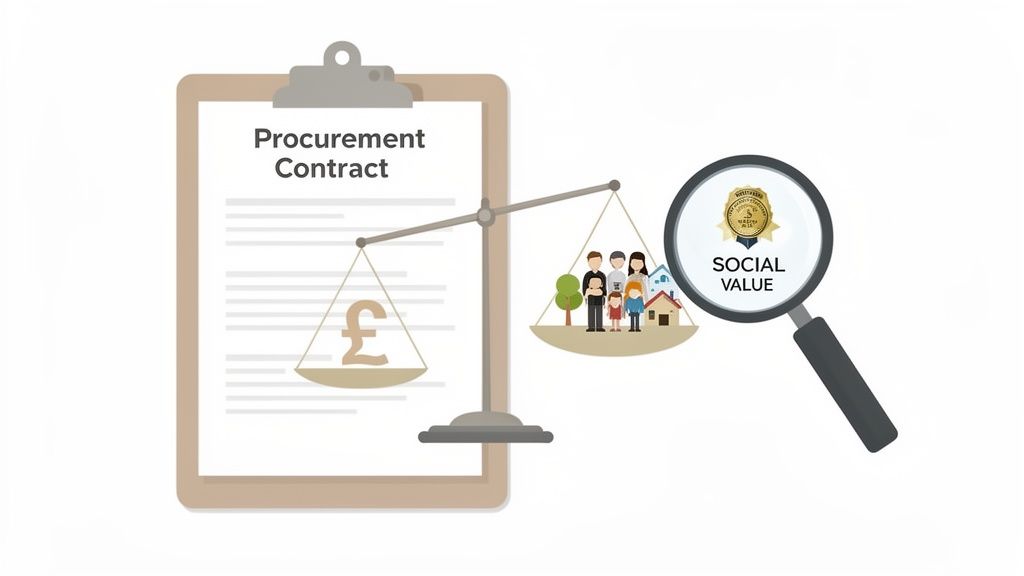
Let’s break it down. For decades, winning a public contract was a race to the bottom on price. The cheapest bid almost always won. This saved money upfront, but it often missed the bigger picture.
Now, the government is thinking smarter. The goal is to get the best overall value, not just the lowest cost. Public spending is being used as a tool to achieve wider social, economic, and environmental goals. It’s a powerful way to make taxpayers' money work much harder for local communities.
This isn't just a "nice-to-have" anymore. It's a core, scored part of the evaluation process. When you bid for a contract, you'll be asked to explain the social value you’ll deliver. Your answer will get marks and can be the deciding factor between winning and losing.
Think of it this way: two companies bid to build a new community centre. Both can do the job for the same price. But one promises to hire three apprentices from the local area and use a local supplier for all their materials. That company is delivering far more value, even if the cost is identical.
The Power of Public Spending
Public procurement is a massive chunk of the UK economy. With gross public procurement spending hitting £407 billion in 2023/24, it represents a huge 15% of the country's GDP. That’s an enormous budget with the power to drive real, tangible change across the country. You can learn more about how procurement creates social value.
What Does This Mean for Your Bids?
For small and medium-sized enterprises (SMEs), this shift is a huge opportunity. You don’t need a massive corporate social responsibility budget to compete. Your existing strengths—like being based locally, employing local people, or having strong community ties—are now major advantages.
The key is showing the buying authority that you understand their local priorities and can help them deliver on them. This could include:
- Creating local employment: Pledging to hire a certain number of people from the local borough.
- Supporting skills and training: Offering work experience placements or apprenticeships to local young people.
- Improving the environment: Committing to reducing carbon emissions or waste on the project.
- Boosting the local economy: Promising to spend a percentage of the contract value with other businesses in the area.
Spotting these requirements early is crucial. The tender monitoring service from Bidwell is built for this. Our AI scans new opportunities and instantly flags the social value criteria. This means you know exactly what the buyer wants from day one, giving you a head start on preparing a winning response.
Understanding UK Policy and Tender Scoring
To win public contracts, you need to know the rules of the game. The landscape for social value in UK procurement kicked off with the Public Services (Social Value) Act 2012. This was the first nudge, encouraging public bodies to think beyond just cost and consider the wider community benefits of their contracts.
But things have moved on. Big time. The new Procurement Act 2023 takes that gentle nudge and makes it a firm shove. It’s no longer an encouragement; social value is now a hard-wired, mandatory part of the bidding process.
The 10 Percent Rule Changes Everything
This is the most important change you need to know about. Public sector tenders in the UK will soon enforce a minimum 10% weighting for social value in their evaluation criteria. This isn't optional or a 'nice-to-have'. It's a fixed slice of the scoring pie that every single bidder has to earn. You can dig into the specifics in the government's official guidance on these procurement reforms.
What does this really mean? It means vague promises are dead. You can't just say you’ll “support the local community” anymore and hope for the best. You have to make concrete, measurable commitments that an evaluator can score against a clear set of criteria. Your social value offer is now just as critical as your price.
How Evaluators Score Your Promises
When an evaluator picks up your bid, they’re not looking for fluffy marketing language. They have a marking sheet, and they are looking for clear, evidenced answers that tick their boxes.
Here’s what they’re trained to spot:
- Relevance: Does your offer actually match the buyer's local priorities, or is it a generic, copy-pasted promise?
- Credibility: Can you prove it? Where’s the evidence to back up what you’re saying?
- Measurability: Are your commitments specific, with clear KPIs? "We will create 3 new apprenticeships" scores points. "We will support young people" does not.
- Impact: How big a difference will your offer actually make to the community?
This is where being organised is the difference between winning and losing. You need your proof points ready to go – case studies, stats on your local hiring, details of your apprenticeship schemes. Wasting time hunting for this stuff mid-bid is a recipe for a weak, rushed response. If you're looking for broader strategies, check out our guide on winning a tender.
Imagine the buyer wants evidence of your local employment commitment. You can't afford to spend half a day digging through old HR files. You need that data instantly.
Staying Organised with a Knowledge Base
This is precisely the problem Bidwell’s Knowledge Base was built to solve. It’s a central vault for all your social value credentials—case studies, apprenticeship stats, environmental policies, and community engagement examples. It becomes your single source of truth for every bit of evidence you have.
When it’s time to write a bid, our AI response generation tool plugs directly into this Knowledge Base. It finds the most powerful pieces of proof and weaves them into a persuasive response, perfectly tailored to the tender's questions. It turns a frantic, time-consuming task into a simple review, ensuring your social value section is compelling and scores highly, every single time.
How to Define Your Social Value Offer
Right, so how do you actually figure out what social value you can offer? It’s easy to get stuck here, thinking you need a massive budget for some grand, headline-grabbing gesture.
You don’t. The secret is to start small, be specific, and connect your offer directly to what the buyer actually cares about.
First things first: you need to go through the tender documents with a fine-tooth comb. Don't just skim them. The buyer will leave clues, often stating their local priorities right there in black and white. Are they focused on tackling youth unemployment, improving local green spaces, or supporting vulnerable residents?
Their priorities are your roadmap. A generic offer to "do good" will be ignored. A specific offer that helps them solve a stated problem is how you win that crucial 10% of the score.
From Vague Ideas to Concrete Commitments
Once you know what the buyer wants, you can start brainstorming how your company can help. The key is to link your offer directly to your own strengths and day-to-day operations. You’re not expected to become a charity overnight. You’re expected to be a thoughtful, responsible business partner.
Think about the natural impact of your work.
- Hiring: Could you commit to interviewing a certain number of long-term unemployed people for new roles?
- Buying: Can you switch one of your suppliers to a local business based in the contract area?
- Training: Could you offer one work experience placement to a student from a local college?
These aren't huge, costly commitments. They are tangible, believable actions that create real social value. An evaluator can easily see the direct benefit to their community.
To define your social value offer and measure it consistently, you need a clear internal process. A great starting point is understanding how to write a Standard Operating Procedure so you can make your commitments repeatable and reliable across all your bids.
Turning Good Intentions into Hard Numbers
This is the most critical step. You have to turn your ideas into measurable commitments, known as Key Performance Indicators (KPIs). Vague promises get zero marks. Specific, quantifiable targets are what evaluators are looking for.
Instead of saying you’ll support local hiring, you need to say you’ll create 2 new full-time jobs for residents within the borough. Don't just say you'll help young people; promise to deliver 40 hours of mentoring for students at a named local school.
The formula is simple: Action + Number + Beneficiary = A Winning KPI. This shows the evaluator you’re serious and that your promises can be tracked and reported on after the contract is won.
Here’s a simple template to map this out:
| Your Business Activity | Buyer's Priority | Your Social Value Action | Measurable KPI |
|---|---|---|---|
| Recruitment | Reduce local unemployment | Hire staff from the contract area | Create 3 new roles for residents of the SK8 postcode. |
| Supply Chain | Boost local economy | Use local suppliers for materials | Spend £5,000 with SMEs based within a 10-mile radius. |
| Staff Development | Improve local skills | Offer training opportunities | Provide 1 apprenticeship for a school leaver from the area. |
This structured approach makes building a compelling bid so much easier. You're not just guessing. You're strategically aligning your strengths with the buyer's needs and backing it all up with hard numbers.
This process can feel repetitive, especially when you're juggling multiple bids. That’s where Bidwell’s Knowledge Base comes in. You can store these mapped-out commitments, KPIs, and supporting evidence in one central place.
When a new tender comes in via our tender monitoring, you don’t start from scratch. Our AI response generation tool can instantly pull the most relevant commitments from your Knowledge Base. It will find the local hiring KPI you used on a similar bid or the apprenticeship data you’ve already collated, crafting a tailored response that is both powerful and quick to produce.
Writing a Social Value Response That Wins
You’ve figured out what the buyer cares about and put some hard numbers on your offer. Now you have to write it up. This is where so many bids fall flat, but a sharp, well-structured response will make you stand out and, more often than not, win the work.
Your social value section can't be a dry list of promises. It needs to tell a story. You’re not just another supplier; you're a partner who gets the local area and is genuinely invested in making a difference.
Start With the 'Why'
Before you get into your KPIs, tie your offer directly back to the buyer's own objectives. Show them you’ve actually read the tender documents and understand what they’re trying to achieve. Start your narrative by acknowledging their specific focus, whether that’s tackling youth unemployment or cutting carbon emissions.
This immediately signals to the evaluator that your response isn't some generic, copy-pasted statement. It proves you’ve put real thought into their needs. That simple step builds huge credibility from the very first sentence.
This flow chart nails the core process you should follow before you even start writing.
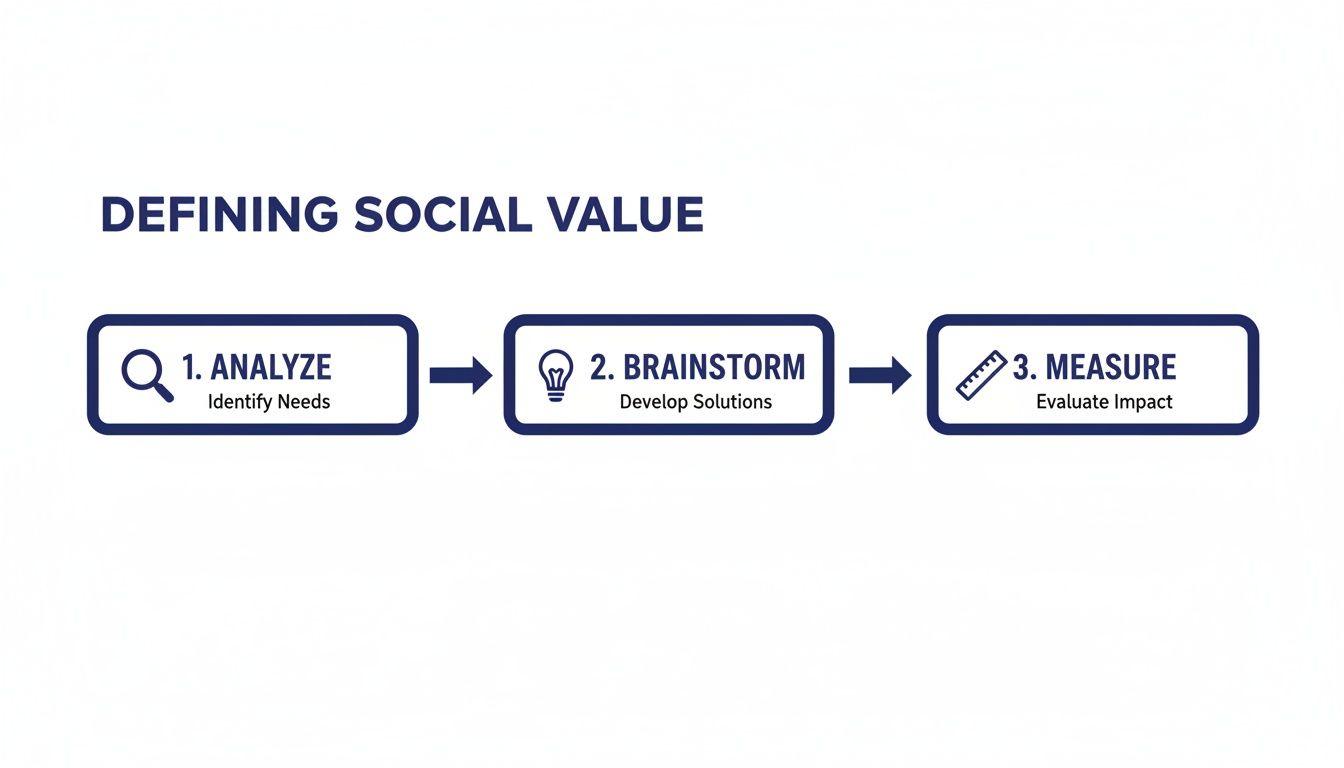
It lays out a clear path from analysing the tender and brainstorming your strengths to, crucially, putting measurable commitments on the table.
Structure Your Response for Easy Scoring
Evaluators are always short on time. They have a pile of submissions to get through and a marking sheet to fill in. Your job is to make it as easy as possible for them to give you the marks.
Structure your response with clear headings that mirror the questions asked in the tender. Use bullet points and bold text to make your specific commitments and KPIs jump off the page. Whatever you do, don't bury your best points in a wall of text.
A good, scannable structure might look something like this:
- Commitment 1: Creating Local Jobs
- KPI: We will create 3 new full-time roles for residents of the M4 postcode.
- Evidence: We have a proven track record, having hired 5 local people on a similar project last year. See our case study in Appendix B.
- Commitment 2: Supporting Local Businesses
- KPI: We will spend £20,000 of the contract value with SMEs based within a 10-mile radius.
- Evidence: Our current supply chain includes 4 local businesses who we have worked with for over 3 years.
This format is clean, direct, and connects your promise to your proof. For a deeper look at structuring your writing, you can find helpful tips in this example of bid writing.
Weave in Your Evidence
Promises are cheap. You have to back them up with solid evidence to make them believable. Your evidence is what proves you can actually deliver on your offer.
Don't just say you're committed to apprenticeships. State that you've successfully trained 12 apprentices over the last five years, with 80% of them going on to secure full-time employment with your company.
This is where your case studies, client testimonials, and past performance data become your most powerful assets. Attach them as appendices and refer to them directly in your response. It shows you’re organised and that your commitments are built on real-world experience, not just good intentions.
Automating the Heavy Lifting With AI
Let’s be honest. Gathering all this information and crafting a unique, persuasive narrative for every single bid is incredibly time-consuming. It’s a huge drain on resources, especially for smaller teams. A decent social value response can easily take 20-30 hours to write from scratch.
This is exactly why we built Bidwell. First, you populate your Knowledge Base with all your social value proof points—case studies, local hiring stats, environmental policies, apprenticeship records. Think of it as your company's memory bank for everything that makes you a great supplier.
When a new tender lands from our tender monitoring service, you don’t have to stare at a blank page. You simply instruct Bidwell’s AI response generation to draft the social value section. The AI digs into your Knowledge Base, pulls the most relevant evidence, and writes a response that’s perfectly aligned with the tender's specific questions.
What used to be a 30-hour writing marathon becomes a 3-hour review. The AI handles the structure, compliance, and evidence-gathering, leaving you to refine the narrative and add that final human touch. It ensures your answer is always compelling, compliant, and backed by your strongest proof.
Real-World Examples of Social Value in Action
Theory is one thing, but seeing social value play out in the real world is what makes it all click. These aren’t just nice-to-have extras. They are concrete, contract-winning strategies that show how smart commitments can make a genuine difference.
Let’s look at how this works across different sectors. Good social value is never a one-size-fits-all solution. It’s about tailoring your offer to the specific contract and community, using your company’s unique strengths to solve a local problem.
Social Value in Construction Bids
Construction is a natural home for social value. A building project is physically rooted in a community, which creates obvious opportunities to deliver benefits right on the buyer’s doorstep. It's about more than just bricks and mortar; it's about building a legacy.
Imagine a construction firm bidding on a new council housing development. Instead of just promising quality work, they commit to:
- Local Sourcing: Pledging that 60% of all building materials, from aggregates to fittings, will be bought from suppliers based within a 20-mile radius.
- Local Labour: Guaranteeing that 1 in every 10 site jobs will be offered to a long-term unemployed person from the local borough.
- Community Engagement: Donating 50 hours of staff time to help renovate a nearby dilapidated community garden, using leftover materials from the site.
This offer works because it’s specific, measurable, and directly tackles local economic and social priorities. The firm isn't just building houses; it's investing in the local economy, creating jobs for those who need them most, and improving community spaces.
Social Value in IT and Professional Services
You might think social value is harder to demonstrate in sectors like IT or consulting, but that's not the case at all. The focus just shifts from physical impact to skills, knowledge, and opportunity.
Consider an IT company bidding for a contract to manage a local authority's digital services. A winning social value offer might include:
- Digital Skills Training: Partnering with a local charity to deliver 10 free workshops on digital literacy for older residents, helping them access vital online services.
- Work Placements: Offering 3 paid internships to students from the local college who are studying IT-related courses.
- Volunteering: Allowing staff to use 2 paid workdays per year to provide pro-bono tech support to local non-profits.
This is powerful stuff. It addresses the digital divide, creates pathways into the tech industry for local young people, and provides valuable support to the third sector.
An evaluator sees this and thinks, "This company isn't just a service provider; they are a community partner who will help us tackle our social challenges."
The Local Government Opportunity
Local government procurement is where SMEs can really shine. With UK local authorities spending around £100 billion annually, they are a huge market for businesses that are smart about their community contributions. This spending is increasingly focused on local recovery and resilience, making authentic social value offers more important than ever. You can explore the latest insights on government strategic suppliers to see how the market is shifting.
Here are a few simple, practical ideas that you could adapt for your next bid.
Social Value Ideas by Sector
This table shows how different types of businesses can make relevant, measurable commitments. Use these as a starting point for your own brainstorming.
| Sector | Example Commitment | Potential KPI |
|---|---|---|
| Facilities Management | Support mental health awareness for building users. | Run 4 free wellbeing workshops on-site per year. |
| Professional Services | Boost social mobility for local youth. | Provide 100 hours of mentoring to students at a local secondary school. |
| IT Services | Reduce e-waste and support the circular economy. | Refurbish and donate 20 decommissioned laptops to a local community centre. |
As you can see, social value isn't about grand, expensive gestures. It's about being thoughtful and specific. The key is to find the intersection between what the buyer needs, what the community needs, and what your business can realistically deliver.
This is where planning saves you time. By storing these examples and your own company's achievements in Bidwell’s Knowledge Base, you create a library of proven social value commitments. When our tender monitoring flags a new opportunity, the AI response generator can instantly pull the most relevant examples, crafting a compelling and evidenced narrative that shows you’re the right partner for the job.
How to Report on Your Social Value After You Win
Winning the contract isn't the finish line; it’s the starting gun. Your social value commitments were a core reason you won, and now you have to prove you’re delivering on them.
This isn't about creating a bureaucratic headache for yourself. It’s about accountability, building trust, and showing you’re a supplier who keeps their word.
The Procurement Act puts a heavy emphasis on contract management and delivery. Public bodies are now expected to track supplier performance closely, and that absolutely includes the social value promises you made in your bid. Getting this right strengthens your relationship with the client and can lead to more work in the future.
Setting Up a Simple Monitoring System
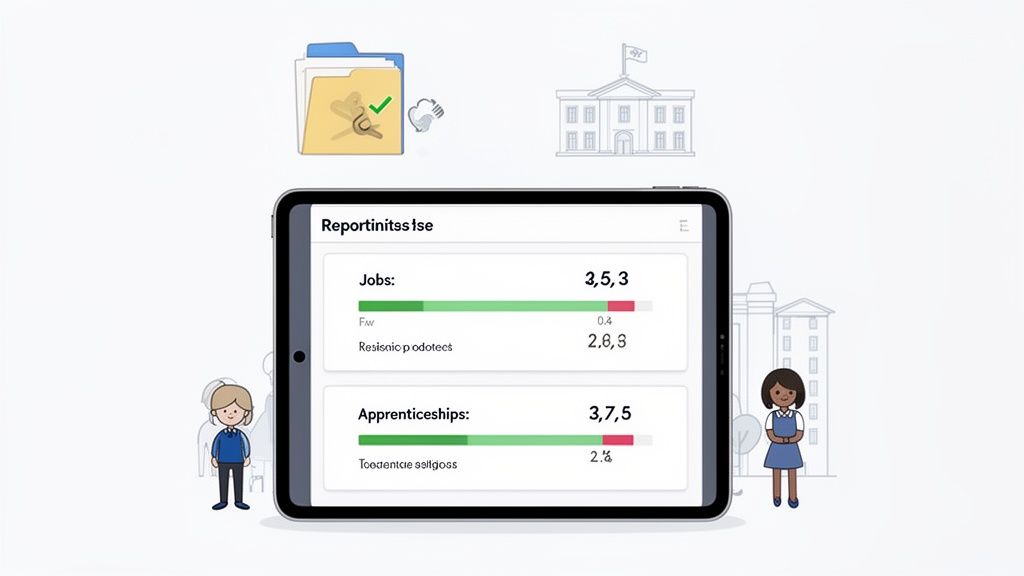
You don't need complicated software to track your progress. A simple spreadsheet is often enough to get started. The key is to be organised from day one of the contract, not scrambling for data a week before your first performance review.
For each social value KPI you committed to, you need to track:
- The KPI: What was the exact promise? (e.g., "Create 3 new apprenticeships for local school leavers").
- The Target: What is the final number or goal?
- Current Progress: Where are you now? (e.g., "Hired 1 apprentice, recruitment open for 2 more").
- Evidence: How can you prove it? (e.g., "Apprenticeship agreements, payroll records").
This simple setup turns reporting into a straightforward data-entry task rather than a panicked investigation.
Being proactive about monitoring shows the client you're serious about your commitments. It demonstrates that social value is part of your operational DNA, not just something you wrote to win the bid.
Once you have the data, you need to present it clearly. For some tips on structuring your updates, check out guides on writing effective business reports to ensure your reporting is clear and impactful.
What to Include in Your Progress Reports
When you report back to the client, they want clarity, not waffle. Your report should be concise, direct, and packed with evidence. Structure it clearly, addressing each of your social value commitments one by one.
For each promise, include a short narrative explaining what you’ve done, followed by the hard data. For example, instead of just saying "we supported a local charity," say "we delivered 25 hours of pro-bono IT support to the Ancoats Community Food Bank in May, helping them set up their new stock management system."
If you're struggling to frame these updates, our guide on how to write a method statement can offer some useful structural tips.
Closing the Loop for Future Bids
This is where you get really smart. The data you collect isn't just for this one contract. It's gold dust for your future bids.
Every successful social value initiative becomes a powerful new case study. Every piece of positive feedback from a community partner is a testimonial you can use again. You need a system to capture this information and feed it back into your business.
This creates a powerful feedback loop. The performance data from your current contracts becomes the hard evidence that proves your promises in future tenders. This is precisely what Bidwell’s Knowledge Base is designed for.
As you complete projects, you should continuously update your Knowledge Base with these new stats, case studies, and testimonials. When our AI response generation tool drafts your next bid, it won't just pull from your old promises. It will use your latest, proven results. This makes your future social value offers more credible, more powerful, and much more likely to win.
Frequently Asked Questions
Got questions? Good. The world of social value can feel a bit murky at first. Let's clear up three of the most common queries we hear from bid managers.
What's the Difference Between Social Value and CSR?
This is a great question, and the answer is crucial.
Think of Corporate Social Responsibility (CSR) as your company's own initiative. It’s you deciding to donate to a local charity or giving staff a day off to volunteer. It’s driven by your values, on your terms.
Social value in a tender is completely different. It’s not about what you want to do; it’s about what the buyer needs you to do. It’s a formal, contractual obligation linked directly to the priorities of the local community you’ll be serving.
It’s CSR with a formal brief and a marking sheet.
Do I Have to Spend a Lot of Money on This?
Absolutely not. This is a myth that holds back so many brilliant SMEs.
Evaluators aren't looking for a grand, expensive gesture. They're looking for thoughtful, relevant, and measurable commitments that are proportionate to the contract's size and value.
Often, the highest-scoring social value offers are low-cost or even no-cost actions that are a natural extension of how you already work. Things like offering a work experience placement, switching your office stationery order to a local supplier, or running a free skills workshop for a nearby community group can score incredibly well without costing a fortune.
How Can I Possibly Compete with Larger Companies?
You don’t just compete; you can often beat them. This is your home turf.
As an SME, you have natural advantages. You're more agile. You have deeper roots in the local community. You can make credible commitments to hiring and spending locally that a big national firm simply can't match.
A huge company can promise to support the local economy, sure. But when you can name the local suppliers you already use, or point to the team members who live down the road, your bid is instantly more believable.
The key is turning that local knowledge into a strategic weapon. And this is where being organised makes all the difference.
By using Bidwell's tender monitoring, you'll spot those local opportunities first. Storing all your local credentials—from employee postcodes to local supplier invoices—in your Knowledge Base means our AI response generation can instantly craft a bid that showcases your deep community connection, turning your size into your greatest strength.
Stop drowning in tender paperwork and start winning. With Bidwell, you can find the right opportunities, build a powerful knowledge base, and let AI generate compelling, compliant responses in a fraction of the time. Visit https://bidwell.app to see how it works.


