
What Is a Dynamic Purchasing System for Public Sector Contracts?
So, what exactly is a dynamic purchasing system?
Think of it as an electronic, pre-approved list of suppliers that public sector bodies use to buy common goods and services. The key part? This list is always open for new businesses to join. This makes it a much more flexible and accessible route to winning public contracts.
Understanding the Dynamic Purchasing System
The best way to picture a DPS is as a members-only online shop for the public sector. Before a supplier can sell anything, they first have to apply for membership. The "shop owner"—the public body—checks that the supplier meets a set of basic standards. If you pass the check, you’re in.
Once you're a member, you get to see all the requests for quotes that the public body posts. Just being on the list doesn’t guarantee you'll get work. It just gives you the chance to bid on every single opportunity that comes up.
This isn't about landing one big contract. It’s a system designed for lots of smaller, recurring needs. For example, a local council might set up a DPS to source IT hardware. A housing association could use one for finding temporary staff.
What Makes It ‘Dynamic’?
The clue is in the name. Unlike a traditional framework agreement where the list of suppliers is locked in for years, a DPS stays open. A new supplier can apply to join at any point during its lifetime.
A DPS is a live marketplace for pre-qualified suppliers. It doesn’t shut the door on new businesses. It doesn’t take six months to re-tender. It’s more like a rolling invitation: if you meet the criteria, you’re in.
This "always open" approach is a massive advantage for small and medium-sized enterprises (SMEs). You don't have to wait years for a major tender to come around. If you’re ready to supply, you can apply to get on the list.
Here's a quick rundown of what defines a DPS.
DPS at a Glance: Key Features
| Feature | Description | What This Means for Suppliers |
|---|---|---|
| Always Open | Suppliers can join at any time throughout the DPS's lifespan, provided they meet the pre-qualification criteria. | No more waiting years for a framework to be re-tendered. You can apply whenever your business is ready. |
| Two-Stage Process | Stage 1: Prequalification to get on the list. Stage 2: Mini-competitions for specific contracts among approved suppliers. | The initial hurdle is lower. Once you're on, you only compete against other qualified suppliers for actual work. |
| Fully Electronic | The entire process, from application to bidding, is managed through an online portal. | It’s efficient and paperless. All communication and submissions are handled digitally, which speeds things up. |
| Lighter Touch | Tends to be less complex than a full tender for a framework, focusing on standard, common requirements. | Often a more straightforward entry point into public procurement, especially for SMEs. |
This structure makes the DPS a much more agile and supplier-friendly way for public bodies to buy what they need.
Why This Matters for Your Business
Because a DPS is always open and new opportunities pop up all the time, you have to stay on the ball. You can't just check a portal once a year and hope for the best.
This is where a tender monitoring service like Bidwell becomes essential. It constantly scans for new DPS opportunities. It also alerts you to mini-competitions on those you’ve already joined, so you never miss a chance to bid.
Being prepared is also key. When you apply to a DPS, you'll need standard documents and company information ready to go. Bidwell’s knowledge base lets you store and organise all this, turning a lengthy application into a much quicker task. Once you're on the DPS, the AI response generation can help you turn around high-quality bids for mini-competitions fast.
How a DPS Stacks Up Against Frameworks and Contracts
It’s easy to get procurement terms mixed up. You hear about a Dynamic Purchasing System, and it sounds a lot like a framework agreement or just another government contract. They’re all ways the public sector buys things, but how they work for suppliers couldn't be more different.
Let's start with the simplest: a standard, one-off contract. A buyer needs something specific, they run a tender, pick one supplier, and award the job. Once it's done, it's done. No pre-approved lists and no ongoing relationship. It's the most straightforward transaction.
Frameworks and a DPS are different. They both create a pool of pre-qualified suppliers that buyers can call on for future work. That's where the similarities end. The main difference comes down to one simple question: can new suppliers join once it's set up?
The Closed Door of a Framework Agreement
Think of a traditional framework agreement like a private club with a one-time membership drive. A public body decides it will need marketing services over the next four years. It runs a big, upfront tender, selects a handful of the best agencies, and puts them on the framework.
Once that list is finalised, the door slams shut. No other agency can join for the entire life of the agreement, which can be up to four years. If you miss that initial tender, that's it. You've missed your chance until the whole thing is re-procured from scratch years later.
The key thing to remember about framework agreements is their static nature. The suppliers are fixed from day one. This creates a predictable but closed shop for both buyers and suppliers.
For businesses, this means you have to be ready at the exact moment the tender is published. It also means the opportunities are often larger and less frequent. Buyers are looking for partners to cover long-term needs. To get the full picture, you can learn all about what a framework agreement is in our detailed guide.
The Open Door of a Dynamic Purchasing System
A DPS, on the other hand, is the complete opposite. It operates with a permanent open-door policy. It's set up for a specific period, just like a framework, but new suppliers can apply to get on the list at any point. As long as you meet the pre-qualification criteria, you must be let in.
This flexibility is the defining feature of a DPS. It’s a huge advantage for everyone. Buyers get access to an ever-growing pool of talent and new ideas. Suppliers—especially SMEs—can get involved whenever they’re ready, not just during a brief window every few years.
This creates a totally different rhythm of opportunities. Instead of huge, infrequent bids, a DPS is all about a steady stream of smaller, quicker 'mini-competitions'. A local council might use a DPS for school transport, for instance. They invite all approved suppliers to bid for individual bus routes as they become available.
Comparing the Three Procurement Routes
Seeing the options side-by-side really makes the differences click. It helps you see where your business might fit best.
DPS vs Framework Agreement vs Single Contract
| Attribute | Dynamic Purchasing System (DPS) | Framework Agreement | Single Contract |
|---|---|---|---|
| Supplier Access | Always open. New suppliers can join at any time. | Closed. Suppliers are fixed for the entire duration. | N/A. One supplier is chosen for one specific job. |
| Opportunity Type | Frequent, smaller mini-competitions for specific needs. | Larger, less frequent 'call-off' contracts. | A single, one-off project or purchase. |
| Good for SMEs? | Excellent. The open access and smaller contract sizes are ideal. | Challenging. Can be hard to get onto the initial list. | Good for specific projects that match their expertise. |
| Flexibility | High. Buyers can access new suppliers and market innovations. | Low. The buyer is limited to the pre-selected suppliers. | Very low. The terms are fixed for a single transaction. |
This comparison shows exactly why a DPS is such a great entry point for businesses new to public contracts. You aren't penalised for not being ready for a tender that only comes around every four years. You can join when it suits you.
This means you need to organise your bidding strategy differently. With Bidwell's tender monitoring, you can track both the initial notice to join a DPS and the mini-competitions that follow. Your knowledge base becomes your secret weapon for responding quickly to these bids. Our AI response generation helps you turn around tailored submissions in hours, not weeks.
A Step-by-Step Guide to Joining and Bidding on a DPS
So, you're ready to get involved with a Dynamic Purchasing System? It's a great move, especially for SMEs. The whole process is much less intimidating than a full-blown tender and is broken down into two clear stages.
First, you apply to get on the ‘approved list’ of suppliers. Once you're on, you're clear to bid for specific contracts through ‘mini-competitions’. Let’s walk through exactly what happens at each step.
Stage 1: Getting on the Approved List
Your first job is simply to get your company onto the DPS. This initial phase is all about proving you meet the buyer's minimum standards. You're not competing against other suppliers on price or quality yet. You're just showing you're a credible and capable business.
This is where you'll face a set of pre-qualification questions, usually packaged as a Selection Questionnaire (SQ). The buyer just needs to see some basic information to verify your business.
What you'll typically need to provide:
- Company Details: Your registered name, address, company number, and VAT number.
- Financial Standing: Evidence of your financial stability. This might mean sharing recent accounts or turnover figures.
- Accreditations and Policies: Proof of relevant certifications (like ISO 9001 for quality) and key policies (like Health & Safety or Environmental).
- Experience: Examples of similar work you've completed in the past.
A bit of preparation really pays off here. Having a well-organised knowledge base is invaluable. With a tool like Bidwell, you can store all these documents and standard answers in one place. Instead of hunting for certificates and policy documents for every single application, you can pull them instantly, making the whole process much faster.
To get a better feel for the kinds of questions you'll face, check out our guide on what is a pre-qualification questionnaire.
The key thing to remember about this first stage is that it’s a pass/fail test. If you meet the criteria, the public body must admit you to the DPS. They typically have to assess your application within 10-15 working days.
Organising Your Documentation
When you're navigating the process of joining a DPS, an efficient way to manage your documents is absolutely critical. You might want to consider using a dedicated procurement document request system to keep everything organised and accessible. This ensures you can respond to requests quickly and without that last-minute panic.
The following flowchart shows the key differences between the open-door policy of a DPS and the more restrictive nature of frameworks and one-off contracts.
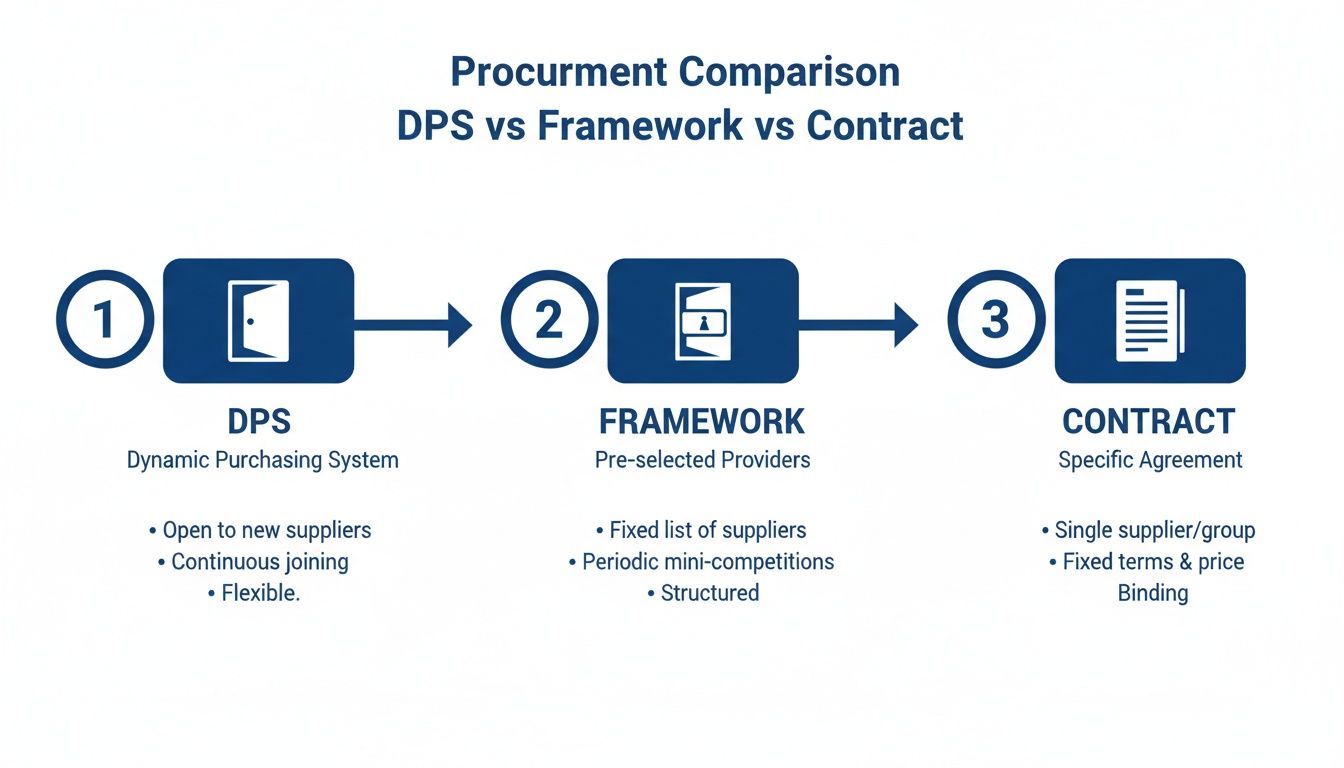
This visual really highlights why a DPS is so much more accessible for growing businesses; the door is always open for you to prove your credentials and join the list.
Stage 2: The Mini-Competition
Once you're on the approved list, you're in the game. Now, whenever the buying organisation has a specific need, they'll invite all suppliers on that DPS to bid for the contract. This is called a mini-competition.
These aren't like full-scale tenders. They are usually much quicker and far less complex. For example, a council might need 50 new laptops. They'll send out a simple request to all approved IT hardware suppliers on their DPS, just asking for a price and a delivery date.
The process usually follows these steps:
- Invitation to Tender (ITT): The buyer issues an ITT to every supplier on the DPS. This document outlines the specific requirements of the job.
- Supplier Response: You submit your bid. This will normally include your pricing and a short explanation of how you'll meet the specific requirements.
- Evaluation: The buyer evaluates the bids based on the criteria they set out (e.g., price, quality, delivery time).
- Award: The contract is awarded to the winning supplier.
The turnaround time for these mini-competitions is often very short, sometimes just a few days. You have to be able to react quickly to stand a chance of winning.
This is where technology really helps. Bidwell’s tender monitoring ensures you see the invitation as soon as it's published. Then, using the information stored in your knowledge base, the AI response generation tool can help create a tailored, high-quality response in a matter of hours, not days. This speed and efficiency are exactly what you need to compete effectively.
Why Are Public Bodies Suddenly Using DPSs Everywhere?
To bid well, you have to get inside the buyer's head. So, why are UK public sector organisations flocking to Dynamic Purchasing Systems? It’s not just a trend. It comes down to a need for speed, flexibility, and a better way to tap into the full range of suppliers out there.
Traditional procurement is often a slow, rigid beast. Setting up a big framework agreement can take the best part of a year. Once the suppliers are picked, that list is locked in, sometimes for four years or more. This old model just can't keep up with fast-moving markets or urgent needs.
A DPS, on the other hand, neatly sidesteps many of these headaches from the buyer’s point of view.
The Need for Speed and Efficiency
Public bodies are under constant pressure to do more with less. A DPS lets them buy common goods and services much faster than going through a full traditional tender every time. Once the DPS is up and running, a buyer can run a mini-competition and award a contract in as little as a couple of weeks.
Think about services with unpredictable demand. Things like temporary staff, emergency building repairs, or ad-hoc transport services. A council doesn't want to launch a massive, months-long tender every time it needs a new minibus route covered for a school. With a DPS, they just run a quick mini-competition among pre-approved suppliers. Job done.
This drive for efficiency is fuelling huge growth. The global market for DPSs is forecast to hit USD 1980 million by 2032, a massive jump from USD 950 million in 2026. This isn’t a niche tool; it’s rapidly becoming a mainstream procurement method. You can dig into the numbers and see the market growth projections and what's behind them.
Tapping into a Wider, More Competitive Market
One of the biggest frustrations for public buyers is watching competition on their long-term frameworks dwindle. Over a four-year term, suppliers might get acquired, change direction, or just stop bidding. The buyer can end up with only a couple of active suppliers to choose from, which is terrible for value for money.
A DPS completely solves this problem.
Because a Dynamic Purchasing System stays open for new suppliers to join at any time, buyers get a constantly refreshed pool of pre-qualified businesses. This guarantees healthy competition and gives them access to the latest market innovations, not just what was available two years ago.
This is a big plus for getting Small and Medium-sized Enterprises (SMEs) into the public sector supply chain. Most smaller businesses can't justify the huge time and cost of bidding for a place on a four-year framework. The lower barrier to entry and rolling admissions of a DPS make it far more accessible. For buyers, that means more choice, better value, and the ability to support local economies.
Building a Consistent Pipeline of Opportunities
For suppliers, this shift in buying behaviour is fantastic news. The explosion in DPS usage means a more predictable and steady pipeline of work. Instead of the old "feast or famine" cycle of waiting years for a major framework to come around, you now have a constant stream of smaller contract opportunities.
This is where your bidding strategy needs to get sharp. Here’s how you can get ready:
- Be Proactive: Don't just wait for work to land in your lap. A service like Bidwell's tender monitoring sends you an alert the moment a new DPS relevant to your business is published. This means you can be one of the first to get on it.
- Get Your House in Order: Have your core company information, policies, and case studies organised and ready to go. With a knowledge base in Bidwell, you can breeze through the initial qualification stage in minutes.
- Build a Rapid Response Machine: Mini-competitions often have brutally short deadlines. Having a tool like Bidwell’s AI response generation means you can create a high-quality, tailored bid for these smaller contracts quickly. This gives you a serious competitive edge.
The rise of the DPS isn't just a passing phase. It's a fundamental change in how the public sector buys its everyday goods and services. Once you understand why buyers are making this switch, you can position your business to meet their needs head-on and start winning a lot more contracts.
The Future of Public Procurement with Dynamic Markets
The world of public procurement doesn't stand still. If you’re a UK business that relies on public contracts, some big changes are on the horizon. The rulebook is being rewritten, and the familiar Dynamic Purchasing System is evolving. Getting your head around this shift is essential if you want to keep winning work.
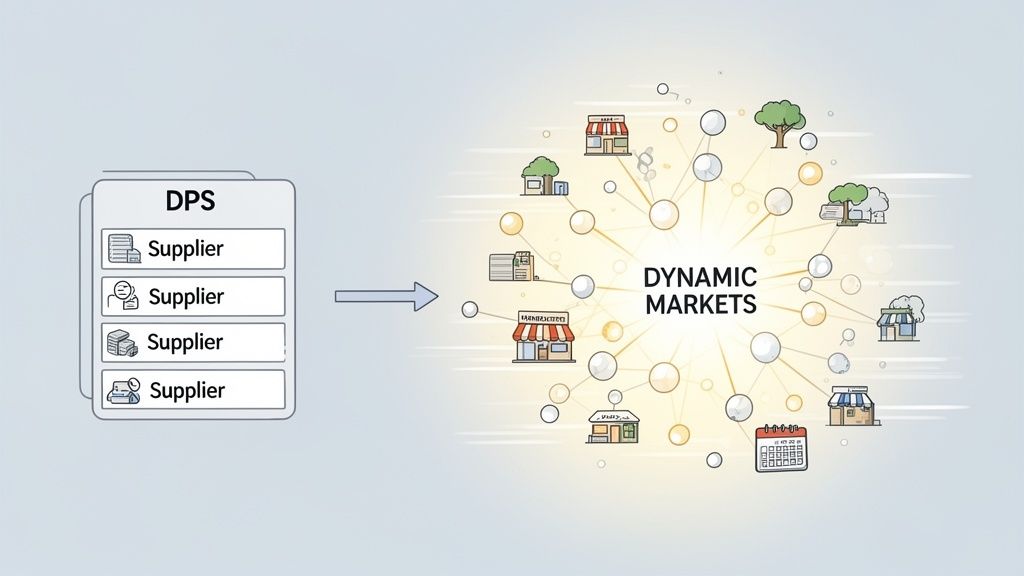
The main driver behind all this is the new Procurement Act 2023. This is a major piece of legislation set to overhaul how the public sector buys pretty much everything. One of its most significant changes is the introduction of a new concept called a ‘Dynamic Market’, which will replace the DPSs we’ve all got used to.
What Is a Dynamic Market?
So, what exactly is a Dynamic Market? The simplest way to think of it is as DPS 2.0. It’s an evolution, designed to be even more flexible and open than its predecessor.
The core idea of an 'always open' list of pre-approved suppliers remains firmly in place. But the new system aims to break down even more barriers for businesses, especially for SMEs trying to get a foot in the door.
The government’s stated goal here is to create a simpler, more transparent, and commercially-minded procurement system. Dynamic Markets are a key part of that vision. They’ll operate a lot like a DPS but with fewer restrictions and a broader scope. This will make it easier for public bodies to buy a wider range of goods and services through this flexible route.
This isn't just a simple rebranding exercise. The move from a Dynamic Purchasing System to a Dynamic Market represents a fundamental shift in philosophy. The new rules are designed to give buyers more commercial freedom while making it easier than ever for suppliers like you to get involved.
Key Changes You Need to Know
While the full details are still bedding in, the direction of travel is clear. This is all about increasing flexibility and cutting the red tape for both buyers and suppliers. It's a direct response to feedback that the old rules could often feel a bit too rigid.
The new Procurement Act 2023 is officially replacing Dynamic Purchasing Systems with Dynamic Markets from October 2024. A key feature is that Dynamic Markets allow suppliers of all sizes to join at any point, with no upper limit on the number of participants. This really opens the door for smaller businesses that might have been excluded under the old rules. You can find more detail on the transition and what these new procurement thresholds mean for your business.
This change introduces several new opportunities for suppliers:
- Broader Scope: Dynamic Markets can be used for a much wider range of requirements than the current DPS. A DPS is often limited to more common goods and services.
- Increased Flexibility: The new rules give public bodies more freedom in how they design and run their markets. This could lead to more innovative and supplier-friendly approaches emerging.
- Simpler Processes: The clear aim is to simplify the qualification and bidding stages, reducing the administrative headache for your business.
For any business serious about public sector contracts, this is a critical moment. The introduction of Dynamic Markets is designed to level the playing field, making it easier for agile and innovative SMEs to compete and win.
This transition means you need to stay informed and be ready to adapt. The principles of being prepared and responsive that work for a DPS today will be even more vital in the new world of Dynamic Markets.
How to Prepare for the Change
The shift from a DPS to a Dynamic Market isn't something to worry about. Far from it. You should see it as a huge opportunity. The new system is being built to make your life easier and to open up more avenues for work.
The best way to prepare is simply to double down on the good habits that make you a successful bidder today. Your ability to react quickly to new opportunities will be your greatest asset. With more flexibility comes a faster-moving marketplace, and you need the right tools to keep up.
This is where a platform like Bidwell becomes indispensable.
- Stay Ahead of the Curve: Our tender monitoring service won't just track old-style DPS notices. It will be fully updated to find and alert you to every new Dynamic Market that matches your business profile, making sure you're first in line to join.
- Be Ready to Go: Having all your company documents, policies, and case studies organised in your knowledge base is crucial. When a new market opens, you can apply in minutes, not days.
- Respond with Speed and Quality: The faster pace means you'll need to turn around bids for mini-competitions quickly. Bidwell's AI response generation lets you create high-quality, tailored submissions in a fraction of the time it would take to do it manually.
The future of public procurement is dynamic by name and dynamic by nature. By understanding these regulatory shifts and equipping your business with the right technology, you'll be perfectly positioned to thrive in this new, more open marketplace.
Common Supplier Mistakes and How to Avoid Them
Getting your business onto a Dynamic Purchasing System is a great first step, but it’s just that—a first step. The real prize is winning work, and this is where so many suppliers stumble. It’s surprisingly easy to fall into bad habits that burn time and, worse, leave valuable contracts on the table.
Let's walk through the most common mistakes we see and, more importantly, how to sidestep them. This is about turning your DPS membership into a genuine source of revenue, not just a certificate on the wall.
The ‘Join and Forget’ Trap
One of the biggest errors is what we call 'join and forget'. A company puts in all the hard work to get onto a DPS, gets the approval email, breathes a sigh of relief, and then… nothing. They sit back and wait for the invitations to roll in, assuming the work will now come to them.
But being on the list just means you’re eligible to bid. It doesn't guarantee you'll be invited to everything, or even see every opportunity. You still have to be proactive. This is where a tender monitoring tool is non-negotiable. A service like Bidwell doesn't just find the initial DPS for you. It alerts you the second a mini-competition is released, so you can jump on it immediately.
Submitting Generic, Copy-Paste Bids
When mini-competitions come thick and fast, the temptation to fire off a generic, one-size-fits-all response is huge. You find a similar bid you wrote last month, copy and paste a few answers, change the client's name, and hit send. This is almost always a losing strategy.
Buyers can spot a generic bid a mile off. Even on smaller, supposedly simpler contracts, they want to see that you’ve read and understood their specific problem. Always tailor your response. Reference their requirements, use their language, and show you're paying attention. If you need a refresher, our guide on how to write a tender bid has practical tips for making your submissions hit the mark.
A tailored bid, even for a small contract, demonstrates professionalism and commitment. It tells the buyer you’re not just chasing any work; you’re focused on delivering their work.
Disorganised Document Management
Mini-competitions often have brutally short deadlines—sometimes just a handful of days. If you’re spending the first two of those days scrambling to find your latest insurance certificates, policy documents, or relevant case studies, you’re already behind. Disorganisation is a killer when bidding on a DPS.
This is where a central knowledge base becomes your most valuable asset. Having all your key company information, standard responses, and evidence stored in one place, like within Bidwell, is a big help. You can pull accurate, up-to-date information in seconds. This frees you up to spend your precious time on the part that actually wins the work: tailoring the bid, not wrestling with admin.
Failing to Track and Learn
Finally, a surprising number of suppliers don't track their bidding activity with any real discipline. They bid on everything that moves, but they have no idea what’s actually working. You should be tracking your win/loss rate for each DPS, and even for different types of work within it.
Are you always losing on price? Are your quality scores consistently letting you down? This data is gold. It tells you where to focus your energy. If you've lost 10 bids in a row on a particular DPS, it might be time to radically change your approach or simply cut your losses and focus your resources elsewhere. Bidwell’s AI response generation can help improve the quality of your answers, but tracking your performance is what tells you where that effort is best spent.
Got Questions About Dynamic Purchasing Systems? Here Are Some Quick Answers
We’ve covered the main ideas, but a few specific questions always pop up. Here are the quick, practical answers we give to businesses trying to get to grips with how DPSs actually work.
Is There a Limit on How Many Suppliers Can Join?
Nope, none at all. Any supplier who meets the basic, pre-defined criteria must be allowed on.
This is what makes a DPS so different from a traditional framework, which is like a closed club with a fixed number of members. The doors to a DPS are always open. For small businesses, this is huge. It means you don't have to wait four years for a framework to be re-procured to get a shot at the work.
How Long Does It Take to Get Accepted Onto a DPS?
It's far quicker than a full-blown tender process. Once you’ve submitted your application, the public body has to assess it within 10-15 working days. You won’t be left in limbo for months.
The application is usually a standard Selection Questionnaire (SQ). If you have your core company details, policies, and certificates ready to go, you can get approved pretty fast. This is exactly where having your documents organised in a knowledge base like Bidwell's saves you a ton of time.
Can You Be Kicked Off a DPS?
Yes, it can happen. A buyer can remove you if you no longer meet the original entry criteria. For instance, if a mandatory insurance policy or certification lapses. You can also be removed for consistently poor performance on contracts you’ve won.
The lesson? Keep on top of your admin. Make sure all your company information is kept up to date so you remain an approved supplier, ready to bid.
Do I Have to Bid on Every Single Opportunity?
Absolutely not. You are under zero obligation to respond to every mini-competition that gets published. You get to pick and choose the contracts that are the right fit for your business.
This is a massive advantage. It means you can focus your time and energy on the tenders you have a genuine chance of winning. Using a tool like Bidwell’s AI response generation lets you respond quickly to the right opportunities, without burning hours on the ones that aren’t for you.
Ready to stop missing out on DPS opportunities and start winning more contracts? Bidwell combines tender monitoring with an AI-powered knowledge base and response generation to help you bid faster and smarter. Find out more at https://bidwell.app.