What Is a Framework Agreement? A UK Bidder's Guide
So, what exactly is a framework agreement?
Think of it less like a traditional contract and more like getting on a pre-approved list. It's an arrangement between buyers (like councils) and suppliers for a specific type of work, say, IT support.
You're not guaranteed any work just by getting on the list. But you've cleared the first major hurdle. You're in the club.
Your Guide to Framework Agreements
A framework agreement isn't a contract that promises you a set volume of orders. It creates a pool of vetted suppliers who can be called on when a buyer has a specific need. For public sector bodies, this is a huge help. It means they don't have to run a full, lengthy tender process for every single small job.
The whole thing usually works in two stages:
- Getting on the Framework: First, you bid to win a place on the framework itself. This is the main competition. You’ll need to prove your company has the capability, financial stability, and technical skill to deliver.
- Winning Call-Off Contracts: Once you’re in, you can compete for actual pieces of work, known as ‘call-off’ contracts. These are decided through smaller, faster ‘mini-competitions’ just between the suppliers on that framework.
Why Do Public Bodies Use Them?
Public bodies in the UK love frameworks. Why? They save a colossal amount of time and administrative headache.
Imagine a local council needs cleaning services for 50 different buildings. Instead of running 50 separate tenders, they can set up one framework. Then, whenever a building needs a cleaner, they simply ‘call off’ the service from their pre-approved list.
This efficiency is why their use has grown so much. Frameworks are a cornerstone of UK public procurement. In 2023, 26% of the total value of public contracts were awarded via frameworks—a big jump from just 11% in 2018. Some departments, like the Ministry of Justice, award nearly 80% of their contracts this way.
How This Affects Your Bid Strategy
For suppliers, this changes how you approach bidding. You can't just hunt for individual contracts anymore. You need a strategy for getting onto these long-term frameworks. The bid to join is often more demanding than a bid for a single project. You’re not just proving you can do one job; you’re proving your long-term value.
To get a feel for the structure of these kinds of legal compacts, you can explore various agreement templates that cover a wide range of situations.
This is where planning becomes everything. A service like Bidwell's tender monitoring is crucial for spotting these valuable framework opportunities the moment they're published. Once you've found a relevant framework, you can use our knowledge base to pull your evidence together, and then use the AI response generator to start building a compelling bid.
How Framework Agreements Work in Practice
Alright, so how does this play out in the real world? Let's walk through the typical lifecycle of a UK framework agreement.
It's a structured journey, and getting your head around it is the first step. The process starts long before you write a single word of a proposal. It begins with finding the right framework in the first place.
This is why Bidwell's tender monitoring gives you an immediate advantage. It flags new frameworks as they're published on portals like Find a Tender and Contracts Finder. It means you never miss your shot.
Single Supplier vs Multi-Supplier Frameworks
Frameworks generally come in two main flavours: single-supplier and multi-supplier. They operate quite differently.
A single-supplier framework is exactly what it sounds like. One company wins the entire agreement. This is more common for highly specialised requirements where one supplier can handle all the demand.
Far more common is the multi-supplier framework. In this setup, the buyer creates a panel of several pre-approved suppliers. This keeps things competitive and gives the buyer choice. When a piece of work comes up, they ask the suppliers on the panel to bid for it.
For SMEs, multi-supplier frameworks are the main route into public sector work. They lower the barrier to entry because you're not expected to service the entire contract value alone. You get to compete for manageable chunks of it.
The Two Routes to Winning Work
Once you've secured a place on a multi-supplier framework, the work is awarded in one of two ways. You're either given the job directly, or you have to compete for it.
The process is simpler than a full tender, but you still need to be on the ball. This flow shows the basic steps from applying to the framework to competing for individual jobs.
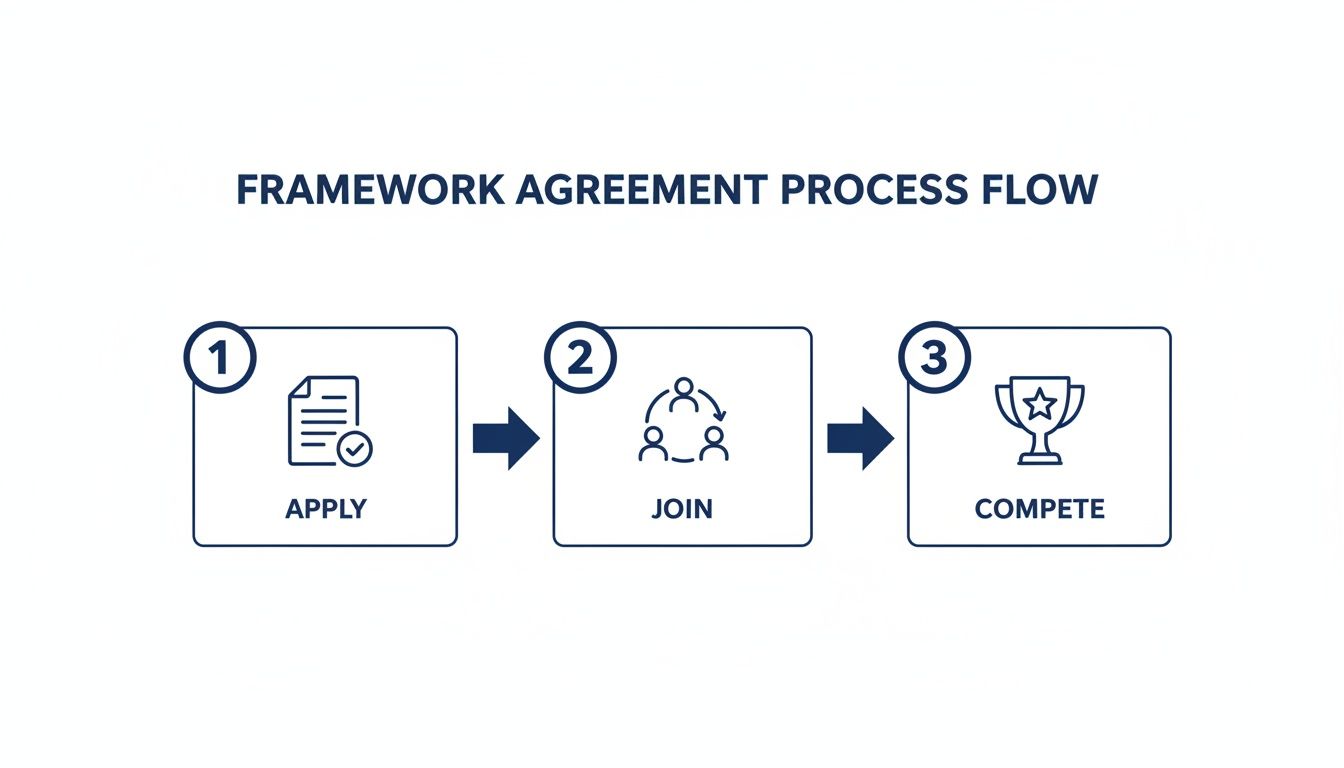
As you can see, winning your spot is just the middle step. The real action starts when you begin competing for those call-off contracts.
1. Direct Award
Sometimes, a buyer can award a contract directly to one supplier without any further competition. This is only allowed if the framework's terms clearly set out how this will be decided. For instance, the work might automatically go to the supplier who offered the best price during the initial tender.
2. Mini-Competitions
This is the most common method. A mini-competition is a smaller, quicker procurement process that’s exclusively for the suppliers on the framework. The buyer sends out their specific requirements, and you’ll submit a focused proposal.
Imagine a council has a framework for IT support with five approved suppliers. When they need a new server installed, they'll invite all five to quote. They don’t need to re-check your company's finances, because that was sorted when you joined. They just need to know who offers the best value for this specific job.
Deadlines for mini-competitions can be very tight, sometimes just a few days. Being organised makes all the difference. Scrambling for information at the last minute is a recipe for a low-quality response.
This is where Bidwell helps at both stages. Your knowledge base stores all your core information—case studies, policies, CVs—ready for the initial application. Then, when a time-sensitive mini-competition lands, Bidwell’s AI response generator uses that same library to create a quality proposal in a fraction of the time.
Types of Framework Agreements in the UK
Not all framework agreements are the same. Figuring out the differences is key to focusing your efforts where they’ll pay off. UK public procurement uses a few different models, and each one demands a different plan.
Closed Frameworks
This is the traditional model, and it’s the most common one. A closed framework has a single, one-off opportunity to get on board. When the tender is published, that’s your window. Once the suppliers are chosen, the doors are shut for the entire term, often up to four years.
If you miss that initial application, you’re out until a new framework comes along. The upside? If you do win a place, it’s a huge advantage. You’ll be competing against a known, limited pool of suppliers for years.
The downside is stark: these are high-stakes bids. Missing out can mean being locked out of a buyer's pipeline for a long time.
Open Frameworks
A newer, more flexible model is the open framework. This is a major feature of the UK's Procurement Act 2023, and it’s designed to give more businesses a fair chance.
An open framework allows the buyer to ‘reopen’ the agreement at set times, letting new suppliers apply to join. For instance, an eight-year open framework might reopen for new applications every two years.
This is great for growing businesses. You might not have been ready to bid in year one, but by year three, you have the case studies to put in a killer application.
The introduction of open frameworks is a significant shift. It means you can plan your business development around future chances to join, making public sector sales a more continuous process.
Dynamic Purchasing Systems (DPS)
Finally, we have the Dynamic Purchasing System, or DPS. It works in a very similar way to a framework and is often talked about in the same breath. A DPS is a completely electronic system for common goods and services.
Its defining feature? It’s always open.
Any supplier who meets the basic entry criteria can apply to join a DPS at any point. There's no fixed list of suppliers and no closing date. This makes it the most accessible way to get in front of public sector buyers.
Once you're on, you get invited to tender for contracts as they come up. The competition can be fiercer because new suppliers can join at any time, but the barrier to entry is much lower than a closed framework.
So, how do you keep track of all this? Your Bidwell knowledge base is perfect for it. You can create organised sections for each type of opportunity. For a high-stakes closed framework, store your best evidence. For a DPS, prepare a solid set of core responses. This organised approach means you're prepared for whatever comes your way.
How to Win Your Place on a Framework
Winning a spot on a framework is the first major battle. It’s a different kind of bid. You're proving your company is a stable, capable partner for the next several years.
Buyers aren't just looking at the price for a single job. They're evaluating your long-term health and expertise. You need to show you have the financial stability, skills, and capacity to deliver. This is a game of evidence and organisation.

Organise Your Evidence First
Before you start writing, get your house in order. A framework bid often feels like a deep audit of your business. You'll be asked for everything from financial accounts to detailed case studies.
Trying to find this information under pressure leads to a weak submission. This is where a central repository like Bidwell's knowledge base becomes your most valuable asset. It lets you gather and organise all the crucial evidence you'll need.
Your knowledge base should contain:
- Case Studies: Detailed examples of past projects, outlining the client, challenge, solution, and outcomes.
- Certifications: Copies of ISO standards, industry qualifications, and any other relevant certificates.
- Team CVs: Up-to-date details on your key people, highlighting their experience.
- Company Policies: Your policies on quality, health and safety, and social value.
Having this information organised means you can respond with solid, verifiable proof of your capabilities.
Understand the Scoring and Evaluation
Every framework tender comes with evaluation criteria and a scoring matrix. Don't just skim it—study it. This document is the rulebook for the entire game.
The buyer will break down how they allocate points, usually across quality, technical merit, and price. For example, a framework might have a 60/40 quality-to-price split. This tells you that your written answers are more important than being the cheapest. You need to focus your efforts where the points are.
A framework bid is a numbers game. If a question is worth 15% of the total score, it deserves more attention than a question worth 2%. Allocate your time based on the scoring matrix.
This is also the stage where you'll encounter a PQQ, or Pre-Qualification Questionnaire. You can learn more by reading our guide on what is a pre-qualification questionnaire. It’s a critical first step.
Build Your Quality Responses Efficiently
The quality section of a framework bid is often the most time-consuming part. It can involve dozens of long-form questions. This is where many businesses fall down. The sheer volume of writing is a lot to handle.
This is where you can turn a huge time sink into an advantage. Once your evidence is organised in Bidwell's knowledge base, you can use the AI response generator to do the heavy lifting.
The AI can take the buyer's questions and use your stored case studies and policies to draft detailed answers. It doesn't just give you a generic template; it uses your company's actual information.
This process can turn what is often a 40-hour writing task into just a few hours of review. You're not starting from a blank page. Instead, you're editing a strong first draft, freeing up your team to focus on strategy.
Securing Work Through Call-Off Contracts
So, you’ve done the hard work. You’ve organised your evidence and won your place on a framework agreement. Congratulations, you’re in.
But this is where the real work begins.
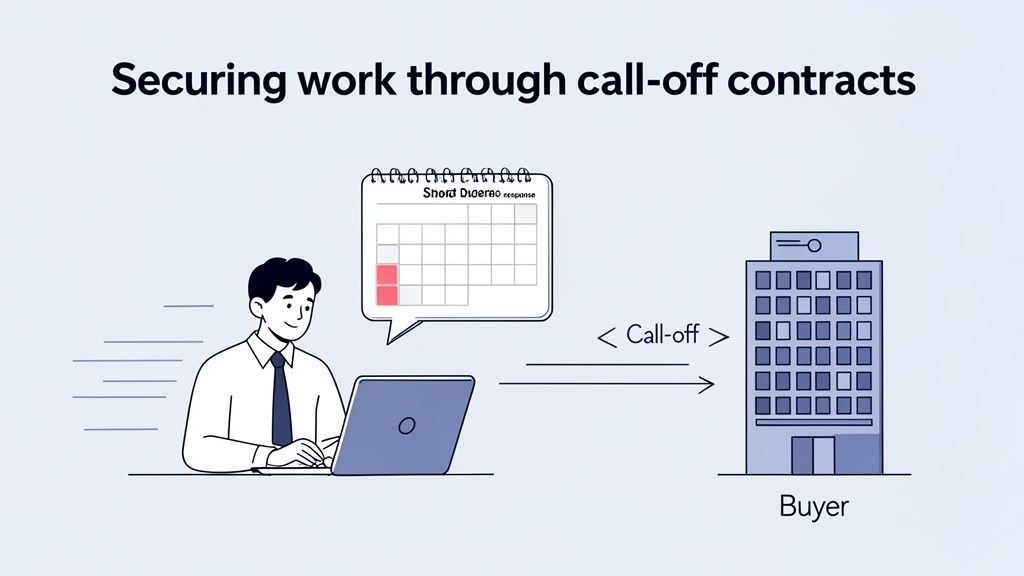
Winning a place on a framework doesn't come with a purchase order. It’s an opportunity, not a guarantee. Now you need to master the second stage: winning the individual call-off contracts.
Speed and Responsiveness Are Everything
Success at the call-off stage requires a different mindset. While the framework bid was about your long-term capability, winning mini-competitions is about speed and consistency.
Mini-competitions often come with very tight deadlines. It’s not unusual to get an invitation with only 48 or 72 hours to respond. If you’re not prepared, you’ll be scrambling. A rushed bid is almost always a losing bid.
The buyer already knows you meet the basic standards. Now they want a specific proposal for the job at hand, and they want it fast. This is where your organisation and tools give you an advantage.
From Days of Writing to Hours of Review
This is the exact problem Bidwell is designed to solve.
Imagine a mini-competition lands in your inbox on a Tuesday morning, due Thursday afternoon. Instead of panicking, you can use a smarter process.
Your Bidwell knowledge base already contains the core information from your successful framework bid. It has your case studies, team details, and answers to common questions. It’s your single source of truth.
When the mini-competition arrives, you feed the new questions into Bidwell's AI response generator. The AI draws from your content in the knowledge base to create a tailored proposal. It’s a specific response built from your own expert information.
This changes the entire dynamic. A task that would normally take a full day is reduced to just an hour or two of review. You're no longer starting from scratch; you're polishing a quality draft.
This speed gives you an incredible edge. While your competitors are still trying to find the right case study, you’re already finalising a polished response.
Managing the Buyer Relationship
Winning call-offs isn't just about responding to tenders. It’s also about building a relationship with the buyer over the life of the framework.
Be professional, responsive, and easy to work with. If you win a call-off, deliver excellent work. Your performance on one small job can influence your chances of winning the next one.
Remember to consider specific requirements in each bid. For example, many public sector contracts now focus on social value. You can learn more about how to demonstrate social value in public procurement in our guide.
By combining a proactive approach with the right tools, you can turn your place on a framework into a reliable pipeline of public sector work.
Common Framework Pitfalls and How to Avoid Them
Framework agreements can be a brilliant route to steady work, but they’re not without their traps. Too many businesses stumble after winning a place, missing out on the revenue they worked so hard to access.
Knowing the common pitfalls is the first step. Avoiding them is the next.
The ‘Bid and Forget’ Mentality
This is the big one. The most common mistake. Teams pour a massive effort into winning a spot, pop the champagne, and then... nothing. They celebrate as if the job is done and wait for the work to roll in.
It never does. A framework place isn't a guarantee of work; it's a licence to hunt for it.
Once you’re on the list, you have to actively chase the call-off contracts. If you’re not monitoring opportunities constantly, you’re invisible. The work will go to proactive suppliers who respond quickly.
This is where a dedicated system is key. Using Bidwell’s tender monitoring means you get an immediate alert for every mini-competition. It takes human error out of the equation and makes sure no opportunity slips through the cracks.
Overstretching Your Resources
Another pitfall is bidding for frameworks that aren’t a good strategic fit. It's a classic case of wishful thinking.
This wastes time on a bid that was unlikely to succeed. Or worse, it wins you a place on a framework where you can't realistically compete for the actual work.
Before bidding, be honest about your capacity. Ask yourselves: do we really have the resources to jump on short-deadline mini-competitions? Does the scope align with what we’re best at?
Your internal data is your best guide here. Your Bidwell knowledge base acts as a mirror for your company’s capabilities. By reviewing your organised case studies, you can make a quick, data-driven decision. If your evidence doesn't align with the framework's demands, it’s often smarter to pass.
A good bid strategy is as much about knowing what not to bid for. For more tips, check out our guide to winning a tender.
Misreading the Scope or Price Structure
Finally, businesses often get caught out by misinterpreting the framework's terms. They might underestimate the resources needed or misread the pricing structure, locking themselves into unprofitable rates.
Remember, the details in the initial tender documents are binding for the entire framework term.
To avoid this, treat the initial framework documents like a legal agreement. Scrutinise the scope, service level agreements (SLAs), and pricing. If anything is unclear, use the clarification question period to get a written answer from the buyer.
A few hours of proper due diligence upfront can save you from four years of commercial pain.
Your Questions, Answered
We get a lot of questions about frameworks. Here are some quick, straight-talking answers to the most common ones.
Does Getting on a Framework Guarantee Work?
Absolutely not. This is the biggest misconception.
Winning a place on a framework is like getting a backstage pass. You're on an exclusive list, but you haven't won the gig yet. You still need to bid for and win the individual ‘call-off’ contracts to see any revenue.
How Long Does a Framework Agreement Usually Last?
Most UK public sector frameworks run for a maximum of four years. You might see some for two years with an option to extend for another two.
The new Procurement Act 2023 is introducing ‘open frameworks’, which can last for up to eight years. These give suppliers more chances to join over the term. Always check the tender documents for the specific duration.
Can We Change Our Prices During a Framework?
It depends on the rules in the original agreement. Some lock in your pricing for the entire term, which is a risk with inflation.
Others include mechanisms for price reviews, like an annual adjustment linked to the Consumer Price Index (CPI). It's critical you understand these pricing rules before you bid.
You're held to the pricing structure for the full term. Getting this wrong can lock you into unprofitable work for years, so read the commercial documents carefully.
What Is a Dynamic Purchasing System?
Think of a Dynamic Purchasing System (DPS) as a more flexible cousin to the traditional framework. It's an electronic method for buying common goods and services.
The key difference? A standard framework is a closed shop. A DPS stays open for new suppliers to join at any point. This makes it a much more accessible route to market, especially for small and medium-sized enterprises (SMEs).
Finding the right frameworks and responding to fast-moving call-offs is a huge challenge. Bidwell makes it simple. Our platform combines tender monitoring with an AI-powered knowledge base and response generator, turning days of bidding into a few hours of review. Stop scrambling and start winning. Learn how Bidwell can help you secure your next public sector contract.