What is a pre qualification questionnaire? A Guide to Winning Tenders

A Pre-Qualification Questionnaire (PQQ) is the first big hurdle in most public sector bids. It’s a formal questionnaire buyers use to create a shortlist of suitable suppliers. This happens before they invite anyone to submit a full tender.
Think of it as your company’s CV for winning contracts. It’s a pass/fail gateway. Get through it, and you’re in the race. Fail, and you’re out before you’ve even had a chance to show what you can do.
Understanding the Purpose of a PQQ
At its core, a PQQ is all about efficiency. It acts as a filter, saving everyone a huge amount of time and effort.
Buyers don’t want to wade through dozens of detailed tenders from companies that don’t meet their minimum standards. You don’t want to spend days writing a full proposal you have no realistic chance of winning.
The PQQ is your chance to prove you’re a serious, capable, and compliant supplier. You’ll have to provide solid evidence covering a few key areas of your business:
- Financial Health: Showing you're stable enough to see the contract through.
- Technical Ability: Proving you have the right skills, track record, and experience.
- Compliance Records: Demonstrating you meet all the necessary legal and regulatory standards.
It’s the first step in any effective contractor management process, making sure only qualified players get to the next stage.
To get a clearer picture, here’s a quick breakdown of what a PQQ does for both sides of the table.
The Purpose of a PQQ at a Glance
| Function | Why It Matters |
|---|---|
| Risk Reduction | For the buyer, it weeds out suppliers who are financially unstable or lack the required experience, protecting public money. |
| Efficiency | It saves buyers from evaluating full tenders from unqualified companies. It saves suppliers from wasting time on bids they can't win. |
| Compliance Check | It verifies that suppliers meet mandatory legal, technical, and quality standards (like ISO certifications or specific insurance levels). |
| Capability Assessment | It allows buyers to compare suppliers' experience and technical know-how on a like-for-like basis, creating a competitive shortlist. |
In short, the PQQ establishes a baseline of quality and credibility. It’s the buyer's way of ensuring they only spend time considering serious contenders.
More Than Just Paperwork
The idea isn’t new, but it has been refined. Historically, standardised questionnaires like PAS 91, introduced in 2010, changed construction procurement by cutting repetitive paperwork. For the first time, a construction firm could complete one standard PQQ and reuse it for multiple bids.
This single move was estimated to cut down preparation time by as much as 80%. While names have evolved, the core purpose hasn’t changed. Today, you're more likely to see a Standard Selection Questionnaire (SQ), which will soon become the Procurement Specific Questionnaire (PSQ).
At its heart, a PQQ is designed to answer one simple question for the buyer: "Is this supplier credible enough to be considered for our project?"
For your bid team, this means having all your evidence organised and ready to go is non-negotiable. This is exactly where a platform like Bidwell makes a difference. It helps you build a central knowledge base for all your company's core information—case studies, certificates, policies, and key stats.
Instead of scrambling for documents every time a PQQ lands, you have everything in one place. That speed and organisation are often what separates the companies that pass this first stage from those that don’t.
Decoding the Key Sections of a PQQ
Getting your head around a PQQ means knowing its anatomy. While the layout can vary, they’re all looking for the same core information. The goal is to build a complete view of your business, from registration details to your on-site experience.
Think of it like building a case for your company. Each section adds a crucial piece of evidence. The buyer needs every piece to decide if you’re a safe bet.
Company and Financial Information
This is usually where things start, and it’s the most straightforward part. You’ll be asked for the basics: your company’s registered name, address, and Companies House number. It feels simple, but a typo here looks sloppy right out of the gate.
Then comes the financial health check. Buyers need solid proof you’re not going to go bust halfway through their project. This is a non-negotiable hurdle, so be ready to provide:
- Annual turnover figures, usually for the last two or three years.
- Copies of your company’s audited accounts.
- Proof of your insurance cover, like public liability and professional indemnity certificates.
This part is often a straightforward pass/fail. If their minimum turnover requirement is £1 million and yours is £500,000, you’re unlikely to get any further.
Technical Ability and Relevant Experience
Okay, you’ve shown you’re a stable business. Now you have to prove you can actually do the work. This is where the PQQ moves beyond the balance sheet to check your practical skills and track record.
The buyer wants to see you’ve handled similar jobs before, and they need concrete proof. Vague claims won’t cut it. The evidence you provide here is critical and typically includes:
- Case studies from at least three recent, relevant projects. Be sure to detail the scope of work, the client, and the contract value.
- Client references who can speak to the quality of your delivery and your team’s professionalism.
- Details of your team’s qualifications, any industry accreditations, and relevant training they’ve completed.
This section is all about demonstrating genuine expertise. Many of the principles for articulating your capabilities here are covered in our guide on how to write a method statement.
As the flowchart shows, each of these checks is designed to filter out unsuitable suppliers and save everyone time down the line.
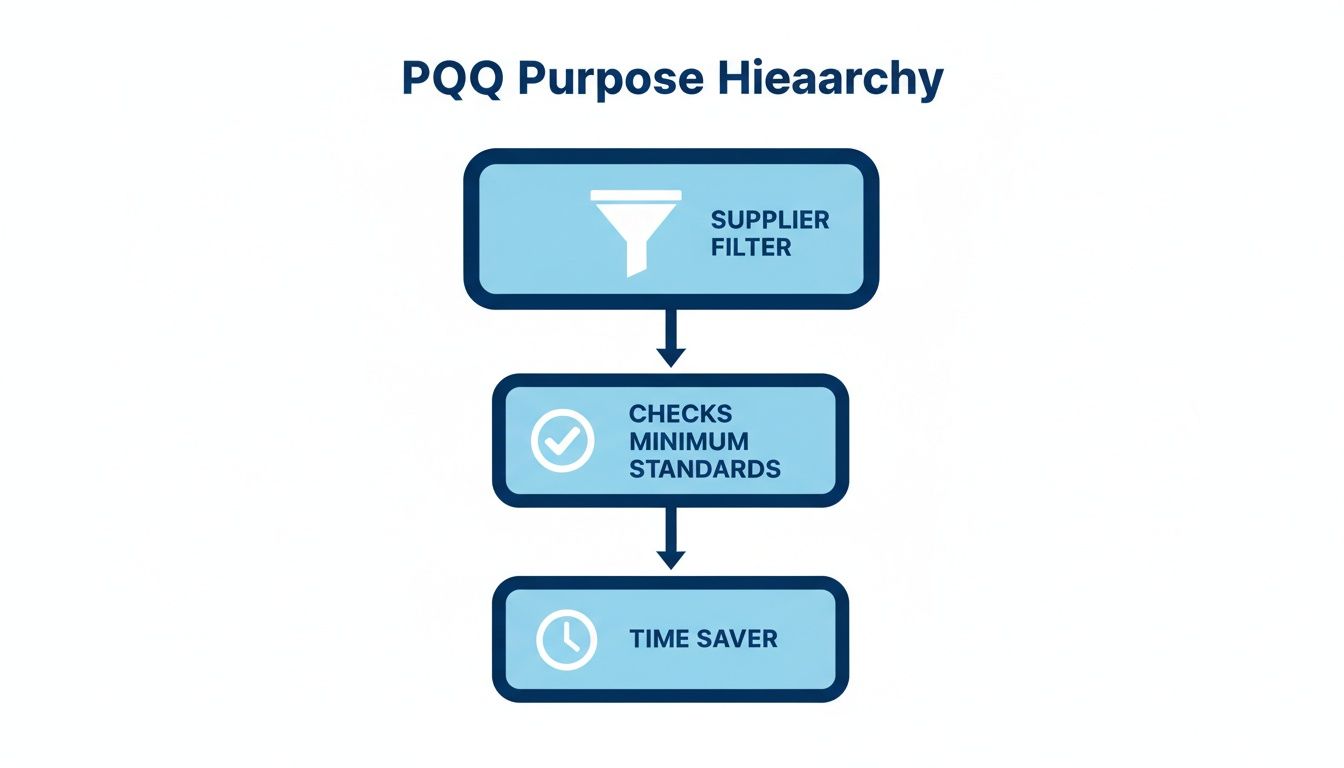
Think of the PQQ as a series of checkpoints. Only companies that can prove they are stable, capable, and compliant get to move on to the next stage.
Compliance and Management Systems
Finally, you need to show that your company operates legally, safely, and ethically. Public sector buyers have a duty to work only with responsible businesses, so this section digs into your internal policies.
Get ready to provide documents like:
- Your Health & Safety policy (often backed by an accreditation like CHAS).
- Your Quality Management policies (ideally with ISO 9001 certification).
- Your Environmental Management policies (like ISO 14001).
- Formal statements on things like modern slavery and equal opportunities.
Having all this paperwork organised is half the battle. This is where a system like Bidwell’s knowledge base is essential. Instead of scrambling for the latest certificate for every PQQ, you store everything in one central library, ready to use in seconds.
How PQQs Are Scored and Why Bidders Fail
Passing a PQQ isn't about ticking boxes. It's a numbers game, and you have to score enough points to make it through. The scoring system is often unforgiving.
For the most critical questions, many buyers use a simple pass/fail model. Certain answers are instant red flags that will get you knocked out immediately. If you have to declare a recent bankruptcy or a criminal conviction, your submission is probably going straight into the 'no' pile.
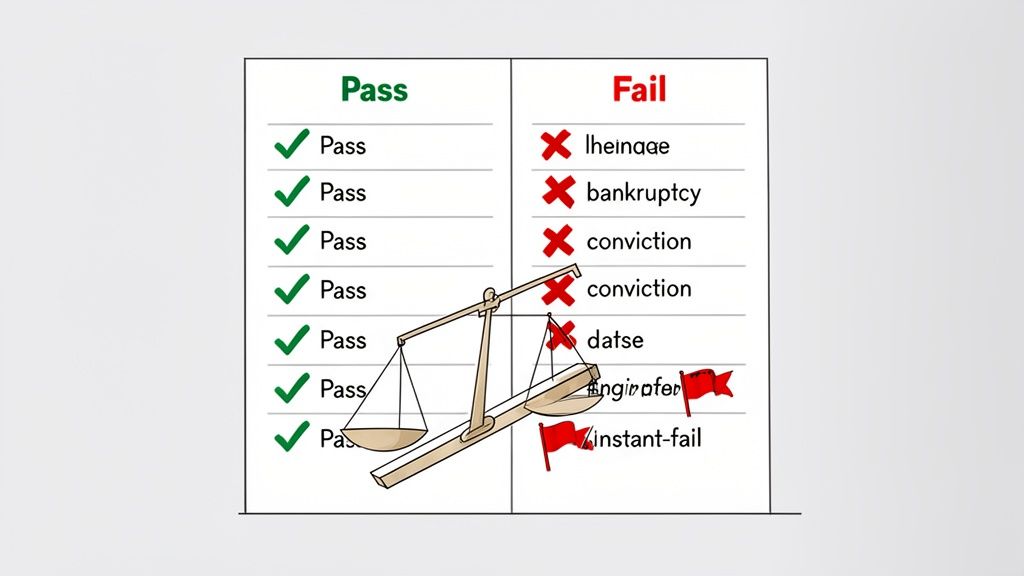
Other sections often use a weighted scoring system. Your relevant experience might be worth 40% of the total score, while your financial standing accounts for 30%. Paying attention to this weighting is crucial; it tells you exactly where to focus your energy.
The Most Common Reasons for Failure
Countless companies get tripped up at this first hurdle. The frustrating part is that the reasons are almost always avoidable. These aren't complex strategic blunders; they're simple mistakes a bit of care would prevent.
The biggest hurdles usually come down to a few key areas:
- Incomplete Answers: Leaving fields blank is a rookie error. If a question doesn’t apply, write "Not Applicable" or "N/A"—don't just leave it empty.
- Missing Evidence: It's great you have an ISO 9001 certificate, but saying so means nothing if you don't attach the document.
- Not Meeting Financial Thresholds: This is a huge one. Public buyers are incredibly strict on this to minimise their risk.
- Poorly Written Responses: Generic, copy-pasted answers that don't address the specific question scream 'low effort' to an evaluator.
A key takeaway: The PQQ is a test of your attention to detail just as much as your company's capability. A sloppy submission suggests you might be a sloppy supplier.
A Closer Look at Financial Hurdles
Let’s be clear: financial checks are tough. Around 70% of UK public buyers require a supplier’s turnover to be at least double the contract's annual value.
So, if you’re bidding for a £5 million a year framework, your business needs to show a revenue history of over £10 million. This single requirement often disqualifies a huge number of SMEs before they’ve even started.
This is why having an organised system is so important. When you use Bidwell’s knowledge base, all your financial records, certificates, and policies are stored and ready. When a tender drops, you’re not scrambling for documents; you’re ready to respond.
A structured approach is your best defence against failure. Having all your information ready in one place, combined with tools like Bidwell’s AI response generation, turns the PQQ from a major barrier into a manageable first step.
The Evolution of the PQQ: From SQ to PSQ
Public procurement never stands still, and the humble PQQ has certainly seen its share of changes. For years, businesses were stuck filling out bespoke PQQs that were slightly different for every single contract. It was a huge, repetitive headache.
To sort this out, the government brought in the Standard Selection Questionnaire (SQ). This was a genuine step forward. The SQ introduced a standardised, three-part structure that was consistent across most public sector bids.
The Rise of the Standard Questionnaire
The whole point of the SQ was to level the playing field. Part 1 was simple company details. Part 2 covered the make-or-break "exclusion grounds"—the pass/fail stuff like criminal convictions. Part 3 was where you demonstrated your company's economic, financial, and technical muscle.
The idea was brilliant in its simplicity. You could answer these core questions once, then reuse huge chunks of your response for other bids. It was a massive win for efficiency.
Looking Ahead to the Procurement Specific Questionnaire
Now, things are evolving again. The Procurement Act 2023 is ushering in the Procurement Specific Questionnaire (PSQ). While the name is changing, the core principle is the same: reduce duplication and make the process smarter.
The PSQ is designed to hook into a central government digital platform. You’ll be able to store all your core company information in one secure place, and the system will automatically pull it through for each bid. It’s a move towards a "tell us once" model, which is fantastic news for every bid team.
The shift from PQQ to SQ, and now to PSQ, is driven by one clear goal: making public procurement simpler, fairer, and more efficient for suppliers. It’s about moving away from repetitive paperwork.
The PSQ isn't just a rebrand, though. It adds new sections covering things like compliance with prompt payment rules. You can find out more about how these changes help bid teams stop wasting time on UK public sector contracts.
Keeping on top of these shifts is vital. Bidwell’s tender monitoring finds the right opportunities, and our central knowledge base keeps all your latest compliance documents and evidence in one place. When our AI response generation drafts your answers, it draws directly from your up-to-date information, making sure every submission meets the latest standards.
Practical Steps for a Winning PQQ Response
Knowing what a PQQ is and actually writing one that gets you shortlisted are two different things. Success at this stage isn't about some secret formula. It comes down to preparation and obsessive attention to detail.
Your PQQ response is the buyer's first real impression of your company. A submission riddled with typos or missing documents screams "disorganised supplier." Simple things, like getting a colleague to give it a final check, are non-negotiable.
Build Your Evidence Library First
The single most effective thing you can do is build a solid evidence library before a tender lands. At Bidwell, we call this your knowledge base. It's your central, organised vault for every document you'll ever need for a PQQ.
This proactive approach eliminates an incredible amount of stress. Instead of a last-minute scramble, everything is just… there. A well-stocked knowledge base should include:
- Company Policies: Your Health & Safety, Quality Management (ISO 9001), and Environmental (ISO 14001) policies.
- Financial Records: Your last three years of audited accounts and turnover figures.
- Essential Certificates: Proof of insurance, accreditations like CHAS, and any industry-specific certifications.
- Case Studies: At least three detailed examples of recent, relevant projects, complete with client references.
Never Leave a Blank Space
This sounds obvious, but it’s a surprisingly common reason for failure. Evaluators often use a simple scoring system, and a blank answer scores zero points, every time.
If a question genuinely doesn’t apply to your business, don't just skip it. Clearly write "Not Applicable" or "N/A". This shows the evaluator you've read and understood the question, which is far better than leaving them to guess.
A well-prepared PQQ isn't just a document; it's a demonstration of your company's professionalism. Every detail, from a correctly attached certificate to a well-written answer, builds the buyer's confidence in you.
With an organised knowledge base, filling out the PQQ becomes much simpler. You're no longer writing from scratch; you're assembling proven information. This is where Bidwell’s AI response generation changes things. It uses your own organised knowledge base to draft accurate, tailored answers automatically.
What was once a long, manual writing slog becomes a much faster process of reviewing and refining AI-generated content. For more tips on crafting compelling submissions, check out our guide to winning a tender.
How Bidwell Helps You Master the PQQ Stage
Knowing what a PQQ is is one thing. Completing them efficiently, and to a high standard, time after time? That’s a different challenge. This is where a proper system, supported by the right tools, makes all the difference.
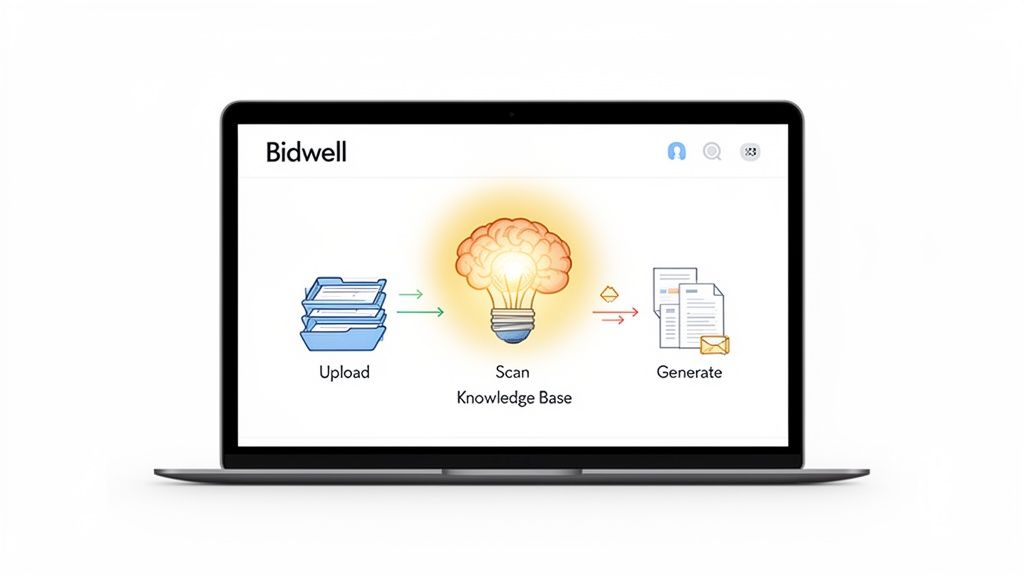
It all starts with spotting the right contracts. Our tender monitoring service scans UK portals like Find a Tender and Contracts Finder every single day. You get alerts for relevant contracts that actually match your business, so you never miss a PQQ opportunity.
Build Your Single Source of Truth
Once you find a tender, the real work starts. Bidwell helps you build a central knowledge base. Think of it as your secure library for every crucial piece of company information:
- Your latest financial accounts and insurance certificates.
- All your company policies, from Health & Safety to Quality Management.
- Detailed case studies and project examples that prove your expertise.
This becomes your team's single source of truth. It puts an end to the chaotic search for documents. It also ensures everyone is working from the most up-to-date, approved information.
From 40 Hours to 4 Hours
The final piece is actually filling out the response. With Bidwell’s AI response generation, you upload the PQQ, and our AI scans your own knowledge base to draft accurate, relevant answers.
Instead of you manually writing about your quality assurance process for the tenth time, the AI drafts it based on your stored ISO 9001 certificate and previous successful responses. This can turn a 40-hour task into a 4-hour review.
This process lets you complete PQQs much faster and with greater accuracy. For organisations looking to improve their procurement processes, exploring dedicated tools for bid management can be invaluable. By combining smart monitoring, an organised knowledge base, and powerful AI, you can get past the PQQ stage with less pain.
PQQ FAQs: Your Questions Answered
We've been through the theory. Now for the practical stuff. Here are some quick answers to the questions that come up time and time again when teams are wrestling with their first few PQQs.
What’s the Difference Between a PQQ and an ITT?
Think of it like a two-stage job interview.
The PQQ is the first stage, like sending in your CV. It’s a screening process. The buyer is checking your company’s general health and stability—are you financially sound, do you have the right insurance, are you legally compliant?
The ITT (Invitation to Tender) is the second stage, the proper interview. This is only sent to suppliers who pass the PQQ. Here, you get into the specifics: exactly how you'll deliver the service, your detailed methodology, your team, and crucially, your price.
How Long Does It Actually Take to Complete a PQQ?
This really depends, but if you're starting from scratch, it's a significant time sink. For a company new to the process, finding all the evidence and writing solid responses typically takes 20-40 hours.
That time is spent digging out three years of financial records, chasing down the latest insurance certificates, and writing detailed policies.
This is where a system like Bidwell completely changes things. Our platform organises all your core information into a central knowledge base. When a PQQ comes in, our AI uses that information to generate first-draft responses. The whole task shrinks from days of admin into just 2-4 hours of focused review.
Can I Reuse Answers from a Previous PQQ?
Yes, and you absolutely should. This is the secret to getting efficient at bidding. Many questions about your company’s basics—finances, policies, accreditations—will appear again and again. Building a knowledge base of your best answers is non-negotiable.
But a word of caution: never just blindly copy and paste. Always read the new PQQ carefully. A question might look the same but have a subtle difference. You might need to provide more recent evidence or tweak the emphasis. Tailoring reused answers shows the evaluator you're paying attention.
Ready to stop scrambling for documents and start submitting winning PQQs? Bidwell finds relevant tenders for you, organises all your evidence in one place, and uses AI to generate compelling responses in a fraction of the time. Discover how Bidwell can help you win more contracts.