
What Is Public Procurement in the UK?
Public procurement is how the government and public bodies go shopping. Instead of a quick trip to the shops, it’s a highly organised, rule-bound process for buying goods, works, and services from private companies.
The goal isn't just to find the cheapest option. It’s about securing the best possible value for money for taxpayers. This whole process is vital for the UK economy, making sure public funds are spent fairly and transparently.
What Public Procurement Really Means for Your Business
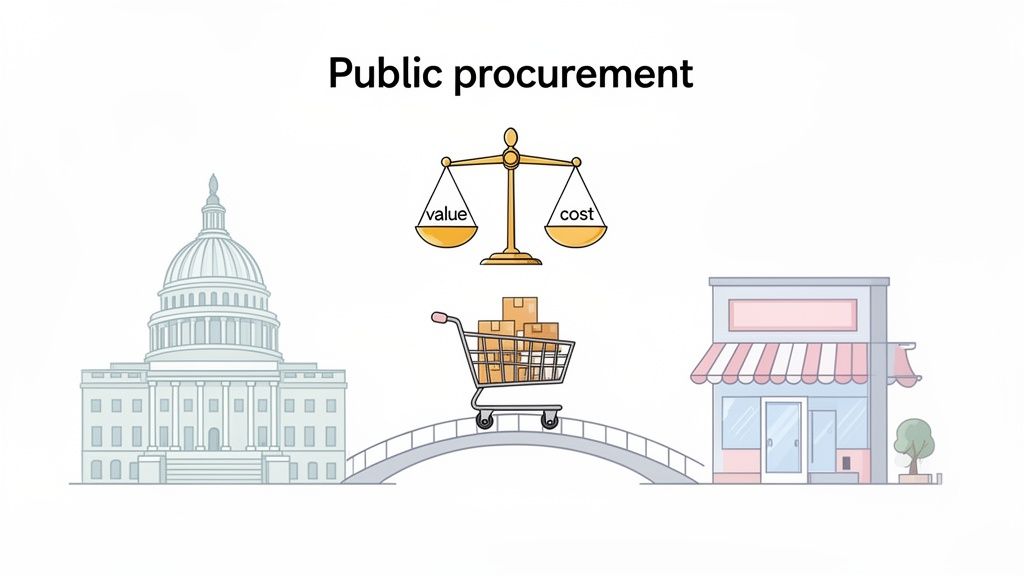
So, what is public procurement in practice? It’s the formal way your local council, NHS trusts, and government departments get what they need. This could be anything from building a new school, buying IT software, or stocking up on office supplies.
Unlike a private company that can pick its favourite supplier, public bodies have to follow strict rules. These regulations are there to prevent corruption and ensure every business gets a fair shot.
For you, this is good news. It means the playing field is level. The best bid wins, not the company with the best connections.
Key Players in the Process
Every procurement process has two main groups: the buyers and the suppliers.
- Public Authorities (The Buyers): These are the organisations with the budget. We’re talking about your local council, a government body like the Ministry of Defence, or an NHS Trust.
- Businesses (The Suppliers): This is you. It includes everyone from solo consultants and small firms to massive corporations.
The system creates a transparent marketplace. Buyers publish their needs in a document called a tender. Suppliers submit proposals—or bids—explaining how they’ll meet those needs. The buyer then scores these bids against set criteria to choose a winner.
Public procurement isn't just a simple transaction; it's a strategic process. It’s used to boost economic growth, support small businesses, and push for social and environmental goals.
Here’s a quick breakdown of what these core concepts mean for you.
Public Procurement at a Glance
| Component | What It Means for Your Business |
|---|---|
| Buyer | The public sector organisation (e.g., council, NHS Trust) that needs to buy something. They hold the budget and set the rules. |
| Supplier | That's you. A private company of any size hoping to win the contract. |
| Tender / ITT | The document the buyer publishes, detailing their exact requirements, the evaluation criteria, and the deadline for submission. |
| Bid / Proposal | Your response to the tender. This is your chance to prove you're the best choice for the job, providing evidence and a competitive price. |
| Value for Money | The core principle. It's not just about the lowest price; it's about the best combination of cost, quality, and social/environmental benefits. |
| Transparency | The whole process is public. The rules, the winner, and often the contract value are all published to ensure fairness. |
This structure is designed to give every business a fair chance to compete on its merits.
Why You Can't Afford to Ignore It
This process is a massive opportunity. The government is one of the biggest customers in the country. This means there’s a constant stream of potential contracts up for grabs.
But navigating this world can feel complicated. You need to know where to find opportunities, understand the rules, and write a compelling bid. Manually keeping track of all the different portals is slow and frustrating.
This is where an organised system is essential. Bidwell makes this simple. Our tender monitoring service scans all major UK portals and alerts you to relevant contracts. Once you find a tender, use your organised knowledge base and our AI response generation to build a quality bid in a fraction of the time.
The Scale of the UK's Procurement Market
To really get public procurement, you need to understand its size. This isn't a niche market; it's a colossal part of the UK economy. Every year, public bodies spend billions on contracts for everything from building motorways to buying pens for a primary school.
This creates a massive, continuous pipeline of work for businesses like yours.
Public procurement in the UK is a huge chunk of all government spending. Last year, the public sector spent an eye-watering £249 billion on goods and services. And that’s before you factor in major capital spending.
That’s money that bid managers and small businesses are chasing every day on portals like Find a Tender and Contracts Finder. You can see a detailed breakdown on Tussell's government supplier insights page.
This figure isn't just an abstract number. It’s a direct invitation for businesses of all sizes to get involved. Every pound spent represents a potential contract and a chance to secure stable, long-term revenue.
It's Not Just for the Big Players Anymore
For a long time, public procurement had a reputation for being a closed shop. While big players still win plenty of work, the landscape is changing. The government is actively pushing to make the market more accessible to small and medium-sized enterprises (SMEs).
One of the best ways they're doing this is by breaking down huge contracts into smaller 'lots'.
Think of it like this:
- Before: A single £50 million contract to manage all IT services for a government department. Only a massive firm could consider bidding.
- Now: That same contract might be split into five separate lots of £10 million each. One for hardware, one for software support, another for cybersecurity, and so on.
This approach opens the door for specialised SMEs to compete for work that was previously out of reach. It lets smaller firms bid for the parts of a project they excel at.
The drive to diversify the supplier base isn't just a policy talking point. It's a real shift in how contracts are structured, meaning more chances for everyone.
The Challenge of Speed and Competition
With so much money on the table, the competition is fierce. Thousands of businesses are vying for the same contracts. You have to be fast, efficient, and organised just to stand a chance.
The problem is that opportunities are scattered across different government portals. Manually checking them all every day is a slow, mind-numbing task. It's easy to miss a relevant tender.
This is where technology gives you a critical advantage. Bidwell’s tender monitoring automates this discovery process. It scans all the key portals for you and sends a daily alert with AI-generated summaries of every relevant opportunity. You'll never miss a chance to bid.
Navigating the Procurement Lifecycle
Public procurement isn't a single event; it's a process. Understanding this journey is critical. It gives you a clear roadmap of what the buyer is doing and what you need to do at each point.
Each step has its own purpose, from the first sign of a need to the final contract sign-off. Knowing this flow helps you prepare a more strategic response.
This infographic shows you the scale of UK public spending and where the opportunities lie for businesses like yours.
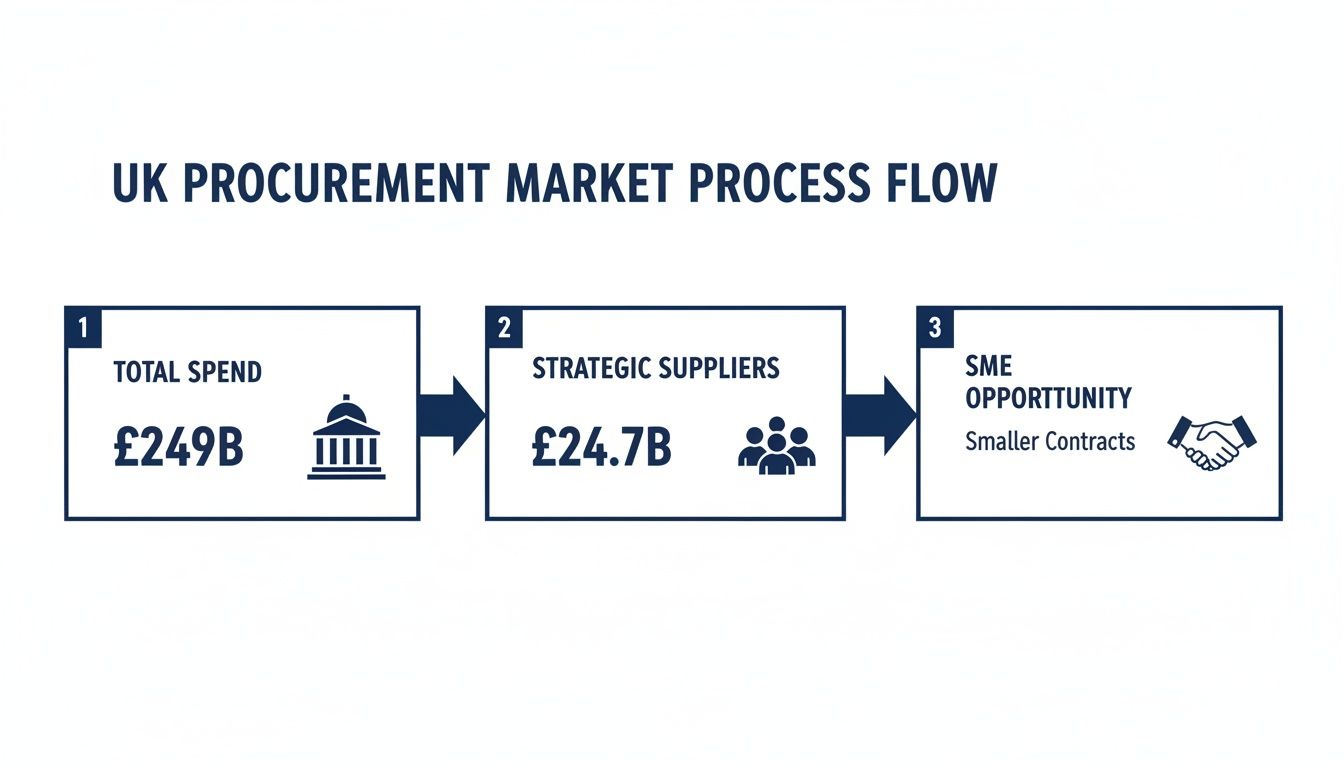
The data makes one thing clear. While huge suppliers take a big slice, the government's push to diversify its supply chain opens up a massive field of play for SMEs.
Stage 1: Identifying the Need
It all starts here. A public body—say, an NHS Trust—realises it has a problem. Maybe their patient management software is outdated, or they need a new cleaning supplier.
This is the first step, where the buyer defines what they need and why. They'll start putting together a business case and getting the budget signed off.
Stage 2: Developing the Specification
Once the need is confirmed and the budget approved, the buyer gets specific. They create a detailed document outlining exactly what the goods or services must achieve. This is a precise set of technical requirements and expected outcomes.
For you, this specification is gold. It tells you exactly what the buyer is looking for. A well-written spec helps you know if you can actually deliver the work.
This is where you’ll often find crucial details on evaluation weightings, such as 60% for quality and 40% for price. Paying close attention here tells you where to focus your effort.
Stage 3: Sourcing and Advertising the Tender
With the requirements finalised, the buyer goes to market. They publish a tender notice on a public portal, like Contracts Finder or Find a Tender. This formally invites businesses like yours to bid.
Manually trawling through multiple portals is a massive time-drain. That’s why Bidwell’s tender monitoring is so valuable; it automatically finds the right tenders for you and drops them into your inbox.
Stage 4: Evaluating Tenders and Selecting a Supplier
After the submission deadline, the buyer’s evaluation panel gets to work. They systematically score every compliant bid against the pre-published criteria. They're looking for the one that offers the best overall value for money.
The quality of your response makes all the difference here. Bidwell’s knowledge base stores all your company details, policies, and case studies in one place. Our AI response generation then uses this information to build a detailed, high-scoring first draft, saving your team hundreds of hours.
Stage 5: Awarding and Managing the Contract
Finally, a winner is chosen. The buyer notifies the successful and unsuccessful bidders. After a mandatory standstill period, the contract is formally awarded.
But the lifecycle doesn't end there. Contract management kicks in to make sure the supplier delivers on their promises. This involves regular performance reviews. You can find out more in our detailed guide on what is a framework agreement.
Understanding UK Procurement Rules and Thresholds
The world of public procurement can feel like it has its own language. But the rules are there to make the whole process fair, open, and competitive. They exist to create a level playing field for every business.
The UK's legal framework is all about transparency. A huge part of this comes down to understanding contract value thresholds.
What Are Procurement Thresholds?
A threshold is a specific contract value. If a contract is estimated to be worth more than that value, the public authority has to follow stricter rules and advertise it more widely. This ensures maximum competition for high-value work.
Think of it this way: ordering a box of pens doesn’t need the same oversight as commissioning a new hospital. The thresholds match the complexity of the rules to the value of the contract.
These thresholds dictate two critical things for your business:
- The Rules to Follow: Contracts above the threshold demand more formal, regulated procedures.
- Where to Look: The contract’s value determines which government portal it must be advertised on.
Where to Find Tenders Based on Their Value
Knowing where to look is half the battle. If you’re only checking one portal, you’re likely missing thousands of opportunities.
Contracts Finder: This is your go-to for lower-value contracts in England. Central government bodies must publish opportunities worth over £12,000 (including VAT). For councils, the trigger is £30,000 (including VAT).
Find a Tender Service (FTS): This is the UK’s main stage for high-value contracts. Any opportunity valued above the official procurement thresholds has to be published here.
Of course, there are also dedicated portals for Scotland and Wales. Manually checking all these sites every day is a huge drain on time. This is where Bidwell's tender monitoring becomes essential, scanning every key portal and bringing all relevant opportunities to you.
The Impact of the Procurement Act
The UK's new Procurement Act is starting to shake things up, with a big emphasis on better data and transparency. Early statistics are showing some eye-opening patterns. According to recent analysis, direct awards made up 15% of all published procedures in March, but that figure jumped to 24% by May. You can see a deeper analysis in the Open Contracting Partnership's report on the Procurement Act's implementation.
This new approach brings information together on a single platform. It makes it easier to track everything from the number of bids per tender to how suitable a contract is for an SME. This transparency is also designed to increase the focus on social value. You can learn more in our complete guide to social value in public procurement.
The key takeaway is that the rules are there to help, not hinder. They create a structured marketplace where the best bid wins. Understanding them allows you to navigate the system effectively.
Once you know the rules, the guesswork disappears. This knowledge, combined with a smart system for finding and responding to tenders, puts you in a powerful position. Bidwell's platform finds the right tenders and our AI response generation helps you respond quickly, pulling from your central knowledge base.
How to Write a Winning Tender Response
Finding the right tender is just the start. Now you have to turn that opportunity into a contract. This means writing a response that convinces the buyer you're the only credible choice.
A winning bid is detailed, full of evidence, and speaks directly to the buyer's specification. Many businesses stumble here. They treat bidding as a chore, submitting generic, copy-pasted answers that blend in. To win, your response needs to be sharp and focused.
Deconstructing the Tender Documents
When you download a tender pack, you’ll usually find two crucial documents: the Selection Questionnaire (SQ) and the Invitation to Tender (ITT).
- The Selection Questionnaire (SQ): Think of this as the first hurdle. It's a pass/fail test designed to weed out bidders who aren’t credible or financially stable. You’ll be asked for company details, finances, and proof of your quality policies.
- The Invitation to Tender (ITT): This is the main event. The ITT is where you make your case. It contains detailed questions about how you’ll deliver the contract—your methodology, your team, and your price.
Your goal with the SQ is simply to get through. Your goal with the ITT is to score as highly as possible.
Answering Every Single Question
It sounds obvious, but many bids are disqualified for being incomplete. You must answer every single question. If a question doesn’t apply to you, write "Not Applicable" and briefly explain why.
Buyers are scoring you against a checklist. A blank answer gets zero points and could get your bid thrown out. A vague answer won’t score well either.
When a buyer asks for evidence, they mean it. Don't just say you have a quality process; provide the certificate. Don't just claim you have happy clients; include a case study. Specifics always beat vague claims.
This is where having a system is vital. Bidwell’s knowledge base acts as a central library for your company’s information. You can store everything from insurance documents and case studies to team CVs. When you need to answer a question, the proof is right there.
Tailoring Your Response to the Evaluation Criteria
Every tender includes evaluation criteria. This is your cheat sheet—it tells you exactly how the buyer will score your bid. It might look like this:
- Quality/Technical Merit: 60%
- Price: 30%
- Social Value: 10%
This tells you that quality is twice as important as price. A bid that focuses only on being the cheapest will almost certainly lose to a competitor who shows superior quality.
You must tailor your response to hit these scoring metrics. If social value is 10% of the marks, dedicate a proportional amount of effort to writing a compelling social value proposal. To learn more, check out our guide on how to start winning a tender.
The Bidwell Advantage in Response Writing
Crafting a bespoke response for every tender is very time-consuming. A typical ITT response can easily take 20-40 hours of focused work. This is where Bidwell's AI response generation gives you a serious edge.
Our AI connects directly to your company’s knowledge base. It analyses the ITT questions and uses your stored information to generate a high-quality, compliant first draft in a fraction of the time.
This isn’t about replacing your bid writers; it’s about making them more effective. The AI handles the heavy lifting. Your team can then focus their expertise on tailoring the narrative and ensuring your bid truly speaks to the buyer's needs.
Building Your Winning System with Bidwell
Winning at public procurement isn't about luck. It’s about building a smart, repeatable system that connects every part of the process.
A successful strategy means understanding the rules and responding with speed and precision. You need a central hub for your entire bidding operation. That's the role Bidwell is designed to fill.
Connecting the Dots: How Bidwell Works
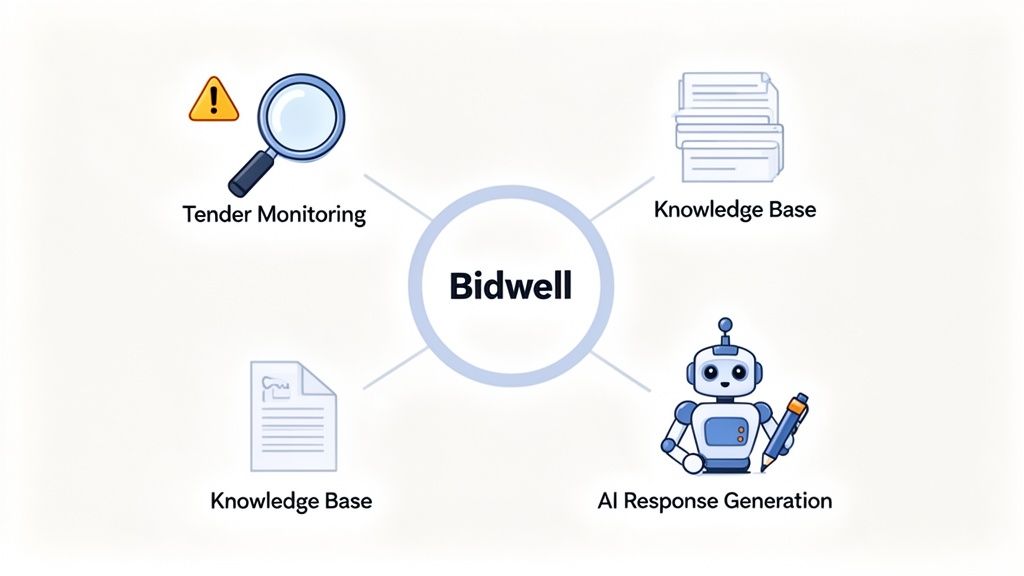
Think of Bidwell's three core features as a connected system. They don’t work in isolation; they feed into one another to create an efficient workflow.
Tender Monitoring: This is your starting point. Instead of spending hours trawling different portals, our system automatically finds every relevant opportunity and delivers it straight to you.
Knowledge Base: This is your company's memory. You store every crucial bit of information here—insurance certificates, team CVs, past answers, and compelling case studies.
AI Response Generation: This is where you get your speed advantage. The AI connects to your knowledge base, reads the buyer's questions, and generates a detailed, compliant first draft. That 20-40 hour slog of writing from scratch becomes just a few hours of review.
A winning strategy is about eliminating friction. By integrating opportunity discovery, information management, and response creation, you remove the bottlenecks that slow your team down.
Shifting from Admin to Strategy
This integrated approach changes everything. Your team spends less time on repetitive admin and more time tailoring your proposals to the buyer's specific needs. That's how you score maximum points.
Winning the bid is only half the battle. You also need solid post-award processes. To see how specialised tools can help, discover how advanced Procurement Contract Management Software can improve your operations and reduce risk.
By combining automation with your team's expertise, you create a system that lets you bid on more of the right contracts with a higher chance of success. It's a smarter way to tackle what is public procurement and gives you a clear competitive edge.
Got Questions? We’ve Got Answers
We’ve walked through the what, why, and how of public procurement. Here are a few common questions we hear from businesses new to tendering.
What's the Difference Between Contracts Finder and Find a Tender?
Think of it as a question of scale.
Contracts Finder is where you'll find the bread-and-butter opportunities in England. Central government posts contracts here worth over £12,000 (inc. VAT), and councils use it for work over £30,000 (inc. VAT).
Find a Tender (FTS) is the UK's main stage for big-ticket items. Every high-value public contract—anything above the official legal thresholds—has to be advertised there.
This is why you need a single view of the market. Bidwell’s tender monitoring scans both these portals, plus the ones for Scotland and Wales, so you never miss a relevant opportunity.
How Important Is Social Value in a Tender Response?
It’s no longer a 'nice-to-have'—it's often a deal-breaker. Social value is a heavily weighted part of the evaluation, often accounting for 10% or more of your total score. Public bodies are legally required to consider how their spending can benefit the community.
This means you can't just pay it lip service. Your bid needs to spell out exactly how you'll make a difference. Will you create local jobs? Offer apprenticeships? Commit to specific environmental targets? You need a concrete, credible plan.
Your Bidwell knowledge base is the perfect home for your social value policies and success stories. This lets our AI response generation pull that crucial information directly into new bids, ensuring your social value case is always robust.
Can I Challenge a Procurement Decision If I Lose a Bid?
Yes, you can—but don't take it lightly. If you believe the procurement process was seriously flawed or the rules weren't followed, you have the right to challenge the outcome.
The first step is to ask for a formal debrief from the buyer. This should explain why your bid was unsuccessful. If that debrief reveals clear grounds for a challenge, there is a formal legal process you can follow. Just be warned: it can be complex and expensive.
Your best strategy is always prevention. Focus your energy on submitting the strongest, most compliant bid you possibly can from the outset.
Ready to stop searching and start winning? Bidwell gives you the tools to find the right public contracts and build winning responses faster. Discover how our tender monitoring, knowledge base, and AI response generation can improve your bidding process at https://bidwell.app.


