
A Practical Guide to Winning a Tender in the UK
Winning a tender isn’t about luck; it’s a repeatable process. Success comes from finding the right opportunities, writing responses that directly answer the buyer's questions, and providing solid evidence to back up every claim you make.
It’s a methodical game. You can absolutely learn to play it well.
Your Starting Point for Winning a Tender
Winning public sector work is a clear, organised process, and this guide is your playbook. We’ll show you exactly how to find the right opportunities. We'll also show you how to avoid wasting time on tenders you have little chance of winning. This is about focusing your effort where it counts.
We'll cover everything from making that crucial 'bid or no-bid' decision to understanding what buyers really want to see in your response. You'll learn how to build a solid foundation for your bids, write answers that stand out, and price your services competitively. If you're new to this, you might find our examples of bid writing helpful for context.
This visual breaks down the simple, three-stage journey of winning a tender: find, bid, and win.
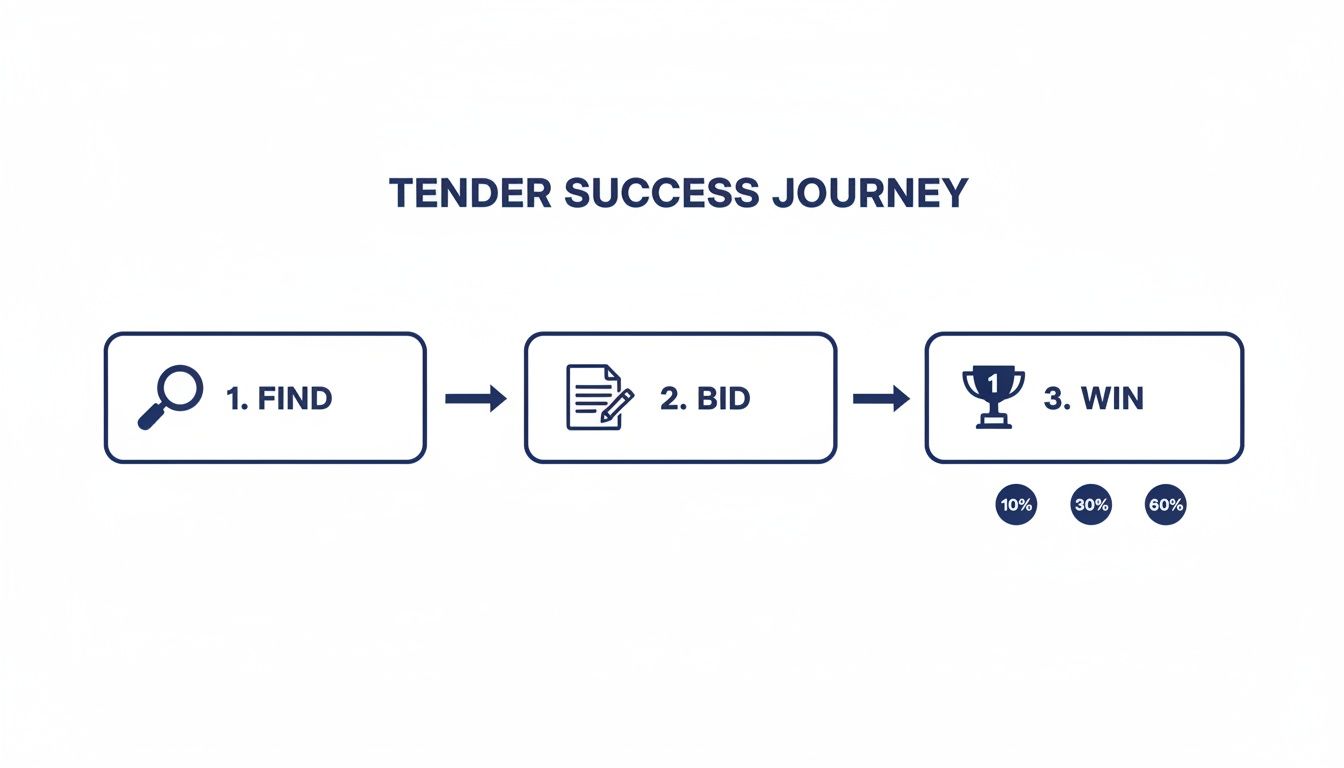
The key takeaway here is that success starts long before you write a single word. It begins with a disciplined approach to finding the right contracts for your business.
Forget the guesswork and the last-minute scramble to find information. We’ll show you how to use your company's existing knowledge and smart tools to make the whole process faster and more effective.
What This Guide Covers
This isn't a high-level overview. We’re getting into the practical steps you need to take. Here’s what you can expect:
- Finding and Qualifying: How to use Bidwell’s tender monitoring to find contracts and then critically decide which ones are worth your time.
- Strategy and Planning: How to properly dissect tender documents, understand the evaluation criteria, and map out a winning response strategy.
- Drafting with Confidence: How to build a knowledge base to store your best content and use AI response generation to accelerate your writing process.
- Submission and Learning: A final checklist for quality assurance and, crucially, how to learn from every outcome—win or lose—to constantly improve your process.
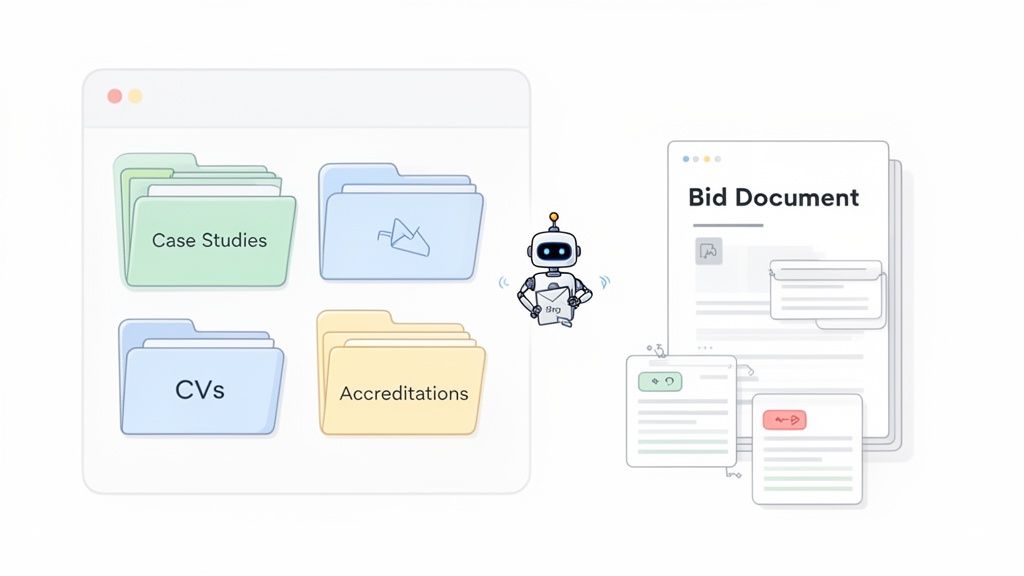
A successful tender is built on organised information. When your case studies, policies, and team details are in one place, you stop wasting time searching and start spending time crafting a winning bid.
Finding and Qualifying the Right Opportunities
You can't win a tender you don't know about. If you're manually checking multiple government portals every day, you're not just wasting time – you're probably missing the best opportunities.
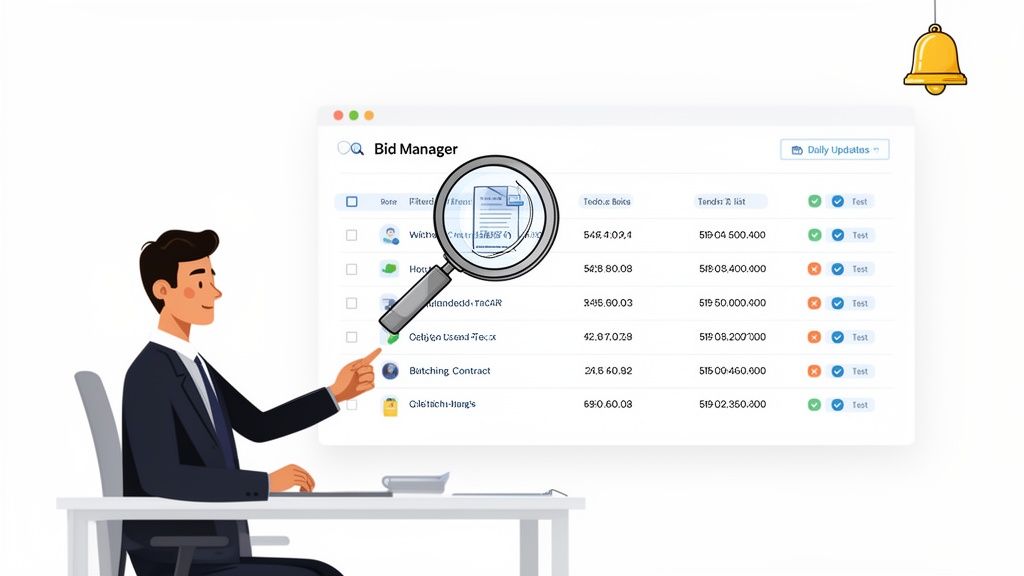
Let's be honest, trawling through sites like Find a Tender and ContractsFinder is a soul-destroying task. A proper system becomes your secret weapon. Services like Bidwell’s tender monitoring are designed to do the heavy lifting. They scan all the key UK portals and drop relevant opportunities straight into your inbox. The daily alerts even come with AI-generated summaries, so you can see what matters in seconds.
The All-Important Bid or No-Bid Decision
Finding an opportunity is just the start. The real skill is knowing which ones to chase.
Many businesses bid for everything that looks remotely relevant. This is a recipe for burnout and a string of disappointing losses. A disciplined 'bid or no-bid' decision is the single most powerful tool you have for boosting your win rate.
Before you even think about writing, you need to step back and qualify the opportunity with a cold, hard look.
The goal isn't to bid on the most tenders; it's to win the ones you bid on. A ruthless qualification process ensures you only spend your valuable time and resources on opportunities you have a genuine chance of securing.
Every time a tender lands on your desk, ask these three non-negotiable questions:
- Is it a strategic fit? Does this contract actually align with where we want to take the business? Is this a sector we excel in, or is it a tempting distraction that will pull us off course?
- Do we meet the mandatory requirements? This is a simple pass/fail. You must meet 100% of the mandatory criteria. We're talking about specific accreditations like ISO 9001, minimum turnover levels, or required insurance cover. There's no wiggle room. If you don't have it, you're out.
- Can we actually deliver it? Be brutally honest. Can we deliver this work to a high standard, on time, and on budget? Do we have the right people, the equipment, and the cash flow to make it happen without stretching ourselves to breaking point?
A Real-World Qualification Example
Let's put this into practice. A tender notice for "IT Support Services for 500 Staff" from a local council appears in your Bidwell alerts. On the surface, it looks like a perfect match.
Time to apply the framework.
| Qualification Question | Your Assessment | Bid or No-Bid? |
|---|---|---|
| Do we have the expertise? | Yes, we specialise in SME IT support. | ✅ Proceed |
| Is the value right? | The estimated value is £150k per year, which fits our growth targets. | ✅ Proceed |
| Do we meet the requirements? | The tender requires ISO 27001 certification, which we don't have. | ❌ No-Bid |
Just like that, the decision is made. Despite looking great initially, the lack of a mandatory accreditation is a deal-breaker. You would be disqualified at the first hurdle.
Making this call in ten minutes instead of after ten days of writing is a massive win. It frees up your team to focus their energy where it will have the greatest impact. Once you’ve qualified an opportunity and decided it’s a go, you can move on to planning your response.
Decoding the Tender and Planning Your Win Strategy
You’ve made the call to go for it. You’re in the game. Now the real work begins.
Winning a tender isn’t about flashy marketing or a slick proposal design. It’s about a forensic, almost obsessive, approach to planning. You need to give the buyer exactly what they’ve asked for. That means getting intimate with the tender documents.
Don’t just skim them. I mean it. Print them out, grab a set of highlighters, and go through every single line. The buyer has literally handed you the instruction manual for winning their contract. Your job is to follow it to the letter. Pay special attention to the language and terminology they use—you’ll want to mirror it in your response.
Uncover the Evaluation Criteria
Buried in that document pack is the single most important part of the entire tender: the evaluation criteria. This is the buyer’s marking scheme. It tells you, in black and white, how they will score your submission and what they truly value.
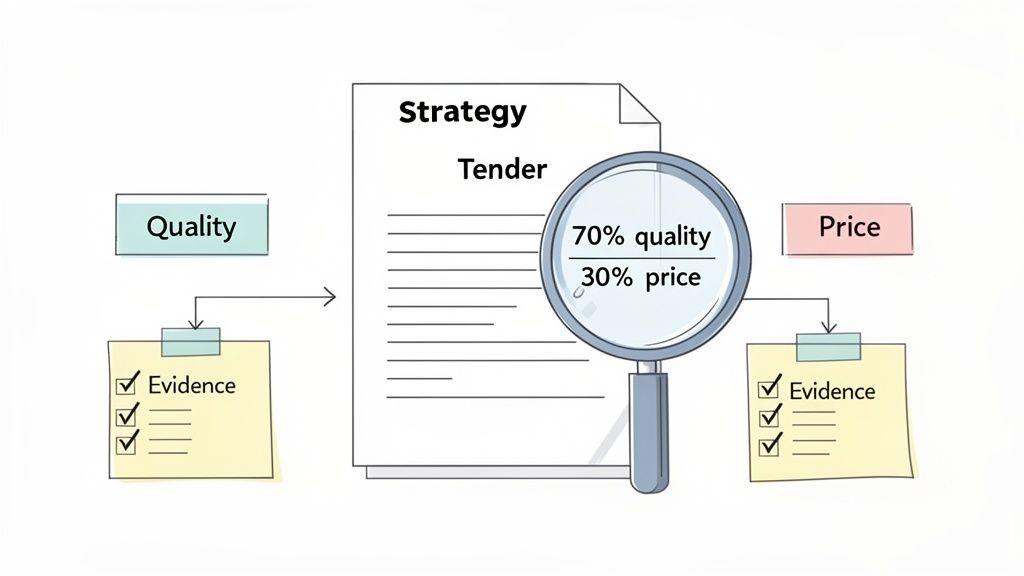
Usually, it's broken down into a percentage split between quality and price. A classic split is 70% quality and 30% price. This immediately tells you where to sink your effort. In this scenario, a rock-bottom price won't rescue a weak, poorly evidenced quality response. It just won't.
The quality section will be broken down even further. Look for the specific weightings on each question. A question about your delivery team’s experience might be worth a hefty 20%, while one on your environmental policy is only worth 5%. Plan your time, detail, and evidence accordingly.
Your entire bid strategy should be a direct reflection of these criteria. If 70% of the marks are for quality, then at least 70% of your effort should go into crafting a brilliant, evidence-backed quality submission. Don't get distracted by anything else.
Organise Your Response Around Evidence
Once you understand the scoring, it's time to map out your response. Go through every single question and identify not just the information you need, but the evidence you need to prove it.
Stating you can do something is never enough. It means nothing. You have to prove it.
This is where having a central, organised library of your company’s key information becomes so valuable. It’s non-negotiable for serious bidding. Bidwell’s knowledge base is built for precisely this. It's a single source of truth to store and instantly pull:
- Company Policies: Your up-to-date Health & Safety, Quality, and Environmental policies.
- Team CVs: Details and experience of the key people who will deliver the work.
- Accreditations: Your ISO certificates, Cyber Essentials, and other vital qualifications.
- Case Studies: Detailed examples of similar projects you've nailed in the past.
Instead of a frantic, last-minute hunt through old emails for that perfect case study from three years ago, it’s just… there. You can pull approved, current content in seconds. For a deeper look into the types of questions you'll face, check out our guide on common request for proposal questions.
Develop a Smart Pricing Strategy
Your price has to be competitive, but it also has to be profitable and justifiable. Don't just pluck a number out of the air or blindly undercut what you think a competitor might bid. Your pricing strategy must be informed by the evaluation model and a solid grasp of what the buyer needs. Understanding common procurement use cases can provide a crucial lens into their perspective.
If the tender is heavily weighted towards quality, you may have more room to price higher, provided you can clearly demonstrate superior value. But if it's a price-driven evaluation (say, 60% price, 40% quality), you’ll need to be much sharper with your figures.
The trend is slowly moving away from purely price-based decisions. Quality is becoming more important. This shift means your ability to interpret documents and demonstrate value is more critical than ever. With a solid plan in place, you're ready to start building a response that stands out.
Building Your Knowledge Base and Drafting Responses
Right, this is where strategy and planning become an actual submission. A well-organised knowledge base isn't just a nice-to-have; it's the engine room of your entire bid operation. It’s what separates the frantic, last-minute teams from the calm, efficient ones.
Think of Bidwell's knowledge base as your company's collective memory. It’s a central library that stores all your best content—past responses, detailed case studies, current accreditations, and key personnel details. Instead of starting from scratch every time, you have a library of approved, high-quality content ready to go.
This simple shift in approach is fundamental. It moves you from a reactive scramble to a proactive state of readiness.
Structuring Your Knowledge Library
A messy library is just as useless as no library at all. You need a logical structure that lets anyone on your team find exactly what they need in seconds. A good starting point is to organise your content into clear, intuitive folders.
Here’s a simple structure you could adopt:
- Company Information: This holds your standard boilerplate text about company history, mission, and values. It also includes your registration details, VAT number, and insurance certificates.
- Policies and Procedures: All your key policies live here. Think Health & Safety, Quality Management (ISO 9001), Environmental (ISO 14001), and Data Security (Cyber Essentials).
- Team CVs and Biographies: Store formatted CVs for key personnel. Make sure they highlight experience relevant to the contracts you typically bid for.
- Case Studies and Testimonials: This is your evidence locker. Organise case studies by sector (e.g., Local Government, NHS, Education) or service type (e.g., IT Support, Facilities Management).
- Past Responses: Keep a "gold standard" library of your best-ever answers to common questions about social value, risk management, and contract mobilisation.
Your knowledge base isn't a "set it and forget it" tool. It's a living library. Schedule a quarterly review to update stats, add new case studies, and remove outdated information. This discipline ensures your content is always current, accurate, and ready for the next bid.
Drafting Responses That Score High Marks
When it’s time to draft, your mantra should be: Answer. The. Question.
It sounds ridiculously simple, but it’s the most common failure point in tender responses. Evaluators don't want to read your marketing brochure; they want a direct answer to their specific query.
Don't just say you're innovative. It's a meaningless claim on its own. Instead, describe a specific project where you introduced a new process that saved a client 15% on their annual operational costs. Use the STAR method (Situation, Task, Action, Result) to structure your evidence. Be specific, be numerate, and be direct.
A crucial component of this is knowing how to write executive summaries that grab an evaluator's attention and clearly convey your value. If you need more guidance on structuring these narrative answers, our guide on how to write a method statement provides a detailed framework.
Accelerating Your Drafts with AI
This is where the real speed advantage comes in. Manually searching for old content, then copying, pasting, and tweaking it for every question is a huge time sink. Bidwell’s AI response generation changes this completely.
It works by connecting directly to your organised knowledge base. You feed it the tender question, and it uses your own approved content—your case studies, your policies, your team's experience—to generate a tailored first draft. It’s not pulling generic text from the internet; it’s using your company’s unique DNA.
This process can turn a 30-hour writing marathon into a focused 3-hour review session. The AI handles the heavy lifting of assembly and initial drafting. This frees you up to do the high-value work: refining the answer, adding strategic insights, and ensuring the response has the perfect tone and focus.
You're not starting with a blank page; you're starting with a solid, relevant draft that's already 80% of the way there. This allows you to spend your precious time on the final 20% that truly makes a bid a winner.
You’ve planned, drafted, and pulled together all your evidence. You're on the home stretch. But before you even think about hitting that submit button, it's time for a final, ruthless quality check. This isn’t a quick spell-check; it's about making sure all your hard work pays off.
The single biggest mistake people make at this stage is reviewing their own work. You’re just too close to it. Your brain will read what you meant to write, not what’s actually on the page. You need a fresh pair of eyes, ideally from a colleague who wasn’t involved in the writing. Their job is to be your harshest critic.
Your Final Submission Checklist
Treat this like a pilot's pre-flight check. Go through it methodically and assume nothing. I’ve seen brilliant bids get disqualified over a simple administrative error before a single word of their response was even read.
- Have you answered every single question? Go back to the tender document and physically tick off each question and sub-question. It's surprisingly easy to miss one part of a multi-part query.
- Are all attachments included and correctly named? Check the submission instructions carefully. If they ask for "Appendix A - Quality Policy.pdf," that is exactly what the file should be named. Don't get creative.
- Is the formatting correct? Have you stuck to the word counts, font sizes, and specified file formats? Deviating from the instructions screams a lack of attention to detail.
- Is the pricing schedule complete and accurate? Double-check your numbers. Then get someone else to check them again. A simple typo in your pricing can be disastrous.
Winning a tender often comes down to discipline. A flawless submission that follows every single rule gives the evaluator confidence in your ability to deliver the contract with the same level of care. Don’t fall at the final hurdle.
Handling Clarification Questions
After submission, the buyer might come back with clarification questions. Don't panic. This is a normal part of the process and is often a good sign – it usually means they're interested but need a specific point cleared up before scoring.
Keep your response direct, concise, and answer only what was asked. This is not another chance to sell. Just give them the information they need, clearly and without any extra fluff.
The Most Important Step: Learning from the Outcome
The tender process doesn't end when the result comes in. Whether you win or lose, the debrief is arguably the most valuable part of the entire experience. You must always ask for feedback.
If you won, find out why. What did the evaluators particularly like? Which of your answers scored highest? This tells you exactly what your strengths are and what you should replicate in future bids.
If you lost, the feedback is even more critical. You need to understand precisely where you fell short. Was it price? Was a specific answer not detailed enough? Getting your scores back, often broken down by section, shows you exactly where the winning bidder out-performed you.
This is how you get better. You take that feedback—good or bad—and you use it to improve. The final, crucial step is to feed this intelligence straight back into your Bidwell knowledge base.
- Update strong answers: If an answer scored 10/10, tag it as a "gold standard" response. It's now a proven winner you can adapt for future bids.
- Refine weak answers: If a section scored poorly, use the evaluator's feedback to rewrite it. Save the improved version so you don't make the same mistake twice.
- Identify content gaps: Did you struggle to find a good case study for a specific requirement? Now is the time to go and create one, so it’s ready for next time.
This creates a cycle of continuous improvement. Every bid you submit makes your knowledge base stronger, and in turn, your AI response generation becomes more effective. This is how you stop repeating mistakes and steadily increase your chances of winning.
A Few Common Questions About Tendering
Over the years, we've heard the same questions pop up time and time again. Here are some straight answers to the things people often wonder about when they start bidding for UK public sector work.
How Long Does It Actually Take to Write a Tender Response?
This is the classic "how long is a piece of string?" question. It genuinely varies. A simple request for a quote might take you a couple of hours over a coffee. A massive infrastructure project could tie up a whole team for months.
For a typical services contract, a small or medium-sized business should budget between 20-40 hours for the whole process. Yes, that much. It's a serious time commitment.
This is where having a proper system in place changes the game. If you’ve got a central knowledge base with all your best content and evidence, you’re not starting from scratch every time. Add in smart tools like AI response generation, and you can slash that active writing time. We've seen businesses cut it down to just 2-4 hours of focused editing and polishing.
What's the Single Biggest Mistake People Make?
Easy. They don't answer the question that was asked.
It sounds almost too obvious to be true, but it happens constantly. Bidders get excited to talk about how great their company is. They end up pasting in generic marketing spiel that completely misses the point of the buyer's question.
Remember, the evaluator has a scoresheet. They are marking you on how well you answered their specific question, not on how impressive your company brochure sounds. You have to dissect every single question, address each part of it, and back up every claim with solid, specific evidence.
A simple but powerful tip: always mirror the buyer's language. If they ask for a bulleted list of three examples showing how you manage risk, you give them a bulleted list of three examples showing how you manage risk. Don't make them dig through a wall of text to find the answer. Make their job easy.
Can I Actually Challenge a Tender Decision if I Lose?
Yes, you can, but you need to be strategic about it.
UK public procurement law includes a mandatory 10-day "standstill period" right after the award decision is announced. This is your window.
If you have a genuine belief that there’s been a major error in the evaluation—maybe they’ve scored you incorrectly against the published criteria, or haven't followed their own rules—you can raise a formal challenge.
A word of caution, though: don't do this lightly. You need solid grounds. It's not for when you're just disappointed you lost. It’s always worth getting proper legal advice before you even think about starting a formal challenge process.
Ready to stop wasting time and start winning more tenders? Bidwell organises your entire process, from finding opportunities with smart monitoring to drafting winning responses in a fraction of the time with AI. See how it works at https://bidwell.app.


